

FBRs provide high fast neutron flux, wherein the neutron reaction cross sections
are small compared with those in the thermal energy region. Moderation of
fast neutrons by hydride materials was considered to increase the transmutation
rate [2–5]. In this chapter, enhancement of transmutation of MA by an MA-hydride
target is studied. Target assemblies containing MA-hydrides are placed in the radial
blanket region. Fast neutrons generated in the core region are moderated in the
hydride target assembly and then produce high flux of thermal neutrons, which have
large nuclear reaction cross sections to actinides. The MA-hydride target also has
another advantage to load MA to limited space. The target of (MA, Zr)H x increases
mass of MA and hydrogen density in the blanket region compared with MA and
ZrH 1.6 loaded separately [4, 5].
Hydride fuels have been used in TRIGA reactors of General Atomics (GA) for
many years [6]. On the other hand, hydride materials do not have much history of
use in FBRs. Recently, a control rod of FBR with hafnium (Hf)-hydride has been
studied [7]. In this chapter, the MA-hydride target pin was designed using experimental data of Hf-hydride.
16.2 Design of MA-Hydride Target
The TRIGA fuel consists of a U-metal phase and a Zr-hydride phase at high
temperature in the reactor. The MA-hydrides are stable at high temperature
[8]. The phase relationship of the U-Th-Zr hydride has been studied, considering
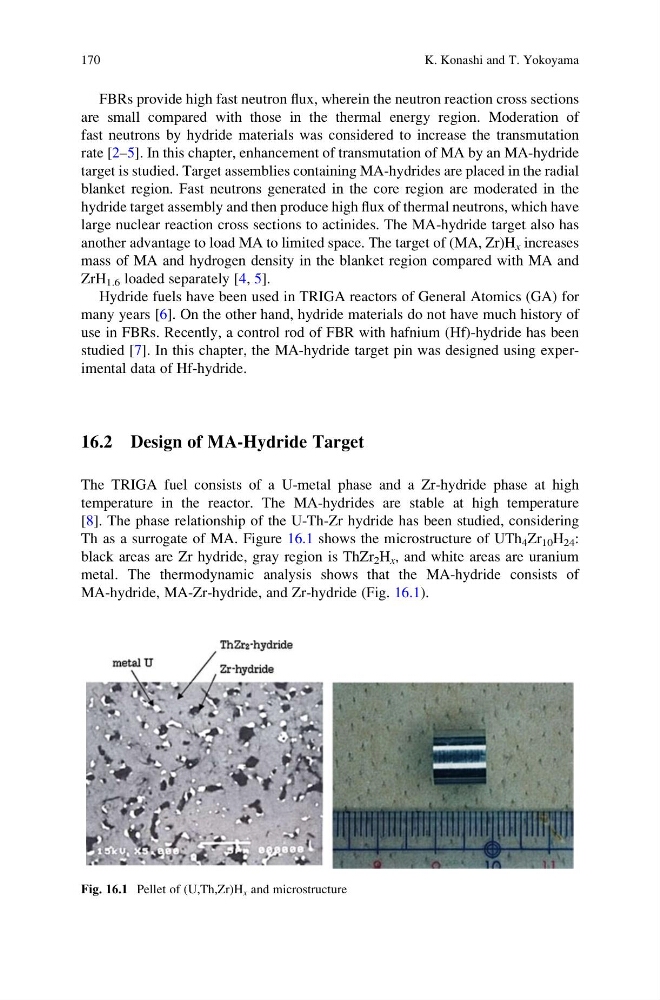
Th as a surrogate of MA. Figure 16.1 shows the microstructure of UTh 4 Zr 10 H 24 :
black areas are Zr hydride, gray region is ThZr 2 H x , and white areas are uranium
metal. The thermodynamic analysis shows that the MA-hydride consists of
MA-hydride, MA-Zr-hydride, and Zr-hydride (Fig. 16.1).
Fig. 16.1 Pellet of (U,Th,Zr)H x and microstructure
170
K. Konashi and T. Yokoyama
are small compared with those in the thermal energy region. Moderation of
fast neutrons by hydride materials was considered to increase the transmutation
rate [2–5]. In this chapter, enhancement of transmutation of MA by an MA-hydride
target is studied. Target assemblies containing MA-hydrides are placed in the radial
blanket region. Fast neutrons generated in the core region are moderated in the
hydride target assembly and then produce high flux of thermal neutrons, which have
large nuclear reaction cross sections to actinides. The MA-hydride target also has
another advantage to load MA to limited space. The target of (MA, Zr)H x increases
mass of MA and hydrogen density in the blanket region compared with MA and
ZrH 1.6 loaded separately [4, 5].
Hydride fuels have been used in TRIGA reactors of General Atomics (GA) for
many years [6]. On the other hand, hydride materials do not have much history of
use in FBRs. Recently, a control rod of FBR with hafnium (Hf)-hydride has been
studied [7]. In this chapter, the MA-hydride target pin was designed using experimental data of Hf-hydride.
16.2 Design of MA-Hydride Target
The TRIGA fuel consists of a U-metal phase and a Zr-hydride phase at high
temperature in the reactor. The MA-hydrides are stable at high temperature
[8]. The phase relationship of the U-Th-Zr hydride has been studied, considering
Th as a surrogate of MA. Figure 16.1 shows the microstructure of UTh 4 Zr 10 H 24 :
black areas are Zr hydride, gray region is ThZr 2 H x , and white areas are uranium
metal. The thermodynamic analysis shows that the MA-hydride consists of
MA-hydride, MA-Zr-hydride, and Zr-hydride (Fig. 16.1).
Fig. 16.1 Pellet of (U,Th,Zr)H x and microstructure
170
K. Konashi and T. Yokoyama