

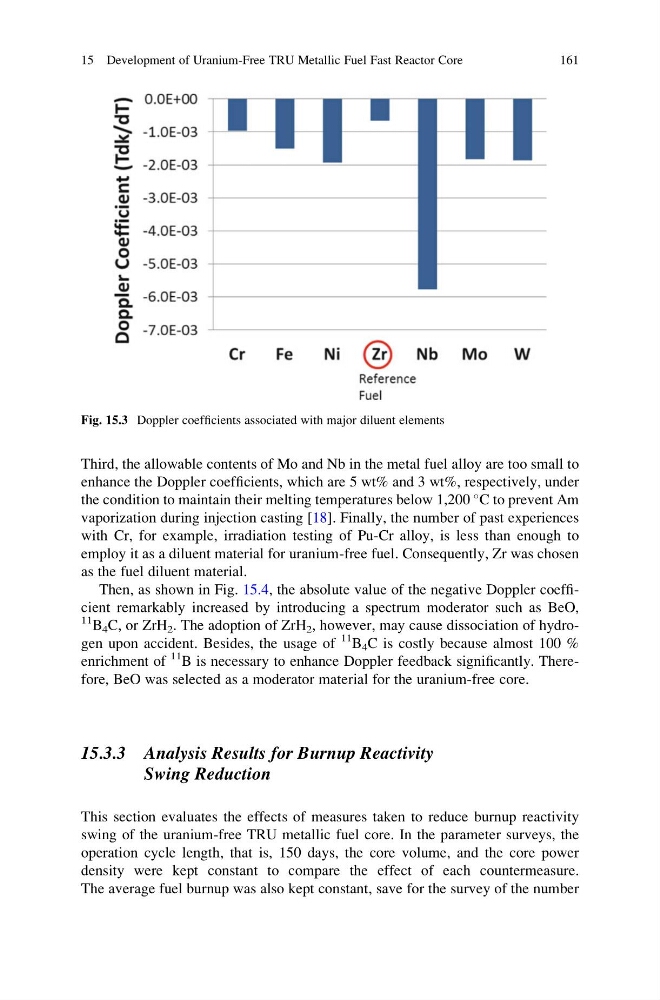
Third, the allowable contents of Mo and Nb in the metal fuel alloy are too small to
enhance the Doppler coefficients, which are 5 wt% and 3 wt%, respectively, under
the condition to maintain their melting temperatures below 1,200
C to prevent Am
vaporization during injection casting [18]. Finally, the number of past experiences
with Cr, for example, irradiation testing of Pu-Cr alloy, is less than enough to
employ it as a diluent material for uranium-free fuel. Consequently, Zr was chosen
as the fuel diluent material.
Then, as shown in Fig. 15.4, the absolute value of the negative Doppler coefficient remarkably increased by introducing a spectrum moderator such as BeO,
11 B 4 C, or ZrH 2 . The adoption of ZrH 2 , however, may cause dissociation of hydrogen upon accident. Besides, the usage of
11 B 4 C is costly because almost 100 %
enrichment of
11 B is necessary to enhance Doppler feedback significantly. Therefore, BeO was selected as a moderator material for the uranium-free core.
15.3.3 Analysis Results for Burnup Reactivity
Swing Reduction
This section evaluates the effects of measures taken to reduce burnup reactivity
swing of the uranium-free TRU metallic fuel core. In the parameter surveys, the
operation cycle length, that is, 150 days, the core volume, and the core power
density were kept constant to compare the effect of each countermeasure.
The average fuel burnup was also kept constant, save for the survey of the number
Fig. 15.3 Doppler coefficients associated with major diluent elements
15 Development of Uranium-Free TRU Metallic Fuel Fast Reactor Core
161
enhance the Doppler coefficients, which are 5 wt% and 3 wt%, respectively, under
the condition to maintain their melting temperatures below 1,200
C to prevent Am
vaporization during injection casting [18]. Finally, the number of past experiences
with Cr, for example, irradiation testing of Pu-Cr alloy, is less than enough to
employ it as a diluent material for uranium-free fuel. Consequently, Zr was chosen
as the fuel diluent material.
Then, as shown in Fig. 15.4, the absolute value of the negative Doppler coefficient remarkably increased by introducing a spectrum moderator such as BeO,
11 B 4 C, or ZrH 2 . The adoption of ZrH 2 , however, may cause dissociation of hydrogen upon accident. Besides, the usage of
11 B 4 C is costly because almost 100 %
enrichment of
11 B is necessary to enhance Doppler feedback significantly. Therefore, BeO was selected as a moderator material for the uranium-free core.
15.3.3 Analysis Results for Burnup Reactivity
Swing Reduction
This section evaluates the effects of measures taken to reduce burnup reactivity
swing of the uranium-free TRU metallic fuel core. In the parameter surveys, the
operation cycle length, that is, 150 days, the core volume, and the core power
density were kept constant to compare the effect of each countermeasure.
The average fuel burnup was also kept constant, save for the survey of the number
Fig. 15.3 Doppler coefficients associated with major diluent elements
15 Development of Uranium-Free TRU Metallic Fuel Fast Reactor Core
161