

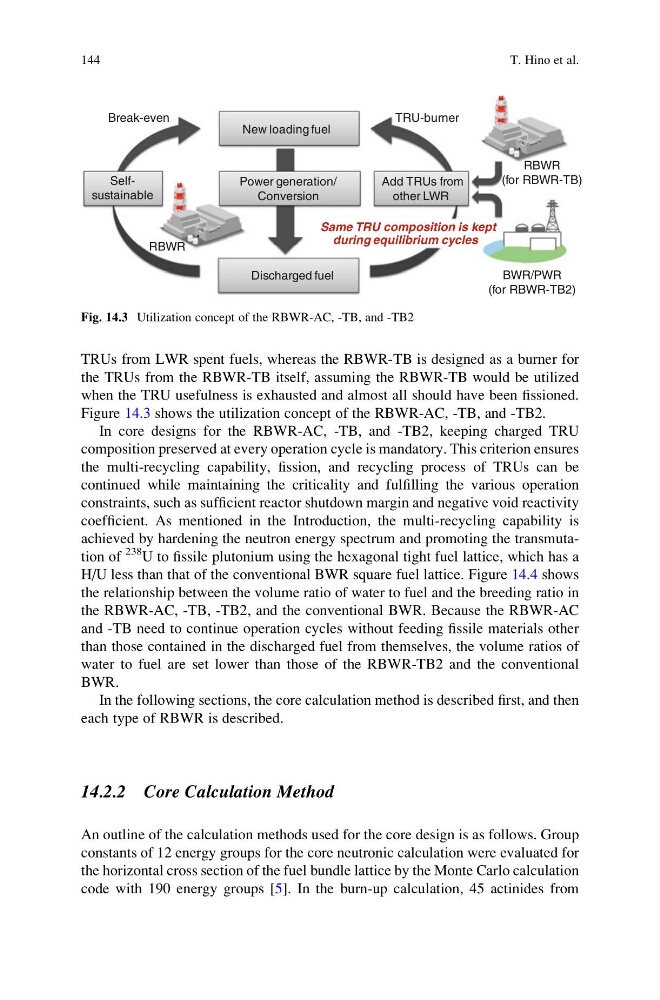
TRUs from LWR spent fuels, whereas the RBWR-TB is designed as a burner for
the TRUs from the RBWR-TB itself, assuming the RBWR-TB would be utilized
when the TRU usefulness is exhausted and almost all should have been fissioned.
Figure 14.3 shows the utilization concept of the RBWR-AC, -TB, and -TB2.
In core designs for the RBWR-AC, -TB, and -TB2, keeping charged TRU
composition preserved at every operation cycle is mandatory. This criterion ensures
the multi-recycling capability, fission, and recycling process of TRUs can be
continued while maintaining the criticality and fulfilling the various operation
constraints, such as sufficient reactor shutdown margin and negative void reactivity
coefficient. As mentioned in the Introduction, the multi-recycling capability is
achieved by hardening the neutron energy spectrum and promoting the transmutation of
238 U to fissile plutonium using the hexagonal tight fuel lattice, which has a
H/U less than that of the conventional BWR square fuel lattice. Figure 14.4 shows
the relationship between the volume ratio of water to fuel and the breeding ratio in
the RBWR-AC, -TB, -TB2, and the conventional BWR. Because the RBWR-AC
and -TB need to continue operation cycles without feeding fissile materials other
than those contained in the discharged fuel from themselves, the volume ratios of
water to fuel are set lower than those of the RBWR-TB2 and the conventional
BWR.
In the following sections, the core calculation method is described first, and then
each type of RBWR is described.
14.2.2 Core Calculation Method
An outline of the calculation methods used for the core design is as follows. Group
constants of 12 energy groups for the core neutronic calculation were evaluated for
the horizontal cross section of the fuel bundle lattice by the Monte Carlo calculation
code with 190 energy groups [5]. In the burn-up calculation, 45 actinides from
New loading fuel
Discharged fuel
Power generation/
Conversion
Same TRU composition is kept
during equilibrium cycles
RBWR
Add TRUs from
other LWR
RBWR
(for RBWR-TB)
Break-even
Selfsustainable
TRU-burner
BWR/PWR
(for RBWR-TB2)
Fig. 14.3 Utilization concept of the RBWR-AC, -TB, and -TB2
144
T. Hino et al.
the TRUs from the RBWR-TB itself, assuming the RBWR-TB would be utilized
when the TRU usefulness is exhausted and almost all should have been fissioned.
Figure 14.3 shows the utilization concept of the RBWR-AC, -TB, and -TB2.
In core designs for the RBWR-AC, -TB, and -TB2, keeping charged TRU
composition preserved at every operation cycle is mandatory. This criterion ensures
the multi-recycling capability, fission, and recycling process of TRUs can be
continued while maintaining the criticality and fulfilling the various operation
constraints, such as sufficient reactor shutdown margin and negative void reactivity
coefficient. As mentioned in the Introduction, the multi-recycling capability is
achieved by hardening the neutron energy spectrum and promoting the transmutation of
238 U to fissile plutonium using the hexagonal tight fuel lattice, which has a
H/U less than that of the conventional BWR square fuel lattice. Figure 14.4 shows
the relationship between the volume ratio of water to fuel and the breeding ratio in
the RBWR-AC, -TB, -TB2, and the conventional BWR. Because the RBWR-AC
and -TB need to continue operation cycles without feeding fissile materials other
than those contained in the discharged fuel from themselves, the volume ratios of
water to fuel are set lower than those of the RBWR-TB2 and the conventional
BWR.
In the following sections, the core calculation method is described first, and then
each type of RBWR is described.
14.2.2 Core Calculation Method
An outline of the calculation methods used for the core design is as follows. Group
constants of 12 energy groups for the core neutronic calculation were evaluated for
the horizontal cross section of the fuel bundle lattice by the Monte Carlo calculation
code with 190 energy groups [5]. In the burn-up calculation, 45 actinides from
New loading fuel
Discharged fuel
Power generation/
Conversion
Same TRU composition is kept
during equilibrium cycles
RBWR
Add TRUs from
other LWR
RBWR
(for RBWR-TB)
Break-even
Selfsustainable
TRU-burner
BWR/PWR
(for RBWR-TB2)
Fig. 14.3 Utilization concept of the RBWR-AC, -TB, and -TB2
144
T. Hino et al.