

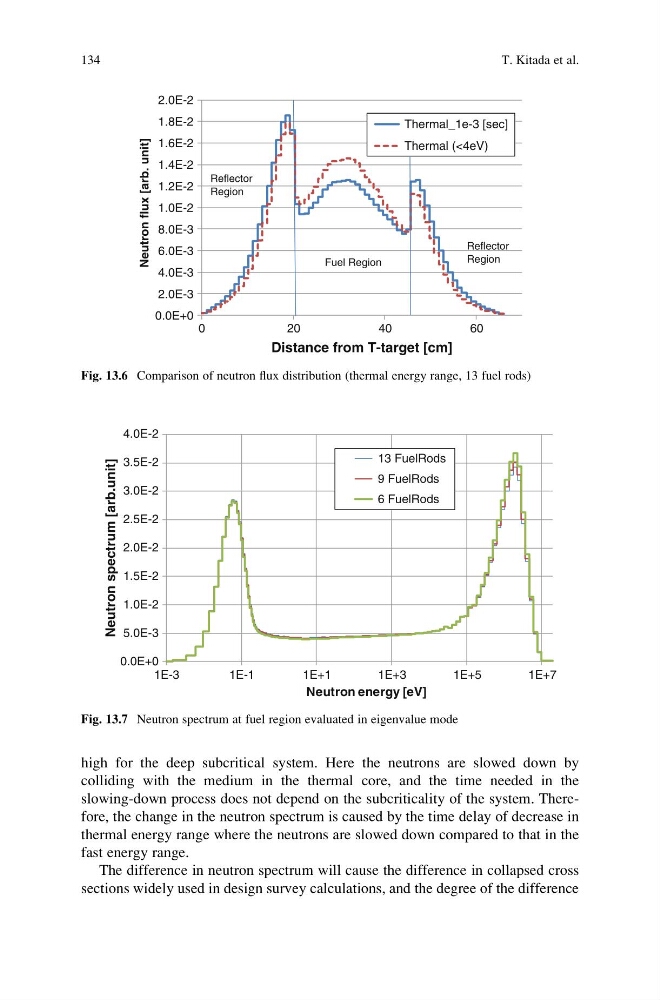
high for the deep subcritical system. Here the neutrons are slowed down by
colliding with the medium in the thermal core, and the time needed in the
slowing-down process does not depend on the subcriticality of the system. Therefore, the change in the neutron spectrum is caused by the time delay of decrease in
thermal energy range where the neutrons are slowed down compared to that in the
fast energy range.
The difference in neutron spectrum will cause the difference in collapsed cross
sections widely used in design survey calculations, and the degree of the difference
0.0E+0
2.0E-3
4.0E-3
6.0E-3
8.0E-3
1.0E-2
1.2E-2
1.4E-2
1.6E-2
1.8E-2
2.0E-2
0
2 0
4 0
6 0
Neutron flux [arb. unit]
Distance from T-target [cm]
Thermal_1e-3 [sec]
Thermal (<4eV)
Fuel Region
Reflector
Region
Reflector
Region
Fig. 13.6 Comparison of neutron flux distribution (thermal energy range, 13 fuel rods)
0.0E+0
5.0E-3
1.0E-2
1.5E-2
2.0E-2
2.5E-2
3.0E-2
3.5E-2
4.0E-2
1E-3
1E-1
1E+1
1E+3
1E+5
1E+7
Neutron spectrum [arb.unit]
Neutron energy [eV]
13 FuelRods
9 FuelRods
6 FuelRods
Fig. 13.7 Neutron spectrum at fuel region evaluated in eigenvalue mode
134
T. Kitada et al.
colliding with the medium in the thermal core, and the time needed in the
slowing-down process does not depend on the subcriticality of the system. Therefore, the change in the neutron spectrum is caused by the time delay of decrease in
thermal energy range where the neutrons are slowed down compared to that in the
fast energy range.
The difference in neutron spectrum will cause the difference in collapsed cross
sections widely used in design survey calculations, and the degree of the difference
0.0E+0
2.0E-3
4.0E-3
6.0E-3
8.0E-3
1.0E-2
1.2E-2
1.4E-2
1.6E-2
1.8E-2
2.0E-2
0
2 0
4 0
6 0
Neutron flux [arb. unit]
Distance from T-target [cm]
Thermal_1e-3 [sec]
Thermal (<4eV)
Fuel Region
Reflector
Region
Reflector
Region
Fig. 13.6 Comparison of neutron flux distribution (thermal energy range, 13 fuel rods)
0.0E+0
5.0E-3
1.0E-2
1.5E-2
2.0E-2
2.5E-2
3.0E-2
3.5E-2
4.0E-2
1E-3
1E-1
1E+1
1E+3
1E+5
1E+7
Neutron spectrum [arb.unit]
Neutron energy [eV]
13 FuelRods
9 FuelRods
6 FuelRods
Fig. 13.7 Neutron spectrum at fuel region evaluated in eigenvalue mode
134
T. Kitada et al.