

the subcriticality changes. This chapter shows the dependence of subcriticality
measurement on its subcriticality, which will contribute to the design of ADSs
and planning of subcriticality measurements in the future.
12.2 Theory of Feynman-α Method in ADS
This section reviews the theory on the higher-order modes in the Feynman-α
method in an ADS based on the work of Yamamoto [15]. Neglecting the energyand spatial dependence of neutrons in a subcritical system driven by a neutron
source with Poisson character, we obtain the Feynman Y function (the variance-tomean ratio of neutron counts minus unity) as
Y Δ
ð Þ ¼
C 1 Δ
ð ÞC 1 Δ
ð Þ
h
iÀ C 1 Δ
ð Þ
h
i
2
C 1 Δ
ð Þ
h
i
À 1 / 1 À
1 À e
Àα 0 Δ
α 0 Δ
ð12:1Þ
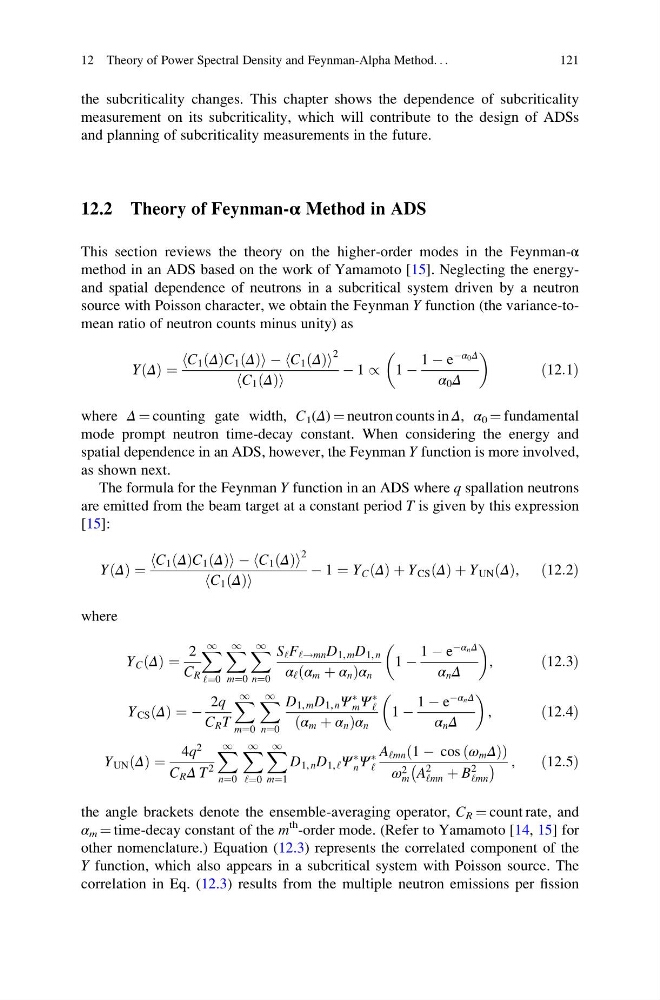
where Δ ¼ counting gate width, C 1 (Δ) ¼ neutron counts in Δ, α 0 ¼ fundamental
mode prompt neutron time-decay constant. When considering the energy and
spatial dependence in an ADS, however, the Feynman Y function is more involved,
as shown next.
The formula for the Feynman Y function in an ADS where q spallation neutrons
are emitted from the beam target at a constant period T is given by this expression
[15]:
Y Δ
ð Þ ¼
C 1 Δ
ð ÞC 1 Δ
ð Þ
h
iÀ C 1 Δ
ð Þ
h
i
2
C 1 Δ
ð Þ
h
i
À 1 ¼ Y C Δ
ð Þ þ Y CS Δ
ð Þ þ Y UN Δ
ð Þ, ð12:2Þ
where
Y C Δ
ð Þ ¼
2
C R
X 1
‘¼0
X 1
m¼0
X 1
n¼0
S ‘ F ‘!mn D 1, m D 1, n
α ‘ α m þ α n
ð
Þ α n
1 À
1 À e
Àα n Δ
α n Δ
,
ð12:3Þ
Y CS Δ
ð Þ ¼ À
2q
C R T
X 1
m¼0
X 1
n¼0
D 1, m D 1, n Ψ
Ã
m Ψ
Ã
‘
α m þ α n
ð
Þ α n
1 À
1 À e
Àα n Δ
α n Δ
,
ð12:4Þ
Y UN Δ
ð Þ ¼
4q
2
C R Δ T
2
X 1
n¼0
X 1
‘¼0
X 1
m¼1
D 1, n D 1, ‘ Ψ
Ã
n Ψ
Ã
‘
A ‘mn 1 À cos ω m Δ
ð
Þ
ð
Þ
ω 2
m A
2
‘mn þ B
2
‘mn
À
Á ,
ð12:5Þ
the angle brackets denote the ensemble-averaging operator, C R ¼ count rate, and
α m ¼ time-decay constant of the m
th -order mode. (Refer to Yamamoto [14, 15] for
other nomenclature.) Equation (12.3) represents the correlated component of the
Y function, which also appears in a subcritical system with Poisson source. The
correlation in Eq. (12.3) results from the multiple neutron emissions per fission
12 Theory of Power Spectral Density and Feynman-Alpha Method. . .
121
measurement on its subcriticality, which will contribute to the design of ADSs
and planning of subcriticality measurements in the future.
12.2 Theory of Feynman-α Method in ADS
This section reviews the theory on the higher-order modes in the Feynman-α
method in an ADS based on the work of Yamamoto [15]. Neglecting the energyand spatial dependence of neutrons in a subcritical system driven by a neutron
source with Poisson character, we obtain the Feynman Y function (the variance-tomean ratio of neutron counts minus unity) as
Y Δ
ð Þ ¼
C 1 Δ
ð ÞC 1 Δ
ð Þ
h
iÀ C 1 Δ
ð Þ
h
i
2
C 1 Δ
ð Þ
h
i
À 1 / 1 À
1 À e
Àα 0 Δ
α 0 Δ
ð12:1Þ
where Δ ¼ counting gate width, C 1 (Δ) ¼ neutron counts in Δ, α 0 ¼ fundamental
mode prompt neutron time-decay constant. When considering the energy and
spatial dependence in an ADS, however, the Feynman Y function is more involved,
as shown next.
The formula for the Feynman Y function in an ADS where q spallation neutrons
are emitted from the beam target at a constant period T is given by this expression
[15]:
Y Δ
ð Þ ¼
C 1 Δ
ð ÞC 1 Δ
ð Þ
h
iÀ C 1 Δ
ð Þ
h
i
2
C 1 Δ
ð Þ
h
i
À 1 ¼ Y C Δ
ð Þ þ Y CS Δ
ð Þ þ Y UN Δ
ð Þ, ð12:2Þ
where
Y C Δ
ð Þ ¼
2
C R
X 1
‘¼0
X 1
m¼0
X 1
n¼0
S ‘ F ‘!mn D 1, m D 1, n
α ‘ α m þ α n
ð
Þ α n
1 À
1 À e
Àα n Δ
α n Δ
,
ð12:3Þ
Y CS Δ
ð Þ ¼ À
2q
C R T
X 1
m¼0
X 1
n¼0
D 1, m D 1, n Ψ
Ã
m Ψ
Ã
‘
α m þ α n
ð
Þ α n
1 À
1 À e
Àα n Δ
α n Δ
,
ð12:4Þ
Y UN Δ
ð Þ ¼
4q
2
C R Δ T
2
X 1
n¼0
X 1
‘¼0
X 1
m¼1
D 1, n D 1, ‘ Ψ
Ã
n Ψ
Ã
‘
A ‘mn 1 À cos ω m Δ
ð
Þ
ð
Þ
ω 2
m A
2
‘mn þ B
2
‘mn
À
Á ,
ð12:5Þ
the angle brackets denote the ensemble-averaging operator, C R ¼ count rate, and
α m ¼ time-decay constant of the m
th -order mode. (Refer to Yamamoto [14, 15] for
other nomenclature.) Equation (12.3) represents the correlated component of the
Y function, which also appears in a subcritical system with Poisson source. The
correlation in Eq. (12.3) results from the multiple neutron emissions per fission
12 Theory of Power Spectral Density and Feynman-Alpha Method. . .
121