

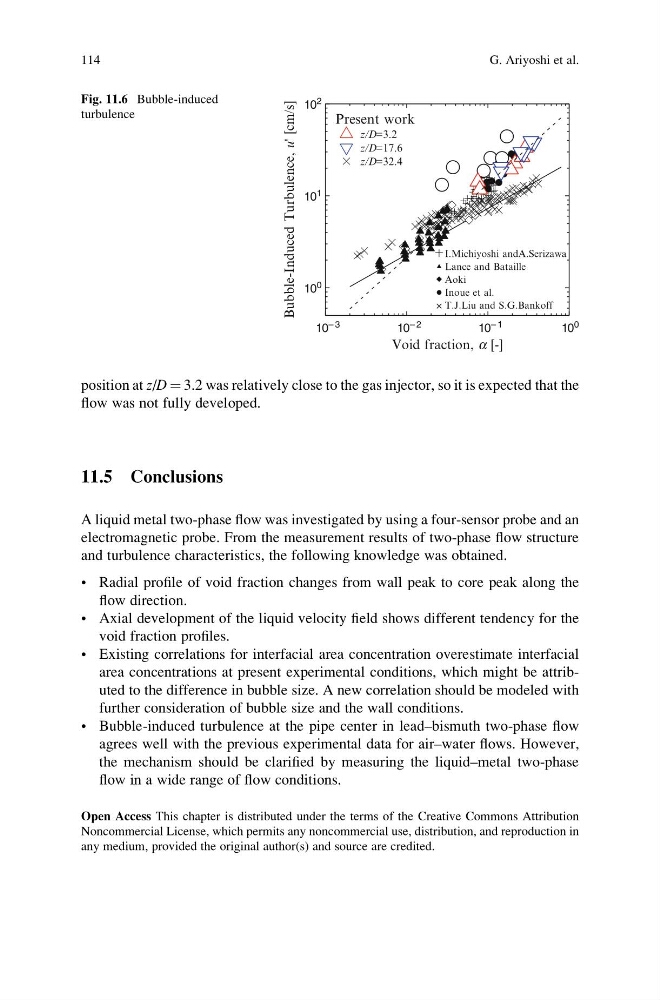
position at z/D ¼ 3.2 was relatively close to the gas injector, so it is expected that the
flow was not fully developed.
11.5 Conclusions
A liquid metal two-phase flow was investigated by using a four-sensor probe and an
electromagnetic probe. From the measurement results of two-phase flow structure
and turbulence characteristics, the following knowledge was obtained.
• Radial profile of void fraction changes from wall peak to core peak along the
flow direction.
• Axial development of the liquid velocity field shows different tendency for the
void fraction profiles.
• Existing correlations for interfacial area concentration overestimate interfacial
area concentrations at present experimental conditions, which might be attributed to the difference in bubble size. A new correlation should be modeled with
further consideration of bubble size and the wall conditions.
• Bubble-induced turbulence at the pipe center in lead–bismuth two-phase flow
agrees well with the previous experimental data for air–water flows. However,
the mechanism should be clarified by measuring the liquid–metal two-phase
flow in a wide range of flow conditions.
Open Access This chapter is distributed under the terms of the Creative Commons Attribution
Noncommercial License, which permits any noncommercial use, distribution, and reproduction in
any medium, provided the original author(s) and source are credited.
10
– 3
10
– 2
10
– 1
10
0
10
0
10
1
10
2
I.Michiyoshi andA.Serizawa
Lance and Bataille
Aoki
Inoue et al.
T.J.Liu and S.G.Bankoff
Bubble-Induced Turbulence, u'
[cm/s]
Void fraction, a [-]
Present work
z/D=3.2
z/D=17.6
z/D=32.4
Fig. 11.6 Bubble-induced
turbulence
114
G. Ariyoshi et al.
flow was not fully developed.
11.5 Conclusions
A liquid metal two-phase flow was investigated by using a four-sensor probe and an
electromagnetic probe. From the measurement results of two-phase flow structure
and turbulence characteristics, the following knowledge was obtained.
• Radial profile of void fraction changes from wall peak to core peak along the
flow direction.
• Axial development of the liquid velocity field shows different tendency for the
void fraction profiles.
• Existing correlations for interfacial area concentration overestimate interfacial
area concentrations at present experimental conditions, which might be attributed to the difference in bubble size. A new correlation should be modeled with
further consideration of bubble size and the wall conditions.
• Bubble-induced turbulence at the pipe center in lead–bismuth two-phase flow
agrees well with the previous experimental data for air–water flows. However,
the mechanism should be clarified by measuring the liquid–metal two-phase
flow in a wide range of flow conditions.
Open Access This chapter is distributed under the terms of the Creative Commons Attribution
Noncommercial License, which permits any noncommercial use, distribution, and reproduction in
any medium, provided the original author(s) and source are credited.
10
– 3
10
– 2
10
– 1
10
0
10
0
10
1
10
2
I.Michiyoshi andA.Serizawa
Lance and Bataille
Aoki
Inoue et al.
T.J.Liu and S.G.Bankoff
Bubble-Induced Turbulence, u'
[cm/s]
Void fraction, a [-]
Present work
z/D=3.2
z/D=17.6
z/D=32.4
Fig. 11.6 Bubble-induced
turbulence
114
G. Ariyoshi et al.