

68
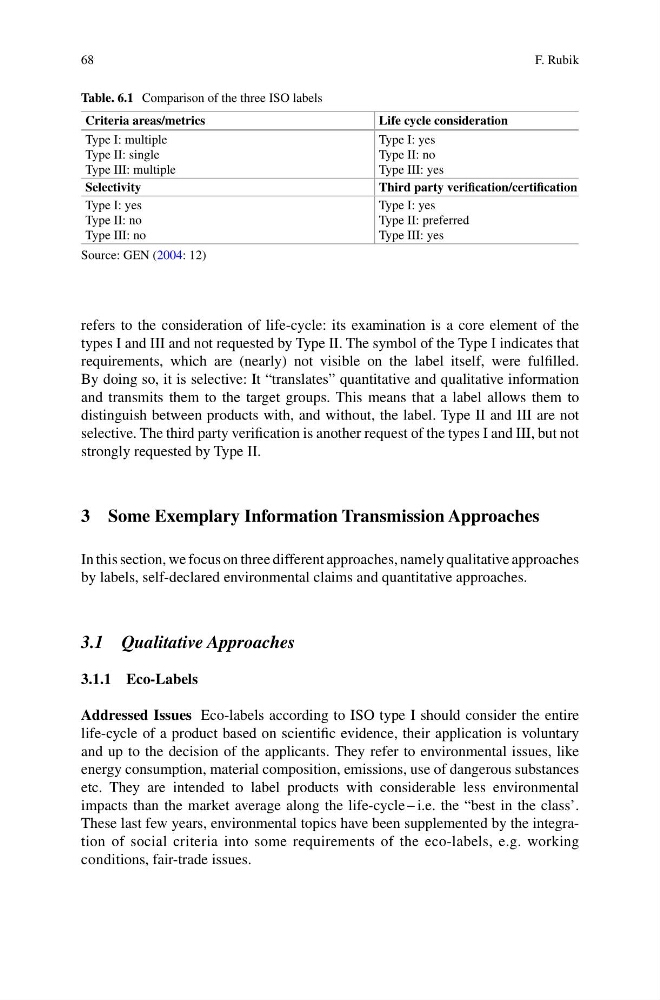
refers to the consideration of life-cycle: its examination is a core element of the
types I and III and not requested by Type II. The symbol of the Type I indicates that
requirements, which are (nearly) not visible on the label itself, were fulfi lled.
By doing so, it is selective: It “translates” quantitative and qualitative information
and transmits them to the target groups. This means that a label allows them to
distinguish between products with, and without, the label. Type II and III are not
selective. The third party verifi cation is another request of the types I and III, but not
strongly requested by Type II.
3 Some Exemplary Information Transmission Approaches
In this section, we focus on three different approaches, namely qualitative approaches
by labels, self-declared environmental claims and quantitative approaches.
3.1 Qualitative Approaches
3.1.1 Eco-Labels
Addressed Issues Eco-labels according to ISO type I should consider the entire
life-cycle of a product based on scientifi c evidence, their application is voluntary
and up to the decision of the applicants. They refer to environmental issues, like
energy consumption, material composition, emissions, use of dangerous substances
etc. They are intended to label products with considerable less environmental
impacts than the market average along the life-cycle − i.e. the “best in the class’.
These last few years, environmental topics have been supplemented by the integration of social criteria into some requirements of the eco-labels, e.g. working
conditions, fair-trade issues.
Table. 6.1 Comparison of the three ISO labels
Criteria areas/metrics
Life cycle consideration
Type I: multiple
Type II: single
Type III: multiple
Type I: yes
Type II: no
Type III: yes
Selectivity
Third party verifi cation/certifi cation
Type I: yes
Type II: no
Type III: no
Type I: yes
Type II: preferred
Type III: yes
Source: GEN ( 2004 : 12)
F. Rubik
refers to the consideration of life-cycle: its examination is a core element of the
types I and III and not requested by Type II. The symbol of the Type I indicates that
requirements, which are (nearly) not visible on the label itself, were fulfi lled.
By doing so, it is selective: It “translates” quantitative and qualitative information
and transmits them to the target groups. This means that a label allows them to
distinguish between products with, and without, the label. Type II and III are not
selective. The third party verifi cation is another request of the types I and III, but not
strongly requested by Type II.
3 Some Exemplary Information Transmission Approaches
In this section, we focus on three different approaches, namely qualitative approaches
by labels, self-declared environmental claims and quantitative approaches.
3.1 Qualitative Approaches
3.1.1 Eco-Labels
Addressed Issues Eco-labels according to ISO type I should consider the entire
life-cycle of a product based on scientifi c evidence, their application is voluntary
and up to the decision of the applicants. They refer to environmental issues, like
energy consumption, material composition, emissions, use of dangerous substances
etc. They are intended to label products with considerable less environmental
impacts than the market average along the life-cycle − i.e. the “best in the class’.
These last few years, environmental topics have been supplemented by the integration of social criteria into some requirements of the eco-labels, e.g. working
conditions, fair-trade issues.
Table. 6.1 Comparison of the three ISO labels
Criteria areas/metrics
Life cycle consideration
Type I: multiple
Type II: single
Type III: multiple
Type I: yes
Type II: no
Type III: yes
Selectivity
Third party verifi cation/certifi cation
Type I: yes
Type II: no
Type III: no
Type I: yes
Type II: preferred
Type III: yes
Source: GEN ( 2004 : 12)
F. Rubik