

67
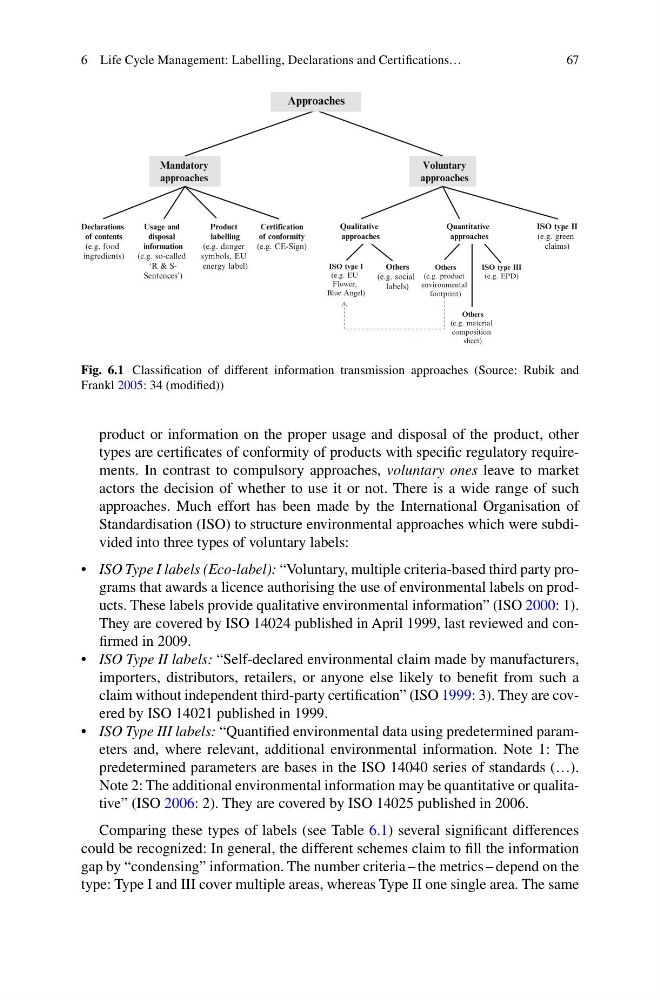
product or information on the proper usage and disposal of the product, other
types are certifi cates of conformity of products with specifi c regulatory requirements. In contrast to compulsory approaches, voluntary ones leave to market
actors the decision of whether to use it or not. There is a wide range of such
approaches. Much effort has been made by the International Organisation of
Standardisation (ISO) to structure environmental approaches which were subdivided into three types of voluntary labels:
• ISO Type I labels (Eco-label): “Voluntary, multiple criteria-based third party programs that awards a licence authorising the use of environmental labels on products. These labels provide qualitative environmental information” (ISO 2000 : 1).
They are covered by ISO 14024 published in April 1999, last reviewed and confi rmed in 2009.
• ISO Type II labels: “Self-declared environmental claim made by manufacturers,
importers, distributors, retailers, or anyone else likely to benefi t from such a
claim without independent third-party certifi cation” (ISO 1999 : 3). They are covered by ISO 14021 published in 1999.
• ISO Type III labels: “Quantifi ed environmental data using predetermined parameters and, where relevant, additional environmental information. Note 1: The
predetermined parameters are bases in the ISO 14040 series of standards (…).
Note 2: The additional environmental information may be quantitative or qualitative” (ISO 2006 : 2). They are covered by ISO 14025 published in 2006.
Comparing these types of labels (see Table 6.1 ) several signifi cant differences
could be recognized: In general, the different schemes claim to fi ll the information
gap by “condensing” information. The number criteria − the metrics − depend on the
type: Type I and III cover multiple areas, whereas Type II one single area. The same
Fig. 6.1 Classifi cation of different information transmission approaches (Source: Rubik and
Frankl 2005 : 34 (modifi ed))
Mandatory
approaches
Voluntary
approaches
Declarations
of contents
(e.g. food
ingredients)
Usage and
disposal
information
(e.g. so-called
‘R & SSentences’)
Product
labelling
(e.g. danger
symbols, EU
energy label)
Certification
of conformity
(e.g. CE-Sign)
Qualitative
approaches
ISO type II
(e.g. green
claims)
Quantitative
approaches
Others
(e.g. social
labels)
ISO type III
(e.g. EPD)
ISO type I
(e.g. EU
Flower,
Blue Angel)
Others
(e.g. product
environmental
footprint)
Others
(e.g. material
composition
sheet)
Approaches
6 Life Cycle Management: Labelling, Declarations and Certifi cations…
product or information on the proper usage and disposal of the product, other
types are certifi cates of conformity of products with specifi c regulatory requirements. In contrast to compulsory approaches, voluntary ones leave to market
actors the decision of whether to use it or not. There is a wide range of such
approaches. Much effort has been made by the International Organisation of
Standardisation (ISO) to structure environmental approaches which were subdivided into three types of voluntary labels:
• ISO Type I labels (Eco-label): “Voluntary, multiple criteria-based third party programs that awards a licence authorising the use of environmental labels on products. These labels provide qualitative environmental information” (ISO 2000 : 1).
They are covered by ISO 14024 published in April 1999, last reviewed and confi rmed in 2009.
• ISO Type II labels: “Self-declared environmental claim made by manufacturers,
importers, distributors, retailers, or anyone else likely to benefi t from such a
claim without independent third-party certifi cation” (ISO 1999 : 3). They are covered by ISO 14021 published in 1999.
• ISO Type III labels: “Quantifi ed environmental data using predetermined parameters and, where relevant, additional environmental information. Note 1: The
predetermined parameters are bases in the ISO 14040 series of standards (…).
Note 2: The additional environmental information may be quantitative or qualitative” (ISO 2006 : 2). They are covered by ISO 14025 published in 2006.
Comparing these types of labels (see Table 6.1 ) several signifi cant differences
could be recognized: In general, the different schemes claim to fi ll the information
gap by “condensing” information. The number criteria − the metrics − depend on the
type: Type I and III cover multiple areas, whereas Type II one single area. The same
Fig. 6.1 Classifi cation of different information transmission approaches (Source: Rubik and
Frankl 2005 : 34 (modifi ed))
Mandatory
approaches
Voluntary
approaches
Declarations
of contents
(e.g. food
ingredients)
Usage and
disposal
information
(e.g. so-called
‘R & SSentences’)
Product
labelling
(e.g. danger
symbols, EU
energy label)
Certification
of conformity
(e.g. CE-Sign)
Qualitative
approaches
ISO type II
(e.g. green
claims)
Quantitative
approaches
Others
(e.g. social
labels)
ISO type III
(e.g. EPD)
ISO type I
(e.g. EU
Flower,
Blue Angel)
Others
(e.g. product
environmental
footprint)
Others
(e.g. material
composition
sheet)
Approaches
6 Life Cycle Management: Labelling, Declarations and Certifi cations…