

38
establishes the processes that are required to deliver the outcome. The “Do” step is
a process of implementing the plan through performing a process to make the target
output product. It also involves activities such as collecting and preparing data
inputs to the next steps. The third stage of the PDCA cycle is the “Check” step. In
this stage, the main results from the “DO” step are analyzed whether or not they
meet the expected outcome set in the “Plan” step. The main factors that affect the
performance of the product are identifi ed and possible improvement solutions are
suggested. The comprehensiveness of the plan to allow a proper execution of the
product is checked in this step. The fi nal stage is the “Act” step. The action is based
on the output results from the “Check” stage. If the results from the “Check” reveal
that the established new plan allows for an improved performance, then the action
will be how the company sustains the improved performance as a new standard. On
the other hand, if the plan fails to ensure an improvement, then the existing standard
will remain in place. In both cases, the “Act” step closes the fi rst cycle and continues
the process by incorporating the knowledge accumulated during the entire process
to be used to set a new goal, adjust the method used and so on.
LCM is a dynamic management process. Hence it considers the PDCA cycle
approach among other management tools that enable a continuous business improvement over time and satisfy employees, customers and other stakeholders (Remmen
et al. 2007 ). The PDCA cycle provides an organization with a systematic approach
to management along the product life cycle. The recommendations of the PDCA
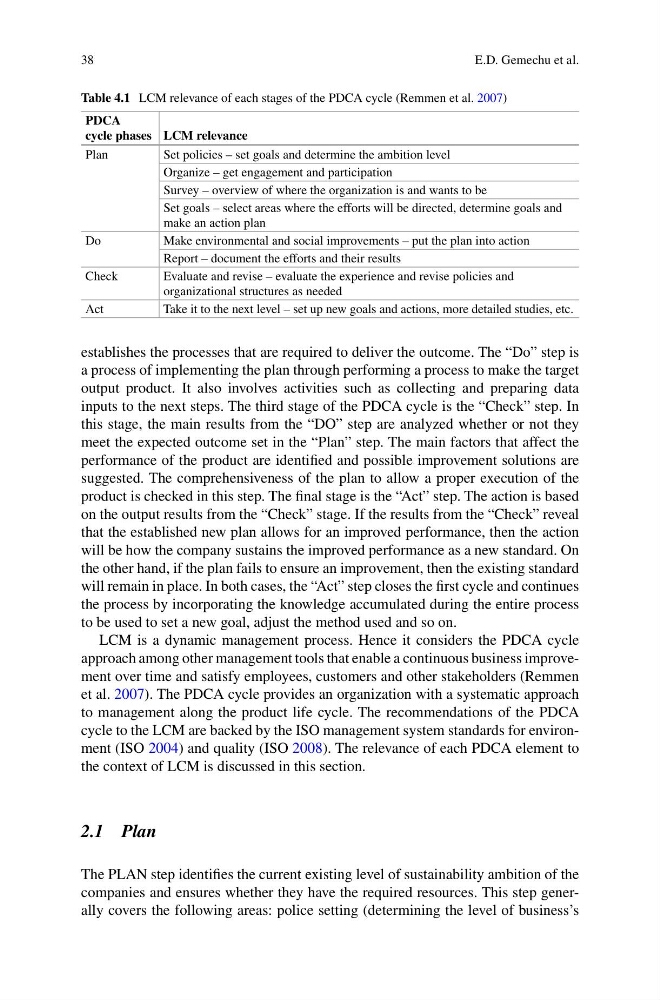
cycle to the LCM are backed by the ISO management system standards for environment (ISO 2004 ) and quality (ISO 2008 ). The relevance of each PDCA element to
the context of LCM is discussed in this section.
2.1 Plan
The PLAN step identifi es the current existing level of sustainability ambition of the
companies and ensures whether they have the required resources. This step generally covers the following areas: police setting (determining the level of business’s
Table 4.1 LCM relevance of each stages of the PDCA cycle (Remmen et al. 2007 )
PDCA
cycle phases LCM relevance
Plan
Set policies – set goals and determine the ambition level
Organize – get engagement and participation
Survey – overview of where the organization is and wants to be
Set goals – select areas where the efforts will be directed, determine goals and
make an action plan
Do
Make environmental and social improvements – put the plan into action
Report – document the efforts and their results
Check
Evaluate and revise – evaluate the experience and revise policies and
organizational structures as needed
Act
Take it to the next level – set up new goals and actions, more detailed studies, etc.
E.D. Gemechu et al.
establishes the processes that are required to deliver the outcome. The “Do” step is
a process of implementing the plan through performing a process to make the target
output product. It also involves activities such as collecting and preparing data
inputs to the next steps. The third stage of the PDCA cycle is the “Check” step. In
this stage, the main results from the “DO” step are analyzed whether or not they
meet the expected outcome set in the “Plan” step. The main factors that affect the
performance of the product are identifi ed and possible improvement solutions are
suggested. The comprehensiveness of the plan to allow a proper execution of the
product is checked in this step. The fi nal stage is the “Act” step. The action is based
on the output results from the “Check” stage. If the results from the “Check” reveal
that the established new plan allows for an improved performance, then the action
will be how the company sustains the improved performance as a new standard. On
the other hand, if the plan fails to ensure an improvement, then the existing standard
will remain in place. In both cases, the “Act” step closes the fi rst cycle and continues
the process by incorporating the knowledge accumulated during the entire process
to be used to set a new goal, adjust the method used and so on.
LCM is a dynamic management process. Hence it considers the PDCA cycle
approach among other management tools that enable a continuous business improvement over time and satisfy employees, customers and other stakeholders (Remmen
et al. 2007 ). The PDCA cycle provides an organization with a systematic approach
to management along the product life cycle. The recommendations of the PDCA
cycle to the LCM are backed by the ISO management system standards for environment (ISO 2004 ) and quality (ISO 2008 ). The relevance of each PDCA element to
the context of LCM is discussed in this section.
2.1 Plan
The PLAN step identifi es the current existing level of sustainability ambition of the
companies and ensures whether they have the required resources. This step generally covers the following areas: police setting (determining the level of business’s
Table 4.1 LCM relevance of each stages of the PDCA cycle (Remmen et al. 2007 )
PDCA
cycle phases LCM relevance
Plan
Set policies – set goals and determine the ambition level
Organize – get engagement and participation
Survey – overview of where the organization is and wants to be
Set goals – select areas where the efforts will be directed, determine goals and
make an action plan
Do
Make environmental and social improvements – put the plan into action
Report – document the efforts and their results
Check
Evaluate and revise – evaluate the experience and revise policies and
organizational structures as needed
Act
Take it to the next level – set up new goals and actions, more detailed studies, etc.
E.D. Gemechu et al.