

37
regulation (Ginsburg and Bloom 2004 ) are also among the drivers that brought sustainability innovation into business context.
Sustainability is becoming an agenda for most business nowadays, but how to
implement and integrate it with other strategies remains challenging. Life cycle
management (LCM) is an approach that can be used by business with the aim to
operationalize their sustainability initiatives: to have better environmental, economic and social performance simultaneously. This chapter, therefore, discusses the
way how business can implement LCM into their management strategies.
2 Implementation of Life Cycle Sustainability Management
LCM is a management approach that provides business a systematic way of managing their sustainability issues. The PDCA (Plan, Do, Check and Act) cycle is one of
the quality management tools that can be used by companies to implement LCM
initiatives in order to improve their sustainability performance. This section introduces the PDCA cycle and discusses in detail its relevance to successfully implement LCM in any business.
The PDCA cycle, for Plan, Do, Check and Act, which is also known as the
Deming cycle, was fi rst proposed by Walter A. Shewhart (Shewhart 2011 ) in the
1950s and further conceptualized by W. Edward Deming (Deming 1952 ) to analyze
and measure business processes and identify the main causes that affect products
quality from customer requirements. The PDCA cycle has its root in scientifi c
methods that have evolved for more than 400 years (Moen and Norman 2006 ). The
cycle is a systematic series of steps and continuous feedback loop in which managers are able to identify and take the required measure to change the parts of the
process that need improvement (Sokovic et al. 2010 ).
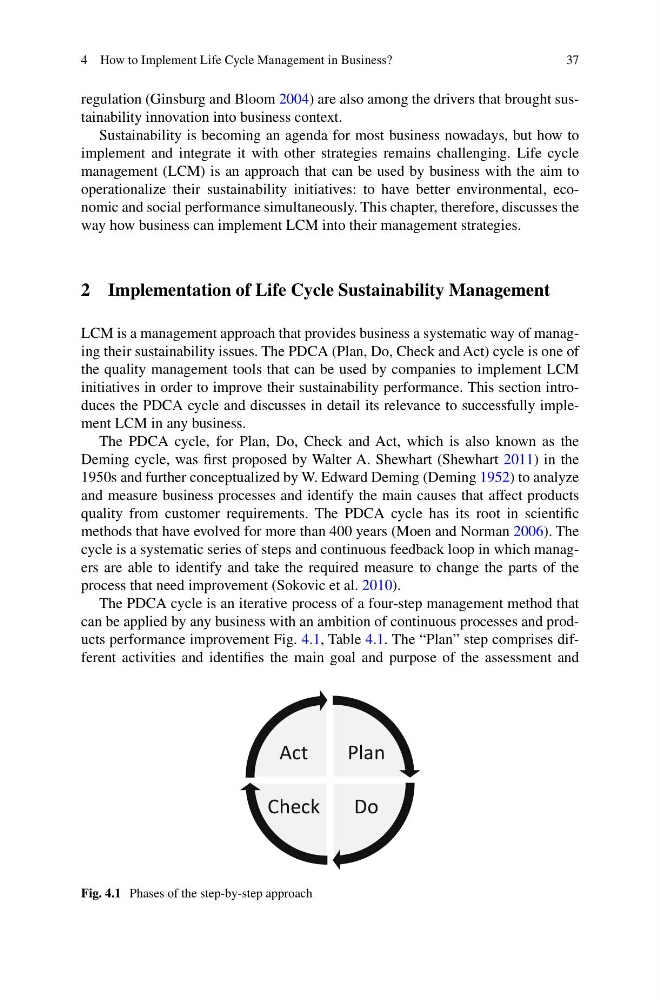
The PDCA cycle is an iterative process of a four-step management method that
can be applied by any business with an ambition of continuous processes and products performance improvement Fig. 4.1 , Table 4.1 . The “Plan” step comprises different activities and identifi es the main goal and purpose of the assessment and
Plan
Do
Check
Act
Fig. 4.1 Phases of the step-by-step approach
4 How to Implement Life Cycle Management in Business?
regulation (Ginsburg and Bloom 2004 ) are also among the drivers that brought sustainability innovation into business context.
Sustainability is becoming an agenda for most business nowadays, but how to
implement and integrate it with other strategies remains challenging. Life cycle
management (LCM) is an approach that can be used by business with the aim to
operationalize their sustainability initiatives: to have better environmental, economic and social performance simultaneously. This chapter, therefore, discusses the
way how business can implement LCM into their management strategies.
2 Implementation of Life Cycle Sustainability Management
LCM is a management approach that provides business a systematic way of managing their sustainability issues. The PDCA (Plan, Do, Check and Act) cycle is one of
the quality management tools that can be used by companies to implement LCM
initiatives in order to improve their sustainability performance. This section introduces the PDCA cycle and discusses in detail its relevance to successfully implement LCM in any business.
The PDCA cycle, for Plan, Do, Check and Act, which is also known as the
Deming cycle, was fi rst proposed by Walter A. Shewhart (Shewhart 2011 ) in the
1950s and further conceptualized by W. Edward Deming (Deming 1952 ) to analyze
and measure business processes and identify the main causes that affect products
quality from customer requirements. The PDCA cycle has its root in scientifi c
methods that have evolved for more than 400 years (Moen and Norman 2006 ). The
cycle is a systematic series of steps and continuous feedback loop in which managers are able to identify and take the required measure to change the parts of the
process that need improvement (Sokovic et al. 2010 ).
The PDCA cycle is an iterative process of a four-step management method that
can be applied by any business with an ambition of continuous processes and products performance improvement Fig. 4.1 , Table 4.1 . The “Plan” step comprises different activities and identifi es the main goal and purpose of the assessment and
Plan
Do
Check
Act
Fig. 4.1 Phases of the step-by-step approach
4 How to Implement Life Cycle Management in Business?