

219
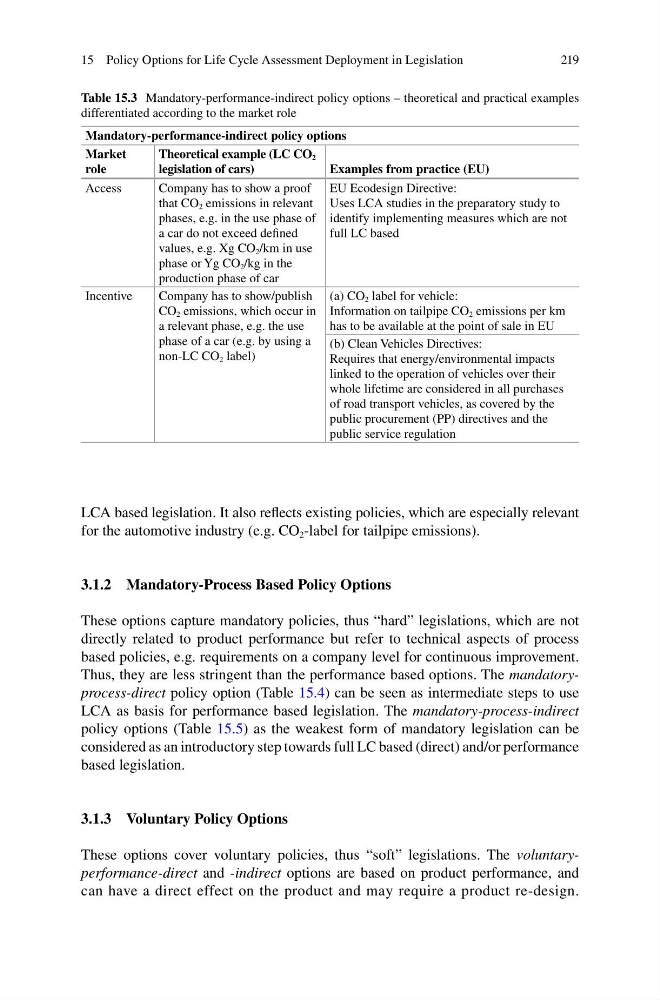
LCA based legislation. It also refl ects existing policies, which are especially relevant
for the automotive industry (e.g. CO 2 -label for tailpipe emissions).
3.1.2 Mandatory-Process Based Policy Options
These options capture mandatory policies, thus “hard” legislations, which are not
directly related to product performance but refer to technical aspects of process
based policies, e.g. requirements on a company level for continuous improvement.
Thus, they are less stringent than the performance based options. The mandatoryprocess- direct policy option (Table 15.4 ) can be seen as intermediate steps to use
LCA as basis for performance based legislation. The mandatory-process-indirect
policy options (Table 15.5 ) as the weakest form of mandatory legislation can be
considered as an introductory step towards full LC based (direct) and/or performance
based legislation.
3.1.3 Voluntary Policy Options
These options cover voluntary policies, thus “soft” legislations. The voluntaryperformance- direct and -indirect options are based on product performance, and
can have a direct effect on the product and may require a product re-design.
Table 15.3 Mandatory-performance-indirect policy options – theoretical and practical examples
differentiated according to the market role
Mandatory-performance-indirect policy options
Market
role
Theoretical example (LC CO 2
legislation of cars)
Examples from practice (EU)
Access
Company has to show a proof
that CO 2 emissions in relevant
phases, e.g. in the use phase of
a car do not exceed defi ned
values, e.g. Xg CO 2 /km in use
phase or Yg CO 2 /kg in the
production phase of car
EU Ecodesign Directive:
Uses LCA studies in the preparatory study to
identify implementing measures which are not
full LC based
Incentive
Company has to show/publish
CO 2 emissions, which occur in
a relevant phase, e.g. the use
phase of a car (e.g. by using a
non-LC CO 2 label)
(a) CO 2 label for vehicle:
Information on tailpipe CO 2 emissions per km
has to be available at the point of sale in EU
(b) Clean Vehicles Directives:
Requires that energy/environmental impacts
linked to the operation of vehicles over their
whole lifetime are considered in all purchases
of road transport vehicles, as covered by the
public procurement (PP) directives and the
public service regulation
15 Policy Options for Life Cycle Assessment Deployment in Legislation
LCA based legislation. It also refl ects existing policies, which are especially relevant
for the automotive industry (e.g. CO 2 -label for tailpipe emissions).
3.1.2 Mandatory-Process Based Policy Options
These options capture mandatory policies, thus “hard” legislations, which are not
directly related to product performance but refer to technical aspects of process
based policies, e.g. requirements on a company level for continuous improvement.
Thus, they are less stringent than the performance based options. The mandatoryprocess- direct policy option (Table 15.4 ) can be seen as intermediate steps to use
LCA as basis for performance based legislation. The mandatory-process-indirect
policy options (Table 15.5 ) as the weakest form of mandatory legislation can be
considered as an introductory step towards full LC based (direct) and/or performance
based legislation.
3.1.3 Voluntary Policy Options
These options cover voluntary policies, thus “soft” legislations. The voluntaryperformance- direct and -indirect options are based on product performance, and
can have a direct effect on the product and may require a product re-design.
Table 15.3 Mandatory-performance-indirect policy options – theoretical and practical examples
differentiated according to the market role
Mandatory-performance-indirect policy options
Market
role
Theoretical example (LC CO 2
legislation of cars)
Examples from practice (EU)
Access
Company has to show a proof
that CO 2 emissions in relevant
phases, e.g. in the use phase of
a car do not exceed defi ned
values, e.g. Xg CO 2 /km in use
phase or Yg CO 2 /kg in the
production phase of car
EU Ecodesign Directive:
Uses LCA studies in the preparatory study to
identify implementing measures which are not
full LC based
Incentive
Company has to show/publish
CO 2 emissions, which occur in
a relevant phase, e.g. the use
phase of a car (e.g. by using a
non-LC CO 2 label)
(a) CO 2 label for vehicle:
Information on tailpipe CO 2 emissions per km
has to be available at the point of sale in EU
(b) Clean Vehicles Directives:
Requires that energy/environmental impacts
linked to the operation of vehicles over their
whole lifetime are considered in all purchases
of road transport vehicles, as covered by the
public procurement (PP) directives and the
public service regulation
15 Policy Options for Life Cycle Assessment Deployment in Legislation