

215
analyzed existing legislations, which are related to CO 2 and/or have implemented
LCT, i.e., include an LC perspective. A fi rst focus was put on Europe (EU).
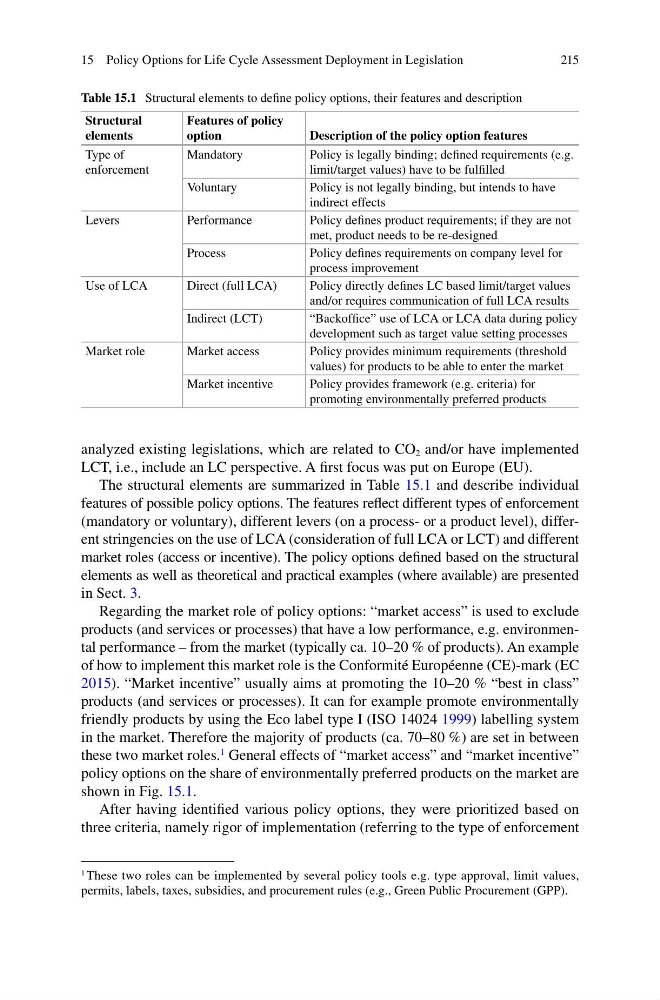
The structural elements are summarized in Table 15.1 and describe individual
features of possible policy options. The features refl ect different types of enforcement
(mandatory or voluntary), different levers (on a process- or a product level), different stringencies on the use of LCA (consideration of full LCA or LCT) and different
market roles (access or incentive). The policy options defi ned based on the structural
elements as well as theoretical and practical examples (where available) are presented
in Sect. 3 .
Regarding the market role of policy options: “market access” is used to exclude
products (and services or processes) that have a low performance, e.g. environmental performance – from the market (typically ca. 10–20 % of products). An example
of how to implement this market role is the Conformité Européenne (CE)-mark (EC
2015 ). “Market incentive” usually aims at promoting the 10–20 % “best in class”
products (and services or processes). It can for example promote environmentally
friendly products by using the Eco label type I (ISO 14024 1999 ) labelling system
in the market. Therefore the majority of products (ca. 70–80 %) are set in between
these two market roles.
1 General effects of “market access” and “market incentive”
policy options on the share of environmentally preferred products on the market are
shown in Fig. 15.1 .
After having identifi ed various policy options, they were prioritized based on
three criteria, namely rigor of implementation (referring to the type of enforcement
1 These two roles can be implemented by several policy tools e.g. type approval, limit values,
permits, labels, taxes, subsidies, and procurement rules (e.g., Green Public Procurement (GPP).
Table 15.1 Structural elements to defi ne policy options, their features and description
Structural
elements
Features of policy
option
Description of the policy option features
Type of
enforcement
Mandatory
Policy is legally binding; defi ned requirements (e.g.
limit/target values) have to be fulfi lled
Voluntary
Policy is not legally binding, but intends to have
indirect effects
Levers
Performance
Policy defi nes product requirements; if they are not
met, product needs to be re-designed
Process
Policy defi nes requirements on company level for
process improvement
Use of LCA
Direct (full LCA)
Policy directly defi nes LC based limit/target values
and/or requires communication of full LCA results
Indirect (LCT)
“Backoffi ce” use of LCA or LCA data during policy
development such as target value setting processes
Market role
Market access
Policy provides minimum requirements (threshold
values) for products to be able to enter the market
Market incentive
Policy provides framework (e.g. criteria) for
promoting environmentally preferred products
15 Policy Options for Life Cycle Assessment Deployment in Legislation
analyzed existing legislations, which are related to CO 2 and/or have implemented
LCT, i.e., include an LC perspective. A fi rst focus was put on Europe (EU).
The structural elements are summarized in Table 15.1 and describe individual
features of possible policy options. The features refl ect different types of enforcement
(mandatory or voluntary), different levers (on a process- or a product level), different stringencies on the use of LCA (consideration of full LCA or LCT) and different
market roles (access or incentive). The policy options defi ned based on the structural
elements as well as theoretical and practical examples (where available) are presented
in Sect. 3 .
Regarding the market role of policy options: “market access” is used to exclude
products (and services or processes) that have a low performance, e.g. environmental performance – from the market (typically ca. 10–20 % of products). An example
of how to implement this market role is the Conformité Européenne (CE)-mark (EC
2015 ). “Market incentive” usually aims at promoting the 10–20 % “best in class”
products (and services or processes). It can for example promote environmentally
friendly products by using the Eco label type I (ISO 14024 1999 ) labelling system
in the market. Therefore the majority of products (ca. 70–80 %) are set in between
these two market roles.
1 General effects of “market access” and “market incentive”
policy options on the share of environmentally preferred products on the market are
shown in Fig. 15.1 .
After having identifi ed various policy options, they were prioritized based on
three criteria, namely rigor of implementation (referring to the type of enforcement
1 These two roles can be implemented by several policy tools e.g. type approval, limit values,
permits, labels, taxes, subsidies, and procurement rules (e.g., Green Public Procurement (GPP).
Table 15.1 Structural elements to defi ne policy options, their features and description
Structural
elements
Features of policy
option
Description of the policy option features
Type of
enforcement
Mandatory
Policy is legally binding; defi ned requirements (e.g.
limit/target values) have to be fulfi lled
Voluntary
Policy is not legally binding, but intends to have
indirect effects
Levers
Performance
Policy defi nes product requirements; if they are not
met, product needs to be re-designed
Process
Policy defi nes requirements on company level for
process improvement
Use of LCA
Direct (full LCA)
Policy directly defi nes LC based limit/target values
and/or requires communication of full LCA results
Indirect (LCT)
“Backoffi ce” use of LCA or LCA data during policy
development such as target value setting processes
Market role
Market access
Policy provides minimum requirements (threshold
values) for products to be able to enter the market
Market incentive
Policy provides framework (e.g. criteria) for
promoting environmentally preferred products
15 Policy Options for Life Cycle Assessment Deployment in Legislation