

205
an entire industry. A sector-wide approach to LCM ensures a level playing fi eld for
companies and gradually moves to a more widespread adoption of the procedures.
Other sector associations are also recommending LCM approaches to their
members.
The chemicals sector has also acknowledged the importance of managing value
chain issues. ICCA’s 2006 Responsible Care Global Charter ( www.icca-chem.org/ )
states that “… member companies and associations commit to promoting the
Responsible Care ethic, principles and practices along their own value chains …
and to …develop and share best practices through mutual assistance, and to … work
in partnership with upstream suppliers and downstream chemical users to collaborate on improved processes for the safe and effective uses of chemicals”. ICCA
organizes workshops and produces guidance publications to assist companies to
implement these principles.
The International Solid Waste Association (ISWA) ( www.iswa.org ) published
already in 2002 a forward-looking 10-year Perspective paper (ISWA 2002 ) advocating a holistic approach to waste management based on more complete consideration
of the life cycle of materials that ultimately become waste. According to ISWA “…
there is a need for a new approach. The focus must be upon the whole product life
cycle and not only on the waste phase of products, substances and materials.
Important decisions in relation to the amount of waste generated are taken both at
the concept and design stage and further on during the production process. There is
a need for dematerialization of the economic process…” Some of ISWA’s workshops and documents are aimed at helping members move in this direction.
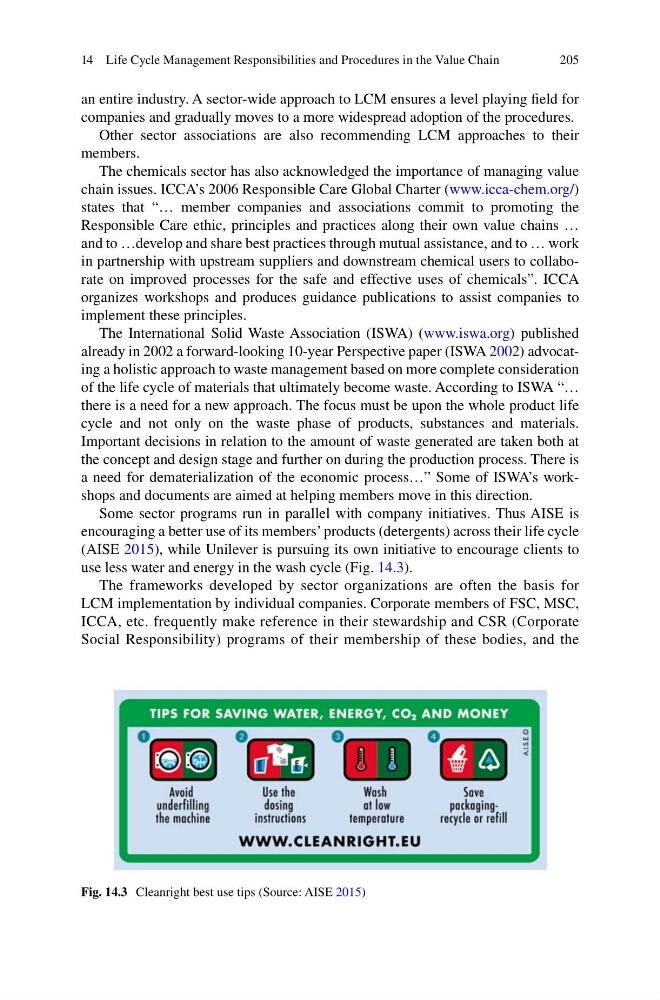
Some sector programs run in parallel with company initiatives. Thus AISE is
encouraging a better use of its members’ products (detergents) across their life cycle
(AISE 2015 ), while Unilever is pursuing its own initiative to encourage clients to
use less water and energy in the wash cycle (Fig. 14.3 ).
The frameworks developed by sector organizations are often the basis for
LCM implementation by individual companies. Corporate members of FSC, MSC,
ICCA, etc. frequently make reference in their stewardship and CSR (Corporate
Social Responsibility) programs of their membership of these bodies, and the
Fig. 14.3 Cleanright best use tips (Source: AISE 2015 )
14 Life Cycle Management Responsibilities and Procedures in the Value Chain
an entire industry. A sector-wide approach to LCM ensures a level playing fi eld for
companies and gradually moves to a more widespread adoption of the procedures.
Other sector associations are also recommending LCM approaches to their
members.
The chemicals sector has also acknowledged the importance of managing value
chain issues. ICCA’s 2006 Responsible Care Global Charter ( www.icca-chem.org/ )
states that “… member companies and associations commit to promoting the
Responsible Care ethic, principles and practices along their own value chains …
and to …develop and share best practices through mutual assistance, and to … work
in partnership with upstream suppliers and downstream chemical users to collaborate on improved processes for the safe and effective uses of chemicals”. ICCA
organizes workshops and produces guidance publications to assist companies to
implement these principles.
The International Solid Waste Association (ISWA) ( www.iswa.org ) published
already in 2002 a forward-looking 10-year Perspective paper (ISWA 2002 ) advocating a holistic approach to waste management based on more complete consideration
of the life cycle of materials that ultimately become waste. According to ISWA “…
there is a need for a new approach. The focus must be upon the whole product life
cycle and not only on the waste phase of products, substances and materials.
Important decisions in relation to the amount of waste generated are taken both at
the concept and design stage and further on during the production process. There is
a need for dematerialization of the economic process…” Some of ISWA’s workshops and documents are aimed at helping members move in this direction.
Some sector programs run in parallel with company initiatives. Thus AISE is
encouraging a better use of its members’ products (detergents) across their life cycle
(AISE 2015 ), while Unilever is pursuing its own initiative to encourage clients to
use less water and energy in the wash cycle (Fig. 14.3 ).
The frameworks developed by sector organizations are often the basis for
LCM implementation by individual companies. Corporate members of FSC, MSC,
ICCA, etc. frequently make reference in their stewardship and CSR (Corporate
Social Responsibility) programs of their membership of these bodies, and the
Fig. 14.3 Cleanright best use tips (Source: AISE 2015 )
14 Life Cycle Management Responsibilities and Procedures in the Value Chain