

204
improving the underlying metrics as, for example, practical materials accounting
procedures.
This concern with metrics is also a preoccupation of other business groups, many
of which have put substantial resources into developing appropriate measurement
and assessment techniques for common use. ICMM (International Council for
Mining and Metals) ( www.icmm.com ), for example, is a long-standing partner in
the UNEP/SETAC Life Cycle Initiative. ICMM has been advocating a deeper use of
‘sustainable materials management’ (SMM) thinking by minerals companies.
This direction is echoed by the Australian government and the Minerals Council
of Australian (MCA) in their advice to companies (Commonwealth of Australia
2006 ). The reach of the approach (up-stream suppliers to end-users), the breadth of
sustainability objectives, its basis in scientifi c assessment, the range of management
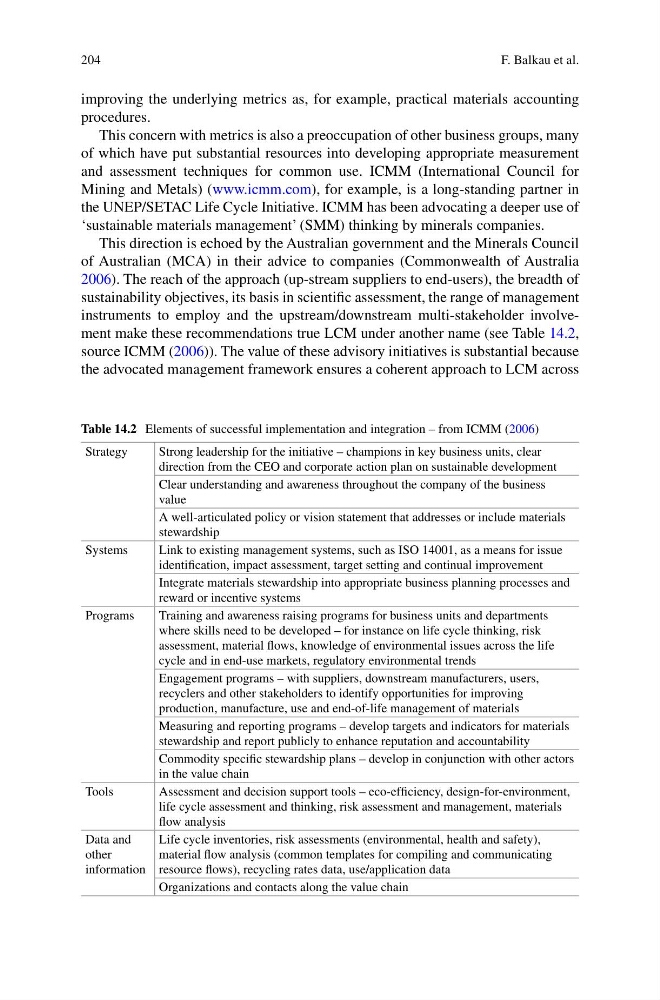
instruments to employ and the upstream/downstream multi-stakeholder involvement make these recommendations true LCM under another name (see Table 14.2 ,
source ICMM ( 2006 )). The value of these advisory initiatives is substantial because
the advocated management framework ensures a coherent approach to LCM across
Table 14.2 Elements of successful implementation and integration – from ICMM ( 2006 )
Strategy
Strong leadership for the initiative – champions in key business units, clear
direction from the CEO and corporate action plan on sustainable development
Clear understanding and awareness throughout the company of the business
value
A well-articulated policy or vision statement that addresses or include materials
stewardship
Systems
Link to existing management systems, such as ISO 14001, as a means for issue
identifi cation, impact assessment, target setting and continual improvement
Integrate materials stewardship into appropriate business planning processes and
reward or incentive systems
Programs
Training and awareness raising programs for business units and departments
where skills need to be developed – for instance on life cycle thinking, risk
assessment, material fl ows, knowledge of environmental issues across the life
cycle and in end-use markets, regulatory environmental trends
Engagement programs – with suppliers, downstream manufacturers, users,
recyclers and other stakeholders to identify opportunities for improving
production, manufacture, use and end-of-life management of materials
Measuring and reporting programs – develop targets and indicators for materials
stewardship and report publicly to enhance reputation and accountability
Commodity specifi c stewardship plans – develop in conjunction with other actors
in the value chain
Tools
Assessment and decision support tools – eco-effi ciency, design-for- environment,
life cycle assessment and thinking, risk assessment and management, materials
fl ow analysis
Data and
other
information
Life cycle inventories, risk assessments (environmental, health and safety),
material fl ow analysis (common templates for compiling and communicating
resource fl ows), recycling rates data, use/application data
Organizations and contacts along the value chain
F. Balkau et al.
improving the underlying metrics as, for example, practical materials accounting
procedures.
This concern with metrics is also a preoccupation of other business groups, many
of which have put substantial resources into developing appropriate measurement
and assessment techniques for common use. ICMM (International Council for
Mining and Metals) ( www.icmm.com ), for example, is a long-standing partner in
the UNEP/SETAC Life Cycle Initiative. ICMM has been advocating a deeper use of
‘sustainable materials management’ (SMM) thinking by minerals companies.
This direction is echoed by the Australian government and the Minerals Council
of Australian (MCA) in their advice to companies (Commonwealth of Australia
2006 ). The reach of the approach (up-stream suppliers to end-users), the breadth of
sustainability objectives, its basis in scientifi c assessment, the range of management
instruments to employ and the upstream/downstream multi-stakeholder involvement make these recommendations true LCM under another name (see Table 14.2 ,
source ICMM ( 2006 )). The value of these advisory initiatives is substantial because
the advocated management framework ensures a coherent approach to LCM across
Table 14.2 Elements of successful implementation and integration – from ICMM ( 2006 )
Strategy
Strong leadership for the initiative – champions in key business units, clear
direction from the CEO and corporate action plan on sustainable development
Clear understanding and awareness throughout the company of the business
value
A well-articulated policy or vision statement that addresses or include materials
stewardship
Systems
Link to existing management systems, such as ISO 14001, as a means for issue
identifi cation, impact assessment, target setting and continual improvement
Integrate materials stewardship into appropriate business planning processes and
reward or incentive systems
Programs
Training and awareness raising programs for business units and departments
where skills need to be developed – for instance on life cycle thinking, risk
assessment, material fl ows, knowledge of environmental issues across the life
cycle and in end-use markets, regulatory environmental trends
Engagement programs – with suppliers, downstream manufacturers, users,
recyclers and other stakeholders to identify opportunities for improving
production, manufacture, use and end-of-life management of materials
Measuring and reporting programs – develop targets and indicators for materials
stewardship and report publicly to enhance reputation and accountability
Commodity specifi c stewardship plans – develop in conjunction with other actors
in the value chain
Tools
Assessment and decision support tools – eco-effi ciency, design-for- environment,
life cycle assessment and thinking, risk assessment and management, materials
fl ow analysis
Data and
other
information
Life cycle inventories, risk assessments (environmental, health and safety),
material fl ow analysis (common templates for compiling and communicating
resource fl ows), recycling rates data, use/application data
Organizations and contacts along the value chain
F. Balkau et al.