

180
WI
N W LCIA
q t
ENV
j
m
j
j
j
i
n
i
i
=
⋅ ⋅
⋅
=
=
∑
∑
1
1
(13.2)
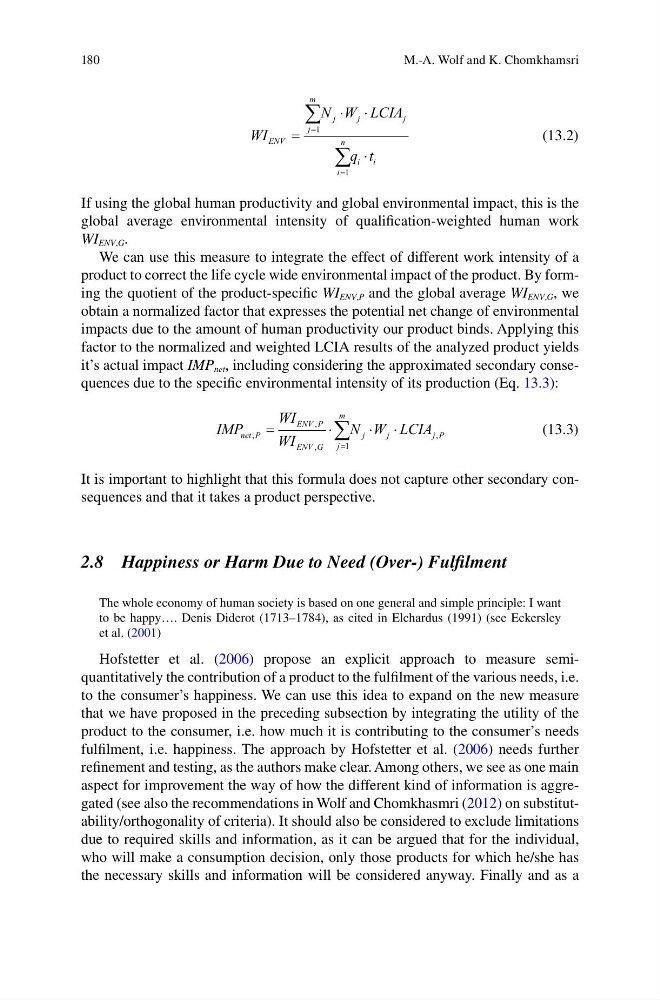
If using the global human productivity and global environmental impact, this is the
global average environmental intensity of qualification-weighted human work
WI ENV,G .
We can use this measure to integrate the effect of different work intensity of a
product to correct the life cycle wide environmental impact of the product. By forming the quotient of the product-specific WI ENV,P and the global average WI ENV,G , we
obtain a normalized factor that expresses the potential net change of environmental
impacts due to the amount of human productivity our product binds. Applying this
factor to the normalized and weighted LCIA results of the analyzed product yields
it’s actual impact IMP net , including considering the approximated secondary consequences due to the specific environmental intensity of its production (Eq. 13.3):
IMP
WI
WI
N W LCIA
net P
ENV P
ENV G
j
m
j
j
j P
,
,
,
,
=
⋅
⋅ ⋅
=
∑
1
(13.3)
It is important to highlight that this formula does not capture other secondary consequences and that it takes a product perspective.
2.8 Happiness or Harm Due to Need (Over-) Fulfilment
The whole economy of human society is based on one general and simple principle: I want
to be happy…. Denis Diderot (1713–1784), as cited in Elchardus (1991) (see Eckersley
et al. (2001)
Hofstetter et al. (2006) propose an explicit approach to measure semiquantitatively the contribution of a product to the fulfilment of the various needs, i.e.
to the consumer’s happiness. We can use this idea to expand on the new measure
that we have proposed in the preceding subsection by integrating the utility of the
product to the consumer, i.e. how much it is contributing to the consumer’s needs
fulfilment, i.e. happiness. The approach by Hofstetter et al. (2006) needs further
refinement and testing, as the authors make clear. Among others, we see as one main
aspect for improvement the way of how the different kind of information is aggregated (see also the recommendations in Wolf and Chomkhasmri (2012) on substitutability/orthogonality of criteria). It should also be considered to exclude limitations
due to required skills and information, as it can be argued that for the individual,
who will make a consumption decision, only those products for which he/she has
the necessary skills and information will be considered anyway. Finally and as a
M.-A. Wolf and K. Chomkhamsri
WI
N W LCIA
q t
ENV
j
m
j
j
j
i
n
i
i
=
⋅ ⋅
⋅
=
=
∑
∑
1
1
(13.2)
If using the global human productivity and global environmental impact, this is the
global average environmental intensity of qualification-weighted human work
WI ENV,G .
We can use this measure to integrate the effect of different work intensity of a
product to correct the life cycle wide environmental impact of the product. By forming the quotient of the product-specific WI ENV,P and the global average WI ENV,G , we
obtain a normalized factor that expresses the potential net change of environmental
impacts due to the amount of human productivity our product binds. Applying this
factor to the normalized and weighted LCIA results of the analyzed product yields
it’s actual impact IMP net , including considering the approximated secondary consequences due to the specific environmental intensity of its production (Eq. 13.3):
IMP
WI
WI
N W LCIA
net P
ENV P
ENV G
j
m
j
j
j P
,
,
,
,
=
⋅
⋅ ⋅
=
∑
1
(13.3)
It is important to highlight that this formula does not capture other secondary consequences and that it takes a product perspective.
2.8 Happiness or Harm Due to Need (Over-) Fulfilment
The whole economy of human society is based on one general and simple principle: I want
to be happy…. Denis Diderot (1713–1784), as cited in Elchardus (1991) (see Eckersley
et al. (2001)
Hofstetter et al. (2006) propose an explicit approach to measure semiquantitatively the contribution of a product to the fulfilment of the various needs, i.e.
to the consumer’s happiness. We can use this idea to expand on the new measure
that we have proposed in the preceding subsection by integrating the utility of the
product to the consumer, i.e. how much it is contributing to the consumer’s needs
fulfilment, i.e. happiness. The approach by Hofstetter et al. (2006) needs further
refinement and testing, as the authors make clear. Among others, we see as one main
aspect for improvement the way of how the different kind of information is aggregated (see also the recommendations in Wolf and Chomkhasmri (2012) on substitutability/orthogonality of criteria). It should also be considered to exclude limitations
due to required skills and information, as it can be argued that for the individual,
who will make a consumption decision, only those products for which he/she has
the necessary skills and information will be considered anyway. Finally and as a
M.-A. Wolf and K. Chomkhamsri