

179
Eco-efficiency, i.e. the quotient of price per environmental impact of a product
therefore is a useful indicator: in its most simple form, a twice as expensive product
of the same impact effectively reduces the ability of the consumer to spend the
money on consuming other goods (Huppes and Ishikawa 2005).
However, we argue here that the concept of eco-efficiency is not considering the
effect of additional consumption if the product is only produced cheaper, but a
higher profit is kept by the producer: this profit is used for investment by the producing company or distributed to the company owners, e.g. shareholders, and hence
available for additional consumption, the same way as it would be available to the
consumer of that product if instead the product price would be reduced. More precisely, all profits along the supply-chain (and of consumables during product use
and end-of-life services) need to be excluded from the economic component of ecoefficiency, to avoid this distortion.
This insight clarifies from a different perspective that the limiting factor in global
consumption is global production, which is obviously limited by the output of the
active labour force: If a product is produced with less workforce along its supplychain, the not anymore required workforce is available for producing more of this
product (or other products), hence increasing global production and consumption
and hence environmental impacts. And the more qualified this not anymore required
workforce is, the more overall production is increased, given the on average higher
productivity of the higher qualified workforce. In short: The higher the quotient of
the qualification-weighted amount of human working time q*t of a product and
overall (i.e. normalized and weighted) environmental impact over the life cycle of a
product, the less impacting the product, including considering the secondary effects
of freed human work productivity (what is structurally equivalent to the effect by
the enabled additional consumption by the product’s consumer due to additionally
available income).
7
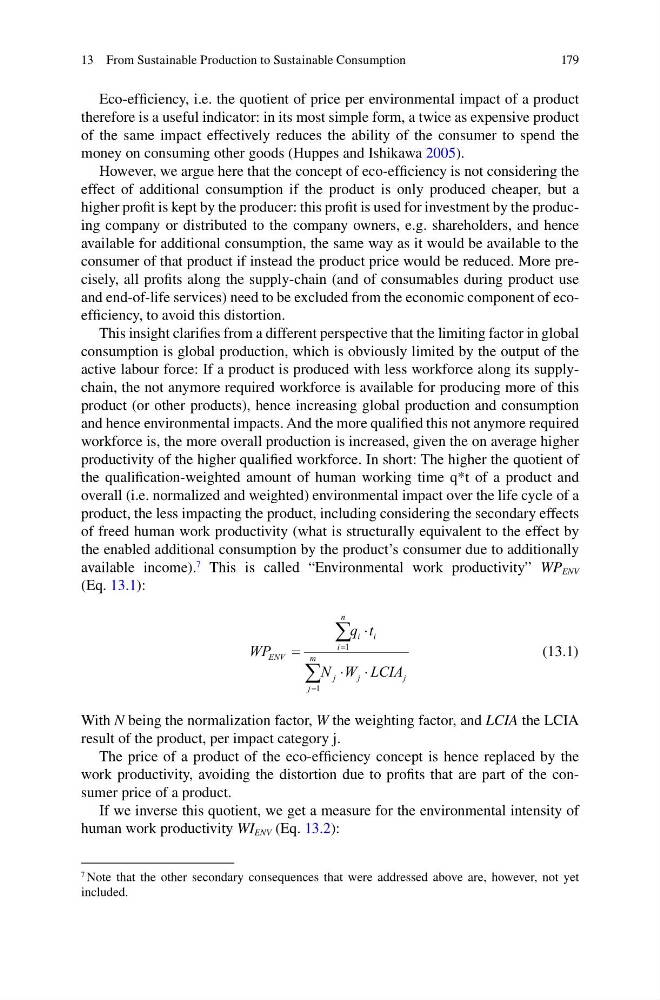
This is called “Environmental work productivity” WP ENV
(Eq. 13.1):
WP
q t
N W LCIA
ENV
i
n
i
i
j
m
j
j
j
=
⋅
⋅ ⋅
=
=
∑
∑
1
1
(13.1)
With N being the normalization factor, W the weighting factor, and LCIA the LCIA
result of the product, per impact category j.
The price of a product of the eco-efficiency concept is hence replaced by the
work productivity, avoiding the distortion due to profits that are part of the consumer price of a product.
If we inverse this quotient, we get a measure for the environmental intensity of
human work productivity WI ENV (Eq. 13.2):
7 Note that the other secondary consequences that were addressed above are, however, not yet
included.
13 From Sustainable Production to Sustainable Consumption
Eco-efficiency, i.e. the quotient of price per environmental impact of a product
therefore is a useful indicator: in its most simple form, a twice as expensive product
of the same impact effectively reduces the ability of the consumer to spend the
money on consuming other goods (Huppes and Ishikawa 2005).
However, we argue here that the concept of eco-efficiency is not considering the
effect of additional consumption if the product is only produced cheaper, but a
higher profit is kept by the producer: this profit is used for investment by the producing company or distributed to the company owners, e.g. shareholders, and hence
available for additional consumption, the same way as it would be available to the
consumer of that product if instead the product price would be reduced. More precisely, all profits along the supply-chain (and of consumables during product use
and end-of-life services) need to be excluded from the economic component of ecoefficiency, to avoid this distortion.
This insight clarifies from a different perspective that the limiting factor in global
consumption is global production, which is obviously limited by the output of the
active labour force: If a product is produced with less workforce along its supplychain, the not anymore required workforce is available for producing more of this
product (or other products), hence increasing global production and consumption
and hence environmental impacts. And the more qualified this not anymore required
workforce is, the more overall production is increased, given the on average higher
productivity of the higher qualified workforce. In short: The higher the quotient of
the qualification-weighted amount of human working time q*t of a product and
overall (i.e. normalized and weighted) environmental impact over the life cycle of a
product, the less impacting the product, including considering the secondary effects
of freed human work productivity (what is structurally equivalent to the effect by
the enabled additional consumption by the product’s consumer due to additionally
available income).
7
This is called “Environmental work productivity” WP ENV
(Eq. 13.1):
WP
q t
N W LCIA
ENV
i
n
i
i
j
m
j
j
j
=
⋅
⋅ ⋅
=
=
∑
∑
1
1
(13.1)
With N being the normalization factor, W the weighting factor, and LCIA the LCIA
result of the product, per impact category j.
The price of a product of the eco-efficiency concept is hence replaced by the
work productivity, avoiding the distortion due to profits that are part of the consumer price of a product.
If we inverse this quotient, we get a measure for the environmental intensity of
human work productivity WI ENV (Eq. 13.2):
7 Note that the other secondary consequences that were addressed above are, however, not yet
included.
13 From Sustainable Production to Sustainable Consumption