

138
LCA of spundyed fabrics
External context
1. Growing population
2. Air pollution in Asia
3. Water pollution and water
scarcity in Asia
4. Legislations in China, Sweden,
EU
5. NGO activity (Greenpeace,
IPE)
Business context (includes
stakeholders’ expectations)
1. SAC tools and awareness
building of industry to reduce
supply chain impacts, esp.
dyeing
2. Increasing water and power
tariffs of dyeing mills
3. Competitiveness of EU
producers
Business
Development
Marketing
Finding opportunities to use spun-dyed
fibres for different new applications (by
forming alliances and partnerships) with
the use of LCA-based insights
Communication to customers and
consumers on overall performance of
spun-dyed fibres compared to
conventional dyeing
a. Customers (brands/retailers): can improve overall performance of products, reduce supply chain impacts and reduce reputational
risks from NGOs (from dyeing mills)
b. Supply chain: can reduce costs of resources (energy, water and chemicals) and prevention of pollution, improvement of
environmental performance, reduction of operational risks due to NGO activity
C. NGOs: lower allegations on textile industry due to reduction of chemical pollution of water bodies and air pollution in Asia
d. Global and local community: get benefit from the reduction of problems related to resource and water scarcity (lower pollution from
dyeing mills), climate change, and lower health problems
For spun-dyed fibre producer:
-Differentiation in the market (with
a premium)
-Preferred supplier to customers
For customers (brands/retailers):
-Opportunities to innovate final
products with lower impacts
-Enhanced brand reputation and
legitimacy of supply chains
-Cost and operational risk reduction
Context and Drivers
Business
functions
Business decisions based on
understanding the life cycle
Sustainable value creation
opportunities
Stakeholders’ responses
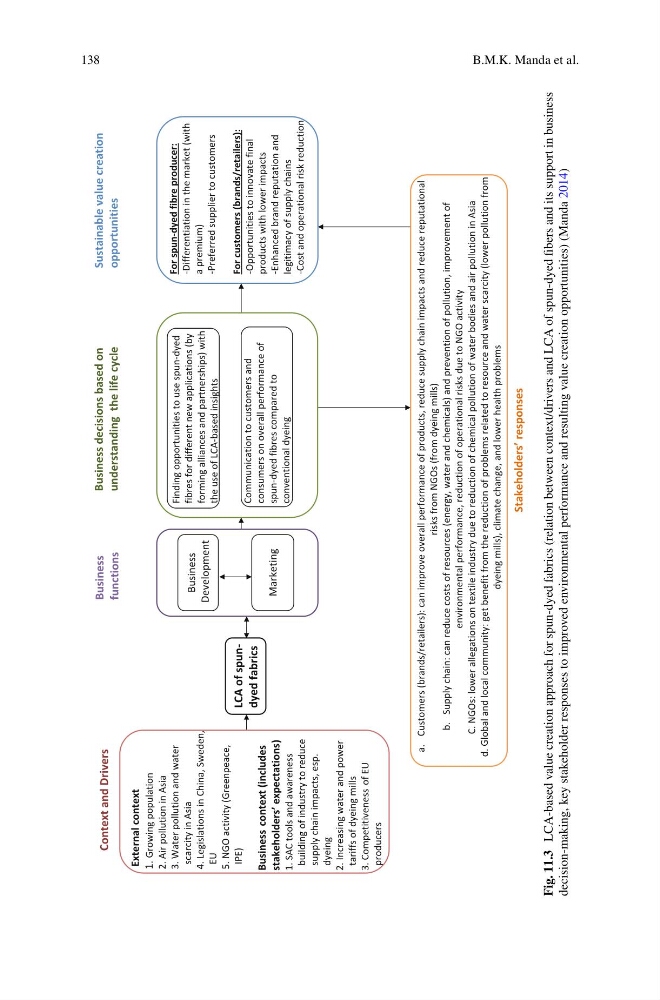
Fig. 11.3
LCA-based value creation approach for spun-dyed fabrics (relation between context/drivers and LCA of spun-dyed fi bers and its support in business
decision-making, key stakeholder responses to improved environmental performance and resulting value creation opportunities) (Manda 2014 )
B.M.K. Manda et al.
LCA of spundyed fabrics
External context
1. Growing population
2. Air pollution in Asia
3. Water pollution and water
scarcity in Asia
4. Legislations in China, Sweden,
EU
5. NGO activity (Greenpeace,
IPE)
Business context (includes
stakeholders’ expectations)
1. SAC tools and awareness
building of industry to reduce
supply chain impacts, esp.
dyeing
2. Increasing water and power
tariffs of dyeing mills
3. Competitiveness of EU
producers
Business
Development
Marketing
Finding opportunities to use spun-dyed
fibres for different new applications (by
forming alliances and partnerships) with
the use of LCA-based insights
Communication to customers and
consumers on overall performance of
spun-dyed fibres compared to
conventional dyeing
a. Customers (brands/retailers): can improve overall performance of products, reduce supply chain impacts and reduce reputational
risks from NGOs (from dyeing mills)
b. Supply chain: can reduce costs of resources (energy, water and chemicals) and prevention of pollution, improvement of
environmental performance, reduction of operational risks due to NGO activity
C. NGOs: lower allegations on textile industry due to reduction of chemical pollution of water bodies and air pollution in Asia
d. Global and local community: get benefit from the reduction of problems related to resource and water scarcity (lower pollution from
dyeing mills), climate change, and lower health problems
For spun-dyed fibre producer:
-Differentiation in the market (with
a premium)
-Preferred supplier to customers
For customers (brands/retailers):
-Opportunities to innovate final
products with lower impacts
-Enhanced brand reputation and
legitimacy of supply chains
-Cost and operational risk reduction
Context and Drivers
Business
functions
Business decisions based on
understanding the life cycle
Sustainable value creation
opportunities
Stakeholders’ responses
Fig. 11.3
LCA-based value creation approach for spun-dyed fabrics (relation between context/drivers and LCA of spun-dyed fi bers and its support in business
decision-making, key stakeholder responses to improved environmental performance and resulting value creation opportunities) (Manda 2014 )
B.M.K. Manda et al.