

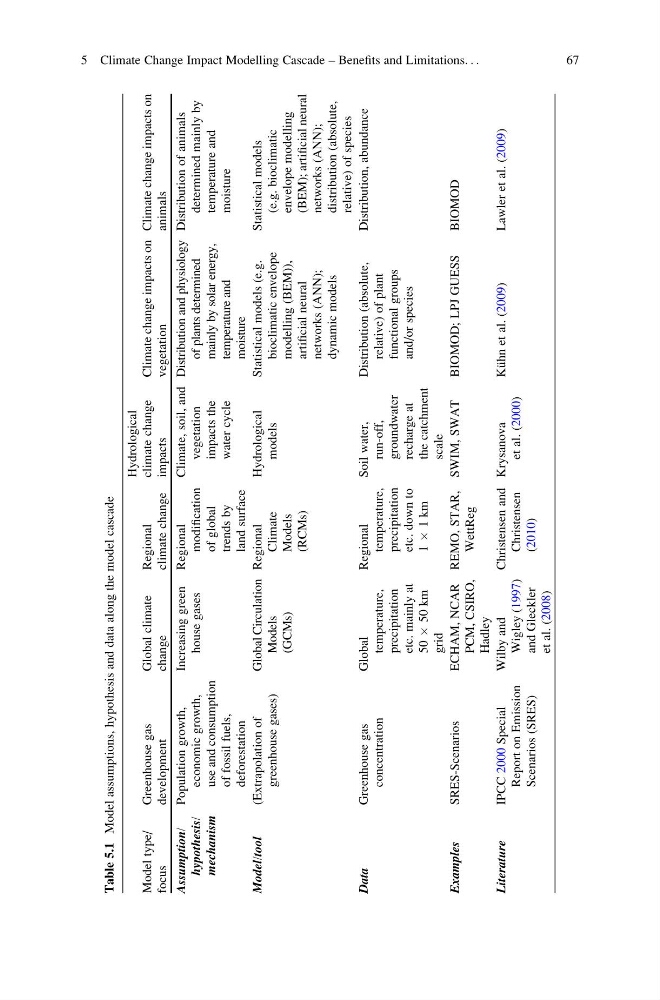
Table 5.1
Model assumptions, hypothesis and data along the model cascade
Model type/
focus
Greenhouse gas
development
Global climate
change
Regional
climate change
Hydrological
climate change
impacts
Climate change impacts on
vegetation
Climate change impacts on
animals
Assumption/
hypothesis/
mechanism
Population growth,
economic growth,
use and consumption
of fossil fuels,
deforestation
Increasing green
house gases
Regional
modification
of global
trends by
land surface
Climate, soil, and
vegetation
impacts the
water cycle
Distribution and physiology
of plants determined
mainly by solar energy,
temperature and
moisture
Distribution of animals
determined mainly by
temperature and
moisture
Model/tool
(Extrapolation of
greenhouse gases)
Global Circulation
Models
(GCMs)
Regional
Climate
Models
(RCMs)
Hydrological
models
Statistical models (e.g.
bioclimatic envelope
modelling (BEM)),
artificial neural
networks (ANN);
dynamic models
Statistical models
(e.g. bioclimatic
envelope modelling
(BEM); artificial neural
networks (ANN);
distribution (absolute,
relative) of species
Data
Greenhouse gas
concentration
Global
temperature,
precipitation
etc. mainly at
50
 50 km
grid
Regional
temperature,
precipitation
etc. down to
1
 1 km
Soil water,
run-off,
groundwater
recharge at
the catchment
scale
Distribution (absolute,
relative) of plant
functional groups
and/or species
Distribution, abundance
Examples
SRES-Scenarios
ECHAM, NCAR
PCM, CSIRO,
Hadley
REMO, STAR,
WettReg
SWIM, SWAT
BIOMOD; LPJ GUESS
BIOMOD
Literature
IPCC 2000 Special
Report on Emission
Scenarios (SRES)
Wilby and
Wigley (1997)
and Gleckler
et al. (2008)
Christensen and
Christensen
(2010)
Krysanova
et al. (2000)
Ku ¨hn
et al. (2009)
Lawler et al. (2009)
5 Climate Change Impact Modelling Cascade – Benefits and Limitations. . .
67
Model assumptions, hypothesis and data along the model cascade
Model type/
focus
Greenhouse gas
development
Global climate
change
Regional
climate change
Hydrological
climate change
impacts
Climate change impacts on
vegetation
Climate change impacts on
animals
Assumption/
hypothesis/
mechanism
Population growth,
economic growth,
use and consumption
of fossil fuels,
deforestation
Increasing green
house gases
Regional
modification
of global
trends by
land surface
Climate, soil, and
vegetation
impacts the
water cycle
Distribution and physiology
of plants determined
mainly by solar energy,
temperature and
moisture
Distribution of animals
determined mainly by
temperature and
moisture
Model/tool
(Extrapolation of
greenhouse gases)
Global Circulation
Models
(GCMs)
Regional
Climate
Models
(RCMs)
Hydrological
models
Statistical models (e.g.
bioclimatic envelope
modelling (BEM)),
artificial neural
networks (ANN);
dynamic models
Statistical models
(e.g. bioclimatic
envelope modelling
(BEM); artificial neural
networks (ANN);
distribution (absolute,
relative) of species
Data
Greenhouse gas
concentration
Global
temperature,
precipitation
etc. mainly at
50
 50 km
grid
Regional
temperature,
precipitation
etc. down to
1
 1 km
Soil water,
run-off,
groundwater
recharge at
the catchment
scale
Distribution (absolute,
relative) of plant
functional groups
and/or species
Distribution, abundance
Examples
SRES-Scenarios
ECHAM, NCAR
PCM, CSIRO,
Hadley
REMO, STAR,
WettReg
SWIM, SWAT
BIOMOD; LPJ GUESS
BIOMOD
Literature
IPCC 2000 Special
Report on Emission
Scenarios (SRES)
Wilby and
Wigley (1997)
and Gleckler
et al. (2008)
Christensen and
Christensen
(2010)
Krysanova
et al. (2000)
Ku ¨hn
et al. (2009)
Lawler et al. (2009)
5 Climate Change Impact Modelling Cascade – Benefits and Limitations. . .
67