

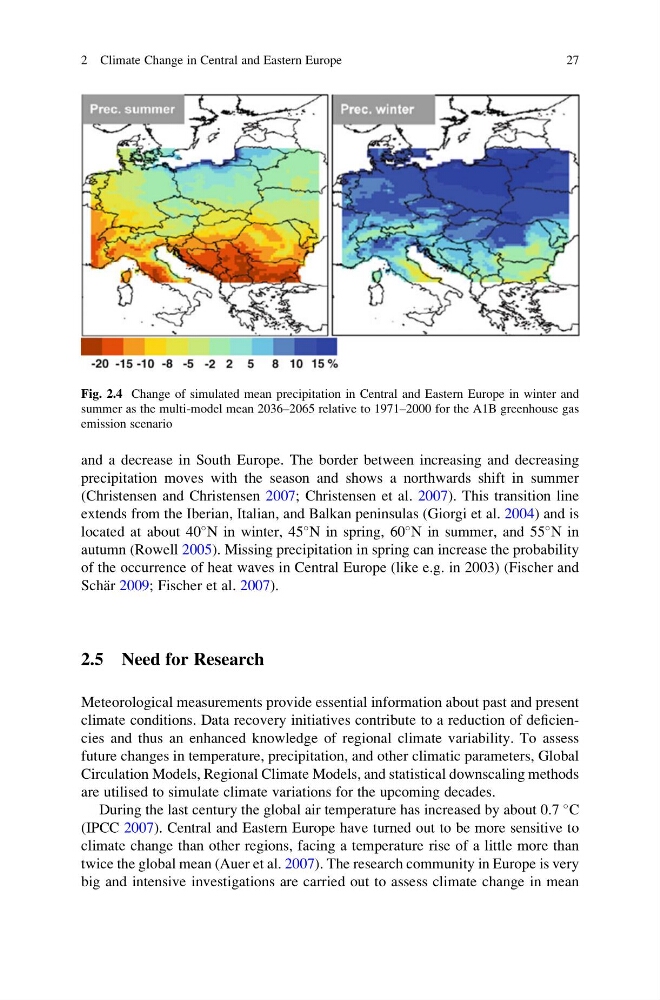
and a decrease in South Europe. The border between increasing and decreasing
precipitation moves with the season and shows a northwards shift in summer
(Christensen and Christensen 2007; Christensen et al. 2007). This transition line
extends from the Iberian, Italian, and Balkan peninsulas (Giorgi et al. 2004) and is
located at about 40
N in winter, 45
N in spring, 60
N in summer, and 55
N in
autumn (Rowell 2005). Missing precipitation in spring can increase the probability
of the occurrence of heat waves in Central Europe (like e.g. in 2003) (Fischer and
Scha ¨r 2009; Fischer et al. 2007).
2.5 Need for Research
Meteorological measurements provide essential information about past and present
climate conditions. Data recovery initiatives contribute to a reduction of deficiencies and thus an enhanced knowledge of regional climate variability. To assess
future changes in temperature, precipitation, and other climatic parameters, Global
Circulation Models, Regional Climate Models, and statistical downscaling methods
are utilised to simulate climate variations for the upcoming decades.
During the last century the global air temperature has increased by about 0.7
C
(IPCC 2007). Central and Eastern Europe have turned out to be more sensitive to
climate change than other regions, facing a temperature rise of a little more than
twice the global mean (Auer et al. 2007). The research community in Europe is very
big and intensive investigations are carried out to assess climate change in mean
Fig. 2.4 Change of simulated mean precipitation in Central and Eastern Europe in winter and
summer as the multi-model mean 2036–2065 relative to 1971–2000 for the A1B greenhouse gas
emission scenario
2 Climate Change in Central and Eastern Europe
27
precipitation moves with the season and shows a northwards shift in summer
(Christensen and Christensen 2007; Christensen et al. 2007). This transition line
extends from the Iberian, Italian, and Balkan peninsulas (Giorgi et al. 2004) and is
located at about 40
N in winter, 45
N in spring, 60
N in summer, and 55
N in
autumn (Rowell 2005). Missing precipitation in spring can increase the probability
of the occurrence of heat waves in Central Europe (like e.g. in 2003) (Fischer and
Scha ¨r 2009; Fischer et al. 2007).
2.5 Need for Research
Meteorological measurements provide essential information about past and present
climate conditions. Data recovery initiatives contribute to a reduction of deficiencies and thus an enhanced knowledge of regional climate variability. To assess
future changes in temperature, precipitation, and other climatic parameters, Global
Circulation Models, Regional Climate Models, and statistical downscaling methods
are utilised to simulate climate variations for the upcoming decades.
During the last century the global air temperature has increased by about 0.7
C
(IPCC 2007). Central and Eastern Europe have turned out to be more sensitive to
climate change than other regions, facing a temperature rise of a little more than
twice the global mean (Auer et al. 2007). The research community in Europe is very
big and intensive investigations are carried out to assess climate change in mean
Fig. 2.4 Change of simulated mean precipitation in Central and Eastern Europe in winter and
summer as the multi-model mean 2036–2065 relative to 1971–2000 for the A1B greenhouse gas
emission scenario
2 Climate Change in Central and Eastern Europe
27