

precipitation events display an overwhelmingly heterogeneous picture. Only a
statistical, not strongly significant tendency towards weaker 1-day and 5-day precipitation events is found in the south-eastern parts of Austria. In eastern and south-eastern
Austria an intensification of precipitation events larger than 20 mm/day can be
identified. On the other hand, consecutive dry days show a clear geographic pattern
south of the alpine divide with a trend towards longer dry periods.
Warmer temperatures should result in a reduced amount of solid precipitation,
which means less snow during the cold season in relation to the annual total
precipitation amount. A pronounced difference between mountains and valleys
can be expected due to the different temperature level. In the lowlands, winters
have experienced more and more rain rather than snow, whereas core months of
winter in the high Alps have not had much change. The snow deficit comes into
effect in summer with negative consequences for Alpine glaciers.
Measurements of 51 stations evenly distributed, homogenised and averaged over
the territory of Poland confirmed the rising of annual temperature for the second half
of the twentieth century (Degirmendzic et al. 2004). It is obvious that not all months
contributed to the annual temperature increase of approximately 1
C; however, the
most pronounced warming was found in spring. Extreme temperatures have been
studied by Wibig and Glowicki (2002). Poland belongs to the group of countries in
which a stronger increase of minimum temperature than maximum temperature
caused a decrease of the daily temperature range (DTR) at most stations. This effect
correlated with increasing cloudiness, however could not be found in the GAR. With
rising minimum temperature, Poland experienced a prolongation of the frost-free
season. At the same time warmer temperatures and the frequency of hot weather
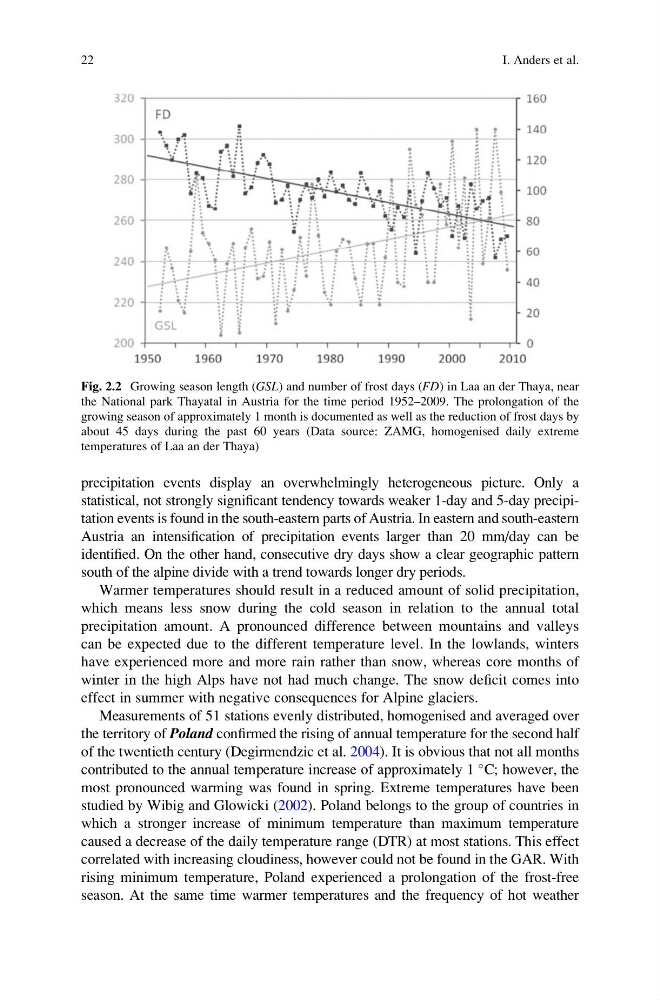
Fig. 2.2 Growing season length (GSL) and number of frost days (FD) in Laa an der Thaya, near
the National park Thayatal in Austria for the time period 1952–2009. The prolongation of the
growing season of approximately 1 month is documented as well as the reduction of frost days by
about 45 days during the past 60 years (Data source: ZAMG, homogenised daily extreme
temperatures of Laa an der Thaya)
22
I. Anders et al.
statistical, not strongly significant tendency towards weaker 1-day and 5-day precipitation events is found in the south-eastern parts of Austria. In eastern and south-eastern
Austria an intensification of precipitation events larger than 20 mm/day can be
identified. On the other hand, consecutive dry days show a clear geographic pattern
south of the alpine divide with a trend towards longer dry periods.
Warmer temperatures should result in a reduced amount of solid precipitation,
which means less snow during the cold season in relation to the annual total
precipitation amount. A pronounced difference between mountains and valleys
can be expected due to the different temperature level. In the lowlands, winters
have experienced more and more rain rather than snow, whereas core months of
winter in the high Alps have not had much change. The snow deficit comes into
effect in summer with negative consequences for Alpine glaciers.
Measurements of 51 stations evenly distributed, homogenised and averaged over
the territory of Poland confirmed the rising of annual temperature for the second half
of the twentieth century (Degirmendzic et al. 2004). It is obvious that not all months
contributed to the annual temperature increase of approximately 1
C; however, the
most pronounced warming was found in spring. Extreme temperatures have been
studied by Wibig and Glowicki (2002). Poland belongs to the group of countries in
which a stronger increase of minimum temperature than maximum temperature
caused a decrease of the daily temperature range (DTR) at most stations. This effect
correlated with increasing cloudiness, however could not be found in the GAR. With
rising minimum temperature, Poland experienced a prolongation of the frost-free
season. At the same time warmer temperatures and the frequency of hot weather
Fig. 2.2 Growing season length (GSL) and number of frost days (FD) in Laa an der Thaya, near
the National park Thayatal in Austria for the time period 1952–2009. The prolongation of the
growing season of approximately 1 month is documented as well as the reduction of frost days by
about 45 days during the past 60 years (Data source: ZAMG, homogenised daily extreme
temperatures of Laa an der Thaya)
22
I. Anders et al.