

urban trends and many other disturbances (Aguilar et al. 2003). Different tests and
correction procedures have been developed to remove inhomogeneities; however
these tests concentrate mainly on monthly temperature and precipitation data. Daily
data requires more sophisticated methods, taking not only the mean but the whole
frequency distribution of an element into account (cf. Della-Marta and Wanner
2006; Mestre et al. 2009).
Nevertheless, some groups have expended great efforts to create and analyse
regional long-term data sets. For the southern part of Central Europe [called
the Greater Alpine Region (GAR)] the Historical Instrumental Time Series for the
Greater Alpine Region (HISTALP) database
3 has been developed. Its temperature
and air pressure series date back to 1760, precipitation to 1800, cloudiness to
the 1840s and sunshine to the 1880s. In those earlier times the network density was
rather sparse; only since national weather services have been founded in the
mid-nineteenth century the number of stations has been steadily increasing. This
growth allows for extensive climate information during the twentieth century.
Not all measured or observed climatological data has been made available for
research or practical applications. Some of the data has been lost forever destroyed
during wars or other misfortunes, some other data is still left in archives, libraries or
other locations in its original paper sheets, some data has been printed in yearbooks
or newspapers that have not been digitised until now. That is why a number of
countries and institutions have started data recovery/rescue activities to make as
much data available as possible. Such efforts have recently begun in 2011 for the
Carpathian region; Hungary, Poland, Romania, Serbia, Slovakia and Ukraine have
made great efforts to improve their database over the last 50 years. However,
particularly in Eastern European countries, there has been a decline in the number
of meteorological observation stations after the political changes of the early 90s. In
some cases, the number decreased to the same level as during the 60s. For the
Mediterranean Region the initiative WMO-MEDARE
4 was born under the auspice
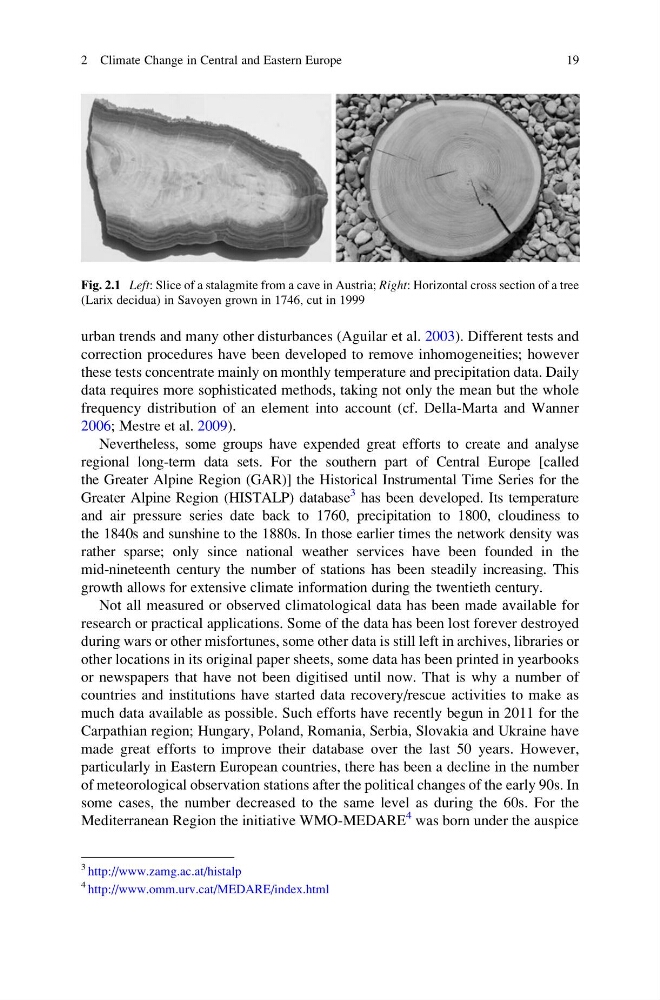
Fig. 2.1 Left: Slice of a stalagmite from a cave in Austria; Right: Horizontal cross section of a tree
(Larix decidua) in Savoyen grown in 1746, cut in 1999
3 http://www.zamg.ac.at/histalp
4 http://www.omm.urv.cat/MEDARE/index.html
2 Climate Change in Central and Eastern Europe
19
correction procedures have been developed to remove inhomogeneities; however
these tests concentrate mainly on monthly temperature and precipitation data. Daily
data requires more sophisticated methods, taking not only the mean but the whole
frequency distribution of an element into account (cf. Della-Marta and Wanner
2006; Mestre et al. 2009).
Nevertheless, some groups have expended great efforts to create and analyse
regional long-term data sets. For the southern part of Central Europe [called
the Greater Alpine Region (GAR)] the Historical Instrumental Time Series for the
Greater Alpine Region (HISTALP) database
3 has been developed. Its temperature
and air pressure series date back to 1760, precipitation to 1800, cloudiness to
the 1840s and sunshine to the 1880s. In those earlier times the network density was
rather sparse; only since national weather services have been founded in the
mid-nineteenth century the number of stations has been steadily increasing. This
growth allows for extensive climate information during the twentieth century.
Not all measured or observed climatological data has been made available for
research or practical applications. Some of the data has been lost forever destroyed
during wars or other misfortunes, some other data is still left in archives, libraries or
other locations in its original paper sheets, some data has been printed in yearbooks
or newspapers that have not been digitised until now. That is why a number of
countries and institutions have started data recovery/rescue activities to make as
much data available as possible. Such efforts have recently begun in 2011 for the
Carpathian region; Hungary, Poland, Romania, Serbia, Slovakia and Ukraine have
made great efforts to improve their database over the last 50 years. However,
particularly in Eastern European countries, there has been a decline in the number
of meteorological observation stations after the political changes of the early 90s. In
some cases, the number decreased to the same level as during the 60s. For the
Mediterranean Region the initiative WMO-MEDARE
4 was born under the auspice
Fig. 2.1 Left: Slice of a stalagmite from a cave in Austria; Right: Horizontal cross section of a tree
(Larix decidua) in Savoyen grown in 1746, cut in 1999
3 http://www.zamg.ac.at/histalp
4 http://www.omm.urv.cat/MEDARE/index.html
2 Climate Change in Central and Eastern Europe
19