

In order to estimate and evaluate potential impacts of climate change-induced
gradual modifications of site and environmental conditions on the typical species
composition of forest habitat types, climate-induced shifts of tree species and related
plant associations were simulated. Following the approach by Schlutow and Huebener
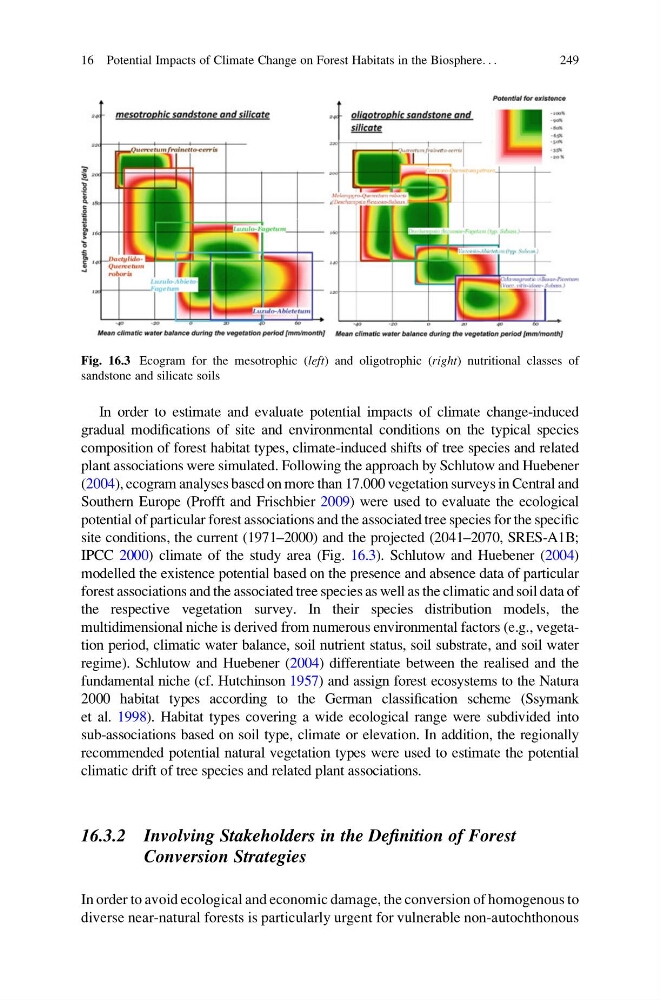
(2004), ecogram analyses based on more than 17.000 vegetation surveys in Central and
Southern Europe (Profft and Frischbier 2009) were used to evaluate the ecological
potential of particular forest associations and the associated tree species for the specific
site conditions, the current (1971–2000) and the projected (2041–2070, SRES-A1B;
IPCC 2000) climate of the study area (Fig. 16.3). Schlutow and Huebener (2004)
modelled the existence potential based on the presence and absence data of particular
forest associations and the associated tree species as well as the climatic and soil data of
the respective vegetation survey. In their species distribution models, the
multidimensional niche is derived from numerous environmental factors (e.g., vegetation period, climatic water balance, soil nutrient status, soil substrate, and soil water
regime). Schlutow and Huebener (2004) differentiate between the realised and the
fundamental niche (cf. Hutchinson 1957) and assign forest ecosystems to the Natura
2000 habitat types according to the German classification scheme (Ssymank
et al. 1998). Habitat types covering a wide ecological range were subdivided into
sub-associations based on soil type, climate or elevation. In addition, the regionally
recommended potential natural vegetation types were used to estimate the potential
climatic drift of tree species and related plant associations.
16.3.2 Involving Stakeholders in the Definition of Forest
Conversion Strategies
In order to avoid ecological and economic damage, the conversion of homogenous to
diverse near-natural forests is particularly urgent for vulnerable non-autochthonous
Fig. 16.3 Ecogram for the mesotrophic (left) and oligotrophic (right) nutritional classes of
sandstone and silicate soils
16 Potential Impacts of Climate Change on Forest Habitats in the Biosphere. . .
249
gradual modifications of site and environmental conditions on the typical species
composition of forest habitat types, climate-induced shifts of tree species and related
plant associations were simulated. Following the approach by Schlutow and Huebener
(2004), ecogram analyses based on more than 17.000 vegetation surveys in Central and
Southern Europe (Profft and Frischbier 2009) were used to evaluate the ecological
potential of particular forest associations and the associated tree species for the specific
site conditions, the current (1971–2000) and the projected (2041–2070, SRES-A1B;
IPCC 2000) climate of the study area (Fig. 16.3). Schlutow and Huebener (2004)
modelled the existence potential based on the presence and absence data of particular
forest associations and the associated tree species as well as the climatic and soil data of
the respective vegetation survey. In their species distribution models, the
multidimensional niche is derived from numerous environmental factors (e.g., vegetation period, climatic water balance, soil nutrient status, soil substrate, and soil water
regime). Schlutow and Huebener (2004) differentiate between the realised and the
fundamental niche (cf. Hutchinson 1957) and assign forest ecosystems to the Natura
2000 habitat types according to the German classification scheme (Ssymank
et al. 1998). Habitat types covering a wide ecological range were subdivided into
sub-associations based on soil type, climate or elevation. In addition, the regionally
recommended potential natural vegetation types were used to estimate the potential
climatic drift of tree species and related plant associations.
16.3.2 Involving Stakeholders in the Definition of Forest
Conversion Strategies
In order to avoid ecological and economic damage, the conversion of homogenous to
diverse near-natural forests is particularly urgent for vulnerable non-autochthonous
Fig. 16.3 Ecogram for the mesotrophic (left) and oligotrophic (right) nutritional classes of
sandstone and silicate soils
16 Potential Impacts of Climate Change on Forest Habitats in the Biosphere. . .
249