

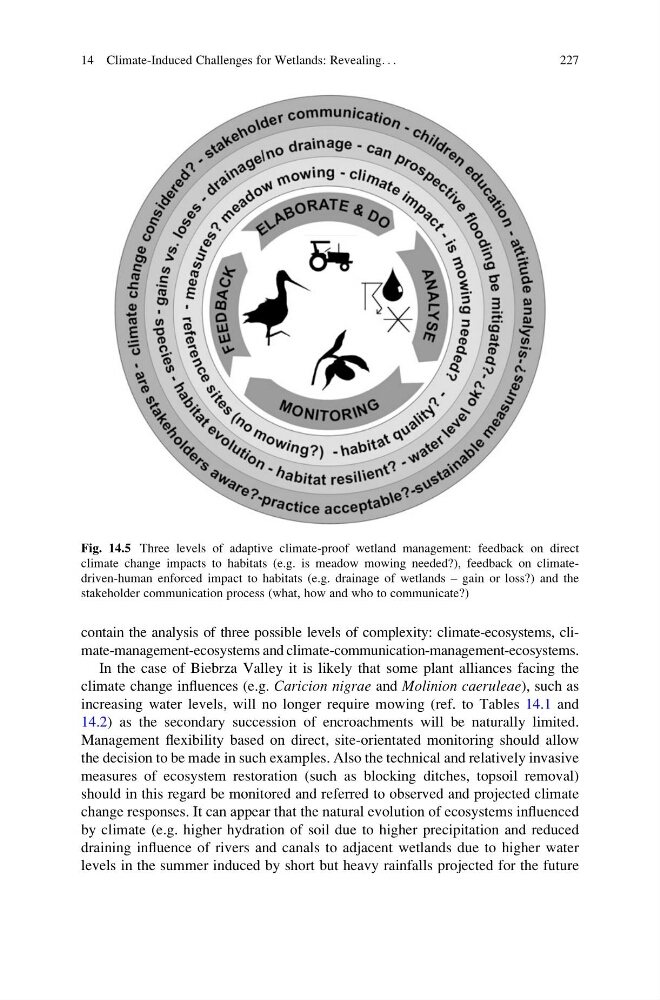
contain the analysis of three possible levels of complexity: climate-ecosystems, climate-management-ecosystems and climate-communication-management-ecosystems.
In the case of Biebrza Valley it is likely that some plant alliances facing the
climate change influences (e.g. Caricion nigrae and Molinion caeruleae), such as
increasing water levels, will no longer require mowing (ref. to Tables 14.1 and
14.2) as the secondary succession of encroachments will be naturally limited.
Management flexibility based on direct, site-orientated monitoring should allow
the decision to be made in such examples. Also the technical and relatively invasive
measures of ecosystem restoration (such as blocking ditches, topsoil removal)
should in this regard be monitored and referred to observed and projected climate
change responses. It can appear that the natural evolution of ecosystems influenced
by climate (e.g. higher hydration of soil due to higher precipitation and reduced
draining influence of rivers and canals to adjacent wetlands due to higher water
levels in the summer induced by short but heavy rainfalls projected for the future
Fig. 14.5 Three levels of adaptive climate-proof wetland management: feedback on direct
climate change impacts to habitats (e.g. is meadow mowing needed?), feedback on climatedriven-human enforced impact to habitats (e.g. drainage of wetlands – gain or loss?) and the
stakeholder communication process (what, how and who to communicate?)
14 Climate-Induced Challenges for Wetlands: Revealing. . .
227
In the case of Biebrza Valley it is likely that some plant alliances facing the
climate change influences (e.g. Caricion nigrae and Molinion caeruleae), such as
increasing water levels, will no longer require mowing (ref. to Tables 14.1 and
14.2) as the secondary succession of encroachments will be naturally limited.
Management flexibility based on direct, site-orientated monitoring should allow
the decision to be made in such examples. Also the technical and relatively invasive
measures of ecosystem restoration (such as blocking ditches, topsoil removal)
should in this regard be monitored and referred to observed and projected climate
change responses. It can appear that the natural evolution of ecosystems influenced
by climate (e.g. higher hydration of soil due to higher precipitation and reduced
draining influence of rivers and canals to adjacent wetlands due to higher water
levels in the summer induced by short but heavy rainfalls projected for the future
Fig. 14.5 Three levels of adaptive climate-proof wetland management: feedback on direct
climate change impacts to habitats (e.g. is meadow mowing needed?), feedback on climatedriven-human enforced impact to habitats (e.g. drainage of wetlands – gain or loss?) and the
stakeholder communication process (what, how and who to communicate?)
14 Climate-Induced Challenges for Wetlands: Revealing. . .
227