

Nevertheless, human influences, specially uncontrolled tourism (ski-resorts, recreation activities) still remains the most important impacts on the rock ptarmigan
population in the Alps and Pyrenees (Storch 2007). As a consequence of mass tourism
the population of Corvus species, which attack chicks and reduce breeding success,
increase (Storch and Leidenberger 2003; Watson and Moss 2004). Although
responses of the species to human disturbances differ between areas, mitigating
human disturbances in core breeding areas is essential (Ellmauer et al. 2005).
The species distribution area in Slovenian Alps encompasses the Julian Alps, the
Karavanke and the Kamnis ˇko-Savinjske Alps (Geister 1995). Its population in
Triglav National Park is estimated at 100–300 breeding pairs (Janc ˇar 1997). Due
to the lack of surveys on rock ptarmigan in Slovenian Alps, no adequate published
data on species population dynamics and distribution is available. Hence, there is a
need for knowledge on its distribution, population density and trends, as well as a
need to understand the disturbances that are influencing the species’ population
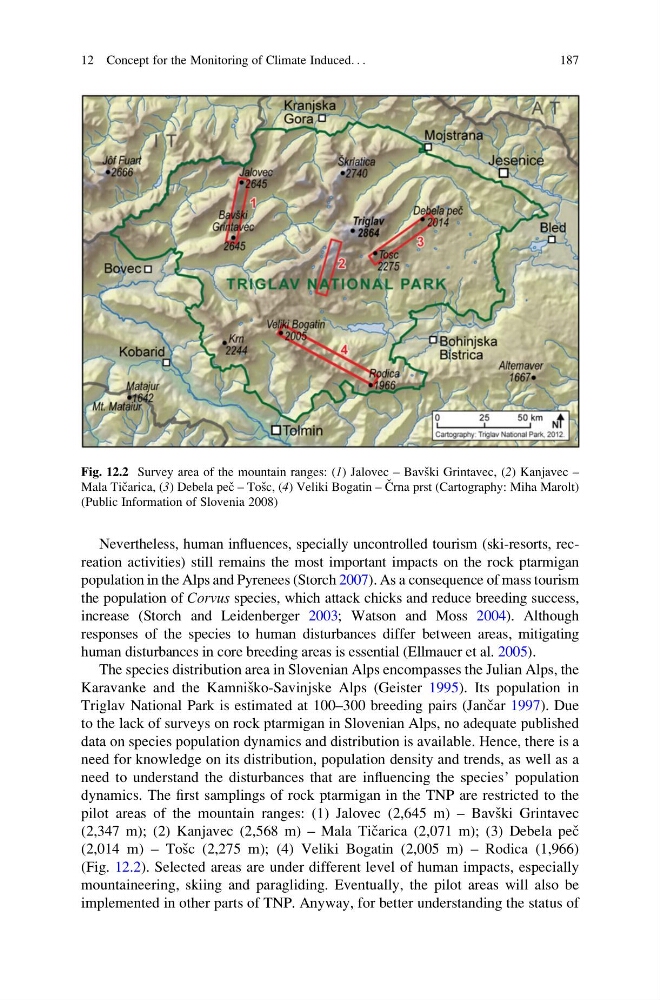
dynamics. The first samplings of rock ptarmigan in the TNP are restricted to the
pilot areas of the mountain ranges: (1) Jalovec (2,645 m) – Bavs ˇki Grintavec
(2,347 m); (2) Kanjavec (2,568 m) – Mala Tic ˇarica (2,071 m); (3) Debela pec ˇ
(2,014 m) – Tos ˇc (2,275 m); (4) Veliki Bogatin (2,005 m) – Rodica (1,966)
(Fig. 12.2). Selected areas are under different level of human impacts, especially
mountaineering, skiing and paragliding. Eventually, the pilot areas will also be
implemented in other parts of TNP. Anyway, for better understanding the status of
Fig. 12.2 Survey area of the mountain ranges: (1) Jalovec – Bavs ˇki Grintavec, (2) Kanjavec –
Mala Tic ˇarica, (3) Debela pec ˇ – Tos ˇc, (4) Veliki Bogatin – C ˇ rna prst (Cartography: Miha Marolt)
(Public Information of Slovenia 2008)
12 Concept for the Monitoring of Climate Induced. . .
187
population in the Alps and Pyrenees (Storch 2007). As a consequence of mass tourism
the population of Corvus species, which attack chicks and reduce breeding success,
increase (Storch and Leidenberger 2003; Watson and Moss 2004). Although
responses of the species to human disturbances differ between areas, mitigating
human disturbances in core breeding areas is essential (Ellmauer et al. 2005).
The species distribution area in Slovenian Alps encompasses the Julian Alps, the
Karavanke and the Kamnis ˇko-Savinjske Alps (Geister 1995). Its population in
Triglav National Park is estimated at 100–300 breeding pairs (Janc ˇar 1997). Due
to the lack of surveys on rock ptarmigan in Slovenian Alps, no adequate published
data on species population dynamics and distribution is available. Hence, there is a
need for knowledge on its distribution, population density and trends, as well as a
need to understand the disturbances that are influencing the species’ population
dynamics. The first samplings of rock ptarmigan in the TNP are restricted to the
pilot areas of the mountain ranges: (1) Jalovec (2,645 m) – Bavs ˇki Grintavec
(2,347 m); (2) Kanjavec (2,568 m) – Mala Tic ˇarica (2,071 m); (3) Debela pec ˇ
(2,014 m) – Tos ˇc (2,275 m); (4) Veliki Bogatin (2,005 m) – Rodica (1,966)
(Fig. 12.2). Selected areas are under different level of human impacts, especially
mountaineering, skiing and paragliding. Eventually, the pilot areas will also be
implemented in other parts of TNP. Anyway, for better understanding the status of
Fig. 12.2 Survey area of the mountain ranges: (1) Jalovec – Bavs ˇki Grintavec, (2) Kanjavec –
Mala Tic ˇarica, (3) Debela pec ˇ – Tos ˇc, (4) Veliki Bogatin – C ˇ rna prst (Cartography: Miha Marolt)
(Public Information of Slovenia 2008)
12 Concept for the Monitoring of Climate Induced. . .
187