

11.4 Expected Results of Climate Change
Impacts on Peat Bog Ecosystems
According to the results of other studies on peatbog and fen vegetation (Dakskobler
et al. 2011; Graf et al. 2010) the occurrence of different plant species seems to be a
good indicator for detecting early environmental changes. Earliest changes will be
most probably detected according to the composition of different Sphagnum species,
species abundances, the decrease of indicator species for low temperature, high
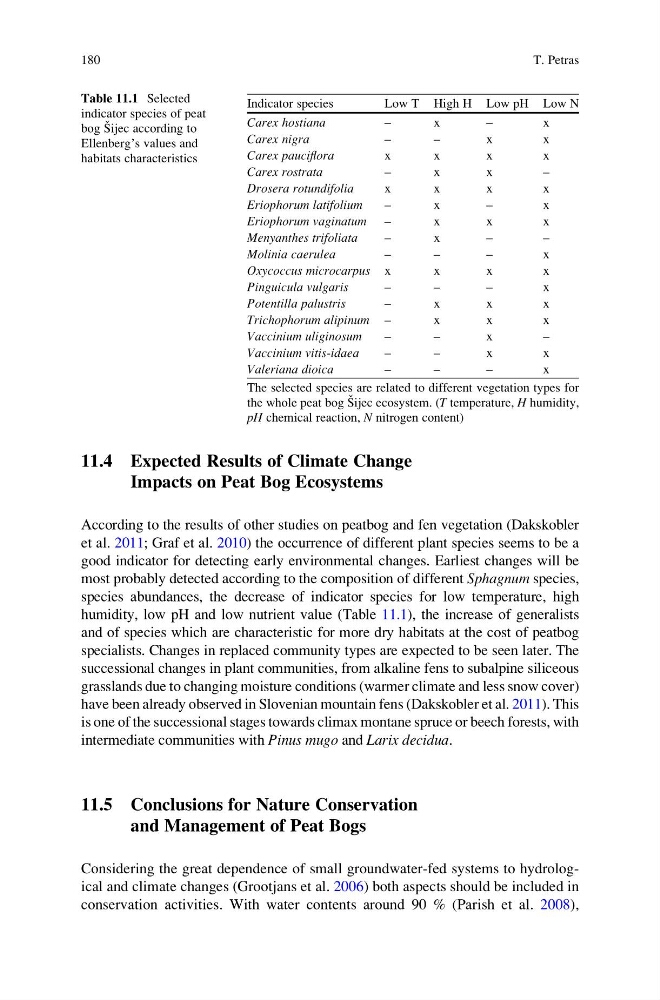
humidity, low pH and low nutrient value (Table 11.1), the increase of generalists
and of species which are characteristic for more dry habitats at the cost of peatbog
specialists. Changes in replaced community types are expected to be seen later. The
successional changes in plant communities, from alkaline fens to subalpine siliceous
grasslands due to changing moisture conditions (warmer climate and less snow cover)
have been already observed in Slovenian mountain fens (Dakskobler et al. 2011). This
is one of the successional stages towards climax montane spruce or beech forests, with
intermediate communities with Pinus mugo and Larix decidua.
11.5 Conclusions for Nature Conservation
and Management of Peat Bogs
Considering the great dependence of small groundwater-fed systems to hydrological and climate changes (Grootjans et al. 2006) both aspects should be included in
conservation activities. With water contents around 90 % (Parish et al. 2008),
Table 11.1 Selected
indicator species of peat
bog S ˇ ijec according to
Ellenberg’s values and
habitats characteristics
Indicator species
Low T High H Low pH Low N
Carex hostiana
–
x
–
x
Carex nigra
–
–
x
x
Carex pauciflora
x
x
x
x
Carex rostrata
–
x
x
–
Drosera rotundifolia
x
x
x
x
Eriophorum latifolium
–
x
–
x
Eriophorum vaginatum –
x
x
x
Menyanthes trifoliata
–
x
–
–
Molinia caerulea
–
–
–
x
Oxycoccus microcarpus x
x
x
x
Pinguicula vulgaris
–
–
–
x
Potentilla palustris
–
x
x
x
Trichophorum alipinum –
x
x
x
Vaccinium uliginosum
–
–
x
–
Vaccinium vitis-idaea
–
–
x
x
Valeriana dioica
–
–
–
x
The selected species are related to different vegetation types for
the whole peat bog S ˇ ijec ecosystem. (T temperature, H humidity,
pH chemical reaction, N nitrogen content)
180
T. Petras
Impacts on Peat Bog Ecosystems
According to the results of other studies on peatbog and fen vegetation (Dakskobler
et al. 2011; Graf et al. 2010) the occurrence of different plant species seems to be a
good indicator for detecting early environmental changes. Earliest changes will be
most probably detected according to the composition of different Sphagnum species,
species abundances, the decrease of indicator species for low temperature, high
humidity, low pH and low nutrient value (Table 11.1), the increase of generalists
and of species which are characteristic for more dry habitats at the cost of peatbog
specialists. Changes in replaced community types are expected to be seen later. The
successional changes in plant communities, from alkaline fens to subalpine siliceous
grasslands due to changing moisture conditions (warmer climate and less snow cover)
have been already observed in Slovenian mountain fens (Dakskobler et al. 2011). This
is one of the successional stages towards climax montane spruce or beech forests, with
intermediate communities with Pinus mugo and Larix decidua.
11.5 Conclusions for Nature Conservation
and Management of Peat Bogs
Considering the great dependence of small groundwater-fed systems to hydrological and climate changes (Grootjans et al. 2006) both aspects should be included in
conservation activities. With water contents around 90 % (Parish et al. 2008),
Table 11.1 Selected
indicator species of peat
bog S ˇ ijec according to
Ellenberg’s values and
habitats characteristics
Indicator species
Low T High H Low pH Low N
Carex hostiana
–
x
–
x
Carex nigra
–
–
x
x
Carex pauciflora
x
x
x
x
Carex rostrata
–
x
x
–
Drosera rotundifolia
x
x
x
x
Eriophorum latifolium
–
x
–
x
Eriophorum vaginatum –
x
x
x
Menyanthes trifoliata
–
x
–
–
Molinia caerulea
–
–
–
x
Oxycoccus microcarpus x
x
x
x
Pinguicula vulgaris
–
–
–
x
Potentilla palustris
–
x
x
x
Trichophorum alipinum –
x
x
x
Vaccinium uliginosum
–
–
x
–
Vaccinium vitis-idaea
–
–
x
x
Valeriana dioica
–
–
–
x
The selected species are related to different vegetation types for
the whole peat bog S ˇ ijec ecosystem. (T temperature, H humidity,
pH chemical reaction, N nitrogen content)
180
T. Petras