

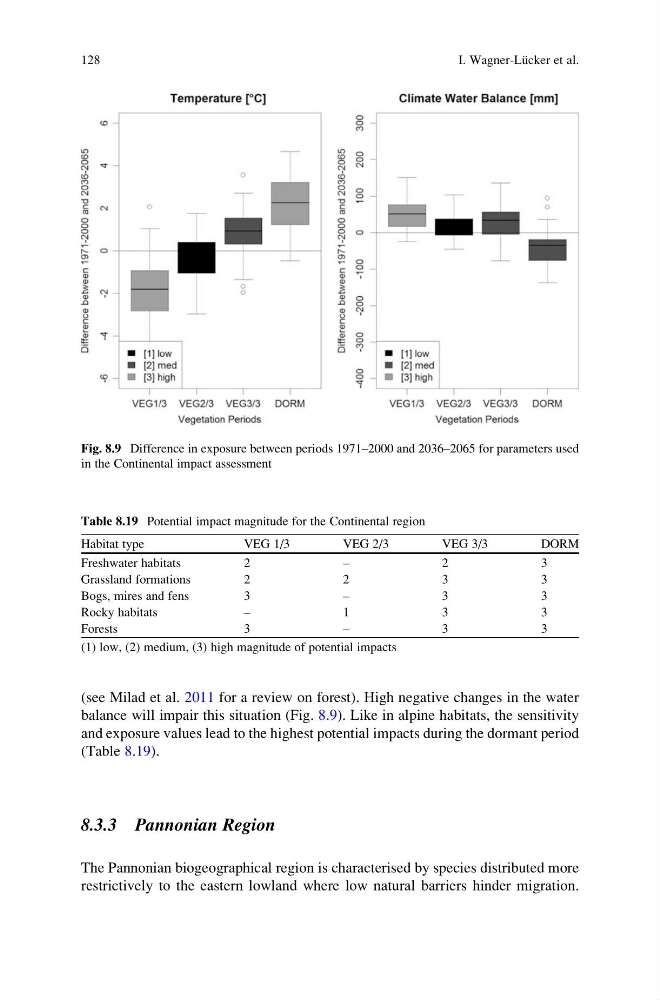
(see Milad et al. 2011 for a review on forest). High negative changes in the water
balance will impair this situation (Fig. 8.9). Like in alpine habitats, the sensitivity
and exposure values lead to the highest potential impacts during the dormant period
(Table 8.19).
8.3.3 Pannonian Region
The Pannonian biogeographical region is characterised by species distributed more
restrictively to the eastern lowland where low natural barriers hinder migration.
Fig. 8.9 Difference in exposure between periods 1971–2000 and 2036–2065 for parameters used
in the Continental impact assessment
Table 8.19 Potential impact magnitude for the Continental region
Habitat type
VEG 1/3
VEG 2/3
VEG 3/3
DORM
Freshwater habitats
2
–
2
3
Grassland formations
2
2
3
3
Bogs, mires and fens
3
–
3
3
Rocky habitats
–
1
3
3
Forests
3
–
3
3
(1) low, (2) medium, (3) high magnitude of potential impacts
128
I. Wagner-Lu ¨cker et al.
balance will impair this situation (Fig. 8.9). Like in alpine habitats, the sensitivity
and exposure values lead to the highest potential impacts during the dormant period
(Table 8.19).
8.3.3 Pannonian Region
The Pannonian biogeographical region is characterised by species distributed more
restrictively to the eastern lowland where low natural barriers hinder migration.
Fig. 8.9 Difference in exposure between periods 1971–2000 and 2036–2065 for parameters used
in the Continental impact assessment
Table 8.19 Potential impact magnitude for the Continental region
Habitat type
VEG 1/3
VEG 2/3
VEG 3/3
DORM
Freshwater habitats
2
–
2
3
Grassland formations
2
2
3
3
Bogs, mires and fens
3
–
3
3
Rocky habitats
–
1
3
3
Forests
3
–
3
3
(1) low, (2) medium, (3) high magnitude of potential impacts
128
I. Wagner-Lu ¨cker et al.