

the habitats. However, existing non-climatic pressures like land use changes modify
the resilience of habitats to climate change on the local level. The sensitivity of
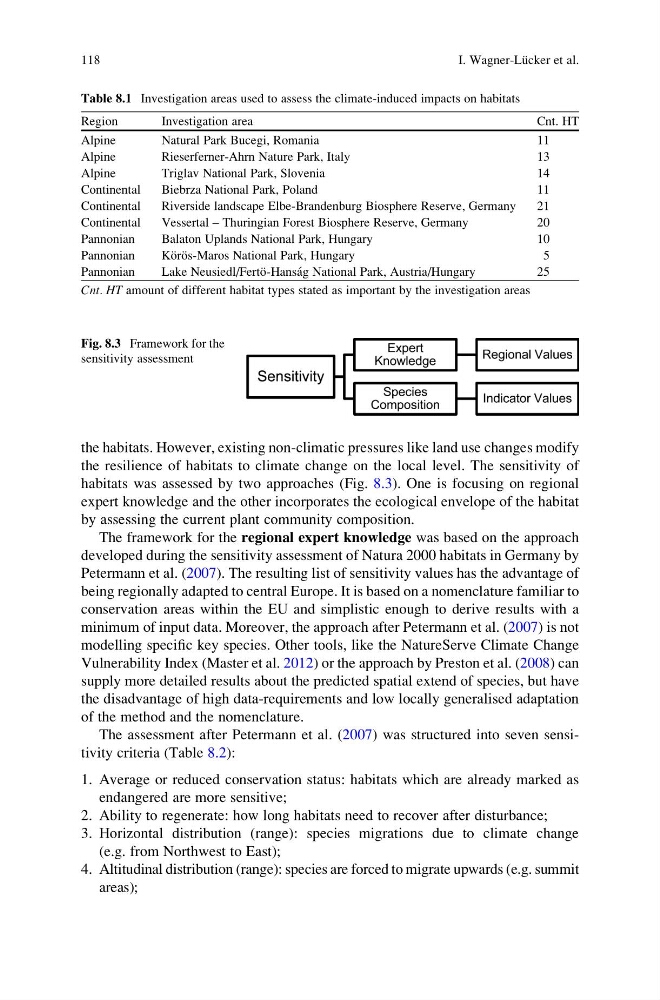
habitats was assessed by two approaches (Fig. 8.3). One is focusing on regional
expert knowledge and the other incorporates the ecological envelope of the habitat
by assessing the current plant community composition.
The framework for the regional expert knowledge was based on the approach
developed during the sensitivity assessment of Natura 2000 habitats in Germany by
Petermann et al. (2007). The resulting list of sensitivity values has the advantage of
being regionally adapted to central Europe. It is based on a nomenclature familiar to
conservation areas within the EU and simplistic enough to derive results with a
minimum of input data. Moreover, the approach after Petermann et al. (2007) is not
modelling specific key species. Other tools, like the NatureServe Climate Change
Vulnerability Index (Master et al. 2012) or the approach by Preston et al. (2008) can
supply more detailed results about the predicted spatial extend of species, but have
the disadvantage of high data-requirements and low locally generalised adaptation
of the method and the nomenclature.
The assessment after Petermann et al. (2007) was structured into seven sensitivity criteria (Table 8.2):
1. Average or reduced conservation status: habitats which are already marked as
endangered are more sensitive;
2. Ability to regenerate: how long habitats need to recover after disturbance;
3. Horizontal distribution (range): species migrations due to climate change
(e.g. from Northwest to East);
4. Altitudinal distribution (range): species are forced to migrate upwards (e.g. summit
areas);
Table 8.1 Investigation areas used to assess the climate-induced impacts on habitats
Region
Investigation area
Cnt. HT
Alpine
Natural Park Bucegi, Romania
11
Alpine
Rieserferner-Ahrn Nature Park, Italy
13
Alpine
Triglav National Park, Slovenia
14
Continental
Biebrza National Park, Poland
11
Continental
Riverside landscape Elbe-Brandenburg Biosphere Reserve, Germany
21
Continental
Vessertal – Thuringian Forest Biosphere Reserve, Germany
20
Pannonian
Balaton Uplands National Park, Hungary
10
Pannonian
Ko ¨ro ¨s-Maros National Park, Hungary
5
Pannonian
Lake Neusiedl/Ferto ¨-Hansa ´g National Park, Austria/Hungary
25
Cnt. HT amount of different habitat types stated as important by the investigation areas
Fig. 8.3 Framework for the
sensitivity assessment
118
I. Wagner-Lu ¨cker et al.
the resilience of habitats to climate change on the local level. The sensitivity of
habitats was assessed by two approaches (Fig. 8.3). One is focusing on regional
expert knowledge and the other incorporates the ecological envelope of the habitat
by assessing the current plant community composition.
The framework for the regional expert knowledge was based on the approach
developed during the sensitivity assessment of Natura 2000 habitats in Germany by
Petermann et al. (2007). The resulting list of sensitivity values has the advantage of
being regionally adapted to central Europe. It is based on a nomenclature familiar to
conservation areas within the EU and simplistic enough to derive results with a
minimum of input data. Moreover, the approach after Petermann et al. (2007) is not
modelling specific key species. Other tools, like the NatureServe Climate Change
Vulnerability Index (Master et al. 2012) or the approach by Preston et al. (2008) can
supply more detailed results about the predicted spatial extend of species, but have
the disadvantage of high data-requirements and low locally generalised adaptation
of the method and the nomenclature.
The assessment after Petermann et al. (2007) was structured into seven sensitivity criteria (Table 8.2):
1. Average or reduced conservation status: habitats which are already marked as
endangered are more sensitive;
2. Ability to regenerate: how long habitats need to recover after disturbance;
3. Horizontal distribution (range): species migrations due to climate change
(e.g. from Northwest to East);
4. Altitudinal distribution (range): species are forced to migrate upwards (e.g. summit
areas);
Table 8.1 Investigation areas used to assess the climate-induced impacts on habitats
Region
Investigation area
Cnt. HT
Alpine
Natural Park Bucegi, Romania
11
Alpine
Rieserferner-Ahrn Nature Park, Italy
13
Alpine
Triglav National Park, Slovenia
14
Continental
Biebrza National Park, Poland
11
Continental
Riverside landscape Elbe-Brandenburg Biosphere Reserve, Germany
21
Continental
Vessertal – Thuringian Forest Biosphere Reserve, Germany
20
Pannonian
Balaton Uplands National Park, Hungary
10
Pannonian
Ko ¨ro ¨s-Maros National Park, Hungary
5
Pannonian
Lake Neusiedl/Ferto ¨-Hansa ´g National Park, Austria/Hungary
25
Cnt. HT amount of different habitat types stated as important by the investigation areas
Fig. 8.3 Framework for the
sensitivity assessment
118
I. Wagner-Lu ¨cker et al.