

about projected species compositions (e.g. Normand et al. 2007; Bakkenes et al. 2006;
Milad et al. 2011), ecological envelope (Ellenberg 1992; Landolt et al. 2010; Borhidi
1995) and expert knowledge systems (Petermann et al. 2007) are used to assess the
sensitivity of habitat types, whereas results from climate scenarios (see Chaps. 2 and 3)
are used to describe the magnitude of the expected exposure to climate change.
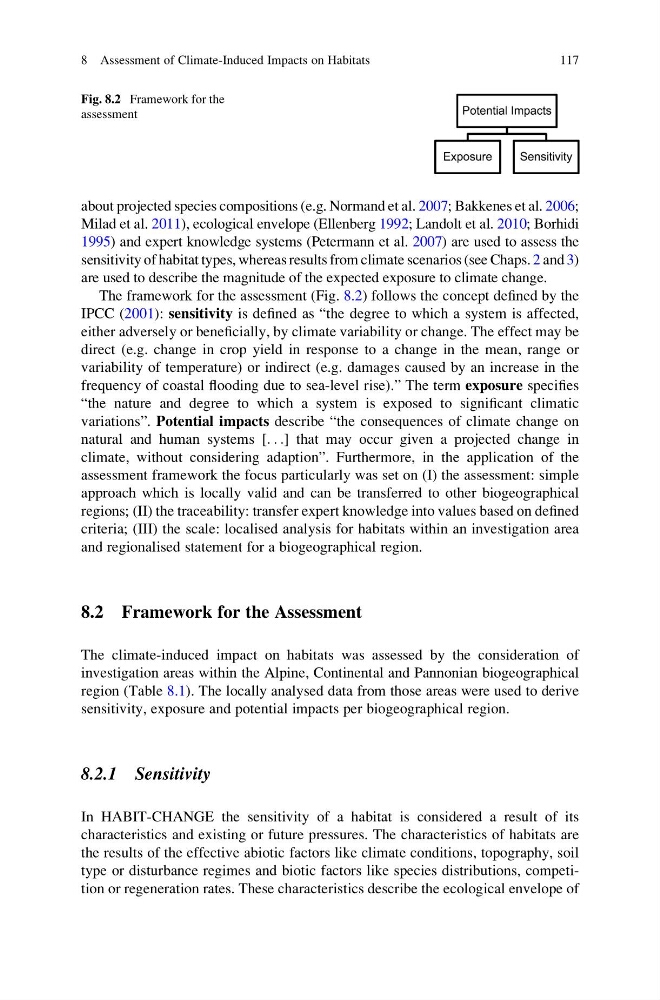
The framework for the assessment (Fig. 8.2) follows the concept defined by the
IPCC (2001): sensitivity is defined as “the degree to which a system is affected,
either adversely or beneficially, by climate variability or change. The effect may be
direct (e.g. change in crop yield in response to a change in the mean, range or
variability of temperature) or indirect (e.g. damages caused by an increase in the
frequency of coastal flooding due to sea-level rise).” The term exposure specifies
“the nature and degree to which a system is exposed to significant climatic
variations”. Potential impacts describe “the consequences of climate change on
natural and human systems [. . .] that may occur given a projected change in
climate, without considering adaption”. Furthermore, in the application of the
assessment framework the focus particularly was set on (I) the assessment: simple
approach which is locally valid and can be transferred to other biogeographical
regions; (II) the traceability: transfer expert knowledge into values based on defined
criteria; (III) the scale: localised analysis for habitats within an investigation area
and regionalised statement for a biogeographical region.
8.2 Framework for the Assessment
The climate-induced impact on habitats was assessed by the consideration of
investigation areas within the Alpine, Continental and Pannonian biogeographical
region (Table 8.1). The locally analysed data from those areas were used to derive
sensitivity, exposure and potential impacts per biogeographical region.
8.2.1 Sensitivity
In HABIT-CHANGE the sensitivity of a habitat is considered a result of its
characteristics and existing or future pressures. The characteristics of habitats are
the results of the effective abiotic factors like climate conditions, topography, soil
type or disturbance regimes and biotic factors like species distributions, competition or regeneration rates. These characteristics describe the ecological envelope of
Fig. 8.2 Framework for the
assessment
8 Assessment of Climate-Induced Impacts on Habitats
117
Milad et al. 2011), ecological envelope (Ellenberg 1992; Landolt et al. 2010; Borhidi
1995) and expert knowledge systems (Petermann et al. 2007) are used to assess the
sensitivity of habitat types, whereas results from climate scenarios (see Chaps. 2 and 3)
are used to describe the magnitude of the expected exposure to climate change.
The framework for the assessment (Fig. 8.2) follows the concept defined by the
IPCC (2001): sensitivity is defined as “the degree to which a system is affected,
either adversely or beneficially, by climate variability or change. The effect may be
direct (e.g. change in crop yield in response to a change in the mean, range or
variability of temperature) or indirect (e.g. damages caused by an increase in the
frequency of coastal flooding due to sea-level rise).” The term exposure specifies
“the nature and degree to which a system is exposed to significant climatic
variations”. Potential impacts describe “the consequences of climate change on
natural and human systems [. . .] that may occur given a projected change in
climate, without considering adaption”. Furthermore, in the application of the
assessment framework the focus particularly was set on (I) the assessment: simple
approach which is locally valid and can be transferred to other biogeographical
regions; (II) the traceability: transfer expert knowledge into values based on defined
criteria; (III) the scale: localised analysis for habitats within an investigation area
and regionalised statement for a biogeographical region.
8.2 Framework for the Assessment
The climate-induced impact on habitats was assessed by the consideration of
investigation areas within the Alpine, Continental and Pannonian biogeographical
region (Table 8.1). The locally analysed data from those areas were used to derive
sensitivity, exposure and potential impacts per biogeographical region.
8.2.1 Sensitivity
In HABIT-CHANGE the sensitivity of a habitat is considered a result of its
characteristics and existing or future pressures. The characteristics of habitats are
the results of the effective abiotic factors like climate conditions, topography, soil
type or disturbance regimes and biotic factors like species distributions, competition or regeneration rates. These characteristics describe the ecological envelope of
Fig. 8.2 Framework for the
assessment
8 Assessment of Climate-Induced Impacts on Habitats
117