

The location in the inner Alps south of the Alpine divide renders the climate
moderately dry. The study area covers an elevation range from 890 to 3,480 m
above mean sea-level. The vegetation reflects the mountainous character of the
nature park. Spruce forests dominate while the timber line is made up of larch and
Swiss pine. Increasing in altitude, the vegetation is composed of Alpine meadows
and sub-Alpine and Alpine small shrubs and heath. Extreme habitats for plants and
animals can be found here. The vegetation above the tree line is very heterogeneous
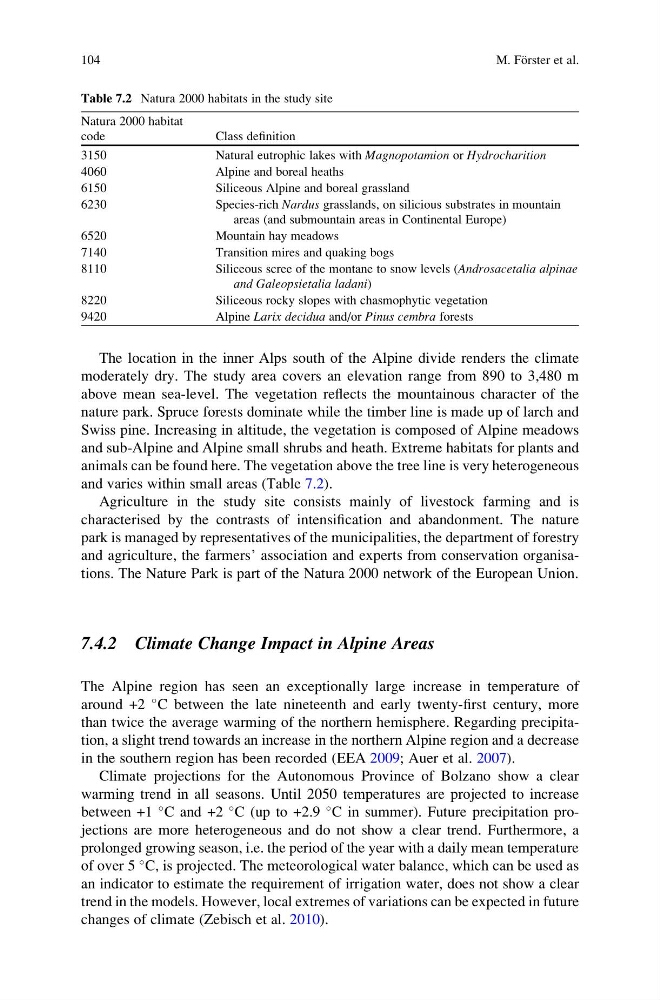
and varies within small areas (Table 7.2).
Agriculture in the study site consists mainly of livestock farming and is
characterised by the contrasts of intensification and abandonment. The nature
park is managed by representatives of the municipalities, the department of forestry
and agriculture, the farmers’ association and experts from conservation organisations. The Nature Park is part of the Natura 2000 network of the European Union.
7.4.2 Climate Change Impact in Alpine Areas
The Alpine region has seen an exceptionally large increase in temperature of
around +2
C between the late nineteenth and early twenty-first century, more
than twice the average warming of the northern hemisphere. Regarding precipitation, a slight trend towards an increase in the northern Alpine region and a decrease
in the southern region has been recorded (EEA 2009; Auer et al. 2007).
Climate projections for the Autonomous Province of Bolzano show a clear
warming trend in all seasons. Until 2050 temperatures are projected to increase
between +1
C and +2
C (up to +2.9
C in summer). Future precipitation projections are more heterogeneous and do not show a clear trend. Furthermore, a
prolonged growing season, i.e. the period of the year with a daily mean temperature
of over 5
C, is projected. The meteorological water balance, which can be used as
an indicator to estimate the requirement of irrigation water, does not show a clear
trend in the models. However, local extremes of variations can be expected in future
changes of climate (Zebisch et al. 2010).
Table 7.2 Natura 2000 habitats in the study site
Natura 2000 habitat
code
Class definition
3150
Natural eutrophic lakes with Magnopotamion or Hydrocharition
4060
Alpine and boreal heaths
6150
Siliceous Alpine and boreal grassland
6230
Species-rich Nardus grasslands, on silicious substrates in mountain
areas (and submountain areas in Continental Europe)
6520
Mountain hay meadows
7140
Transition mires and quaking bogs
8110
Siliceous scree of the montane to snow levels (Androsacetalia alpinae
and Galeopsietalia ladani)
8220
Siliceous rocky slopes with chasmophytic vegetation
9420
Alpine Larix decidua and/or Pinus cembra forests
104
M. Fo ¨rster et al.
moderately dry. The study area covers an elevation range from 890 to 3,480 m
above mean sea-level. The vegetation reflects the mountainous character of the
nature park. Spruce forests dominate while the timber line is made up of larch and
Swiss pine. Increasing in altitude, the vegetation is composed of Alpine meadows
and sub-Alpine and Alpine small shrubs and heath. Extreme habitats for plants and
animals can be found here. The vegetation above the tree line is very heterogeneous
and varies within small areas (Table 7.2).
Agriculture in the study site consists mainly of livestock farming and is
characterised by the contrasts of intensification and abandonment. The nature
park is managed by representatives of the municipalities, the department of forestry
and agriculture, the farmers’ association and experts from conservation organisations. The Nature Park is part of the Natura 2000 network of the European Union.
7.4.2 Climate Change Impact in Alpine Areas
The Alpine region has seen an exceptionally large increase in temperature of
around +2
C between the late nineteenth and early twenty-first century, more
than twice the average warming of the northern hemisphere. Regarding precipitation, a slight trend towards an increase in the northern Alpine region and a decrease
in the southern region has been recorded (EEA 2009; Auer et al. 2007).
Climate projections for the Autonomous Province of Bolzano show a clear
warming trend in all seasons. Until 2050 temperatures are projected to increase
between +1
C and +2
C (up to +2.9
C in summer). Future precipitation projections are more heterogeneous and do not show a clear trend. Furthermore, a
prolonged growing season, i.e. the period of the year with a daily mean temperature
of over 5
C, is projected. The meteorological water balance, which can be used as
an indicator to estimate the requirement of irrigation water, does not show a clear
trend in the models. However, local extremes of variations can be expected in future
changes of climate (Zebisch et al. 2010).
Table 7.2 Natura 2000 habitats in the study site
Natura 2000 habitat
code
Class definition
3150
Natural eutrophic lakes with Magnopotamion or Hydrocharition
4060
Alpine and boreal heaths
6150
Siliceous Alpine and boreal grassland
6230
Species-rich Nardus grasslands, on silicious substrates in mountain
areas (and submountain areas in Continental Europe)
6520
Mountain hay meadows
7140
Transition mires and quaking bogs
8110
Siliceous scree of the montane to snow levels (Androsacetalia alpinae
and Galeopsietalia ladani)
8220
Siliceous rocky slopes with chasmophytic vegetation
9420
Alpine Larix decidua and/or Pinus cembra forests
104
M. Fo ¨rster et al.