

related to several other soil properties (Ostrowska et al. 2006). LAI and VM show
correlation with soil moisture content, while NDVI is correlated with vegetation
productivity, biomass and the intensity of vegetation cover development (Adegoke
and Carleton 2002; Da ˛browska-Zielin ´ska et al. 2003, 2009; Sienkiewicz and
Ostrowska 2010).
6.4 Integrative Indicators
Ecological indicators may be broadly divided into two categories, i.e. simple which
reflect the status of an indicated habitat attribute, and integrative indicators that
summarise the ecological response of habitats to stress (Girardin et al. 1999). The
latter category also includes those indicators that reflect the status of the habitat
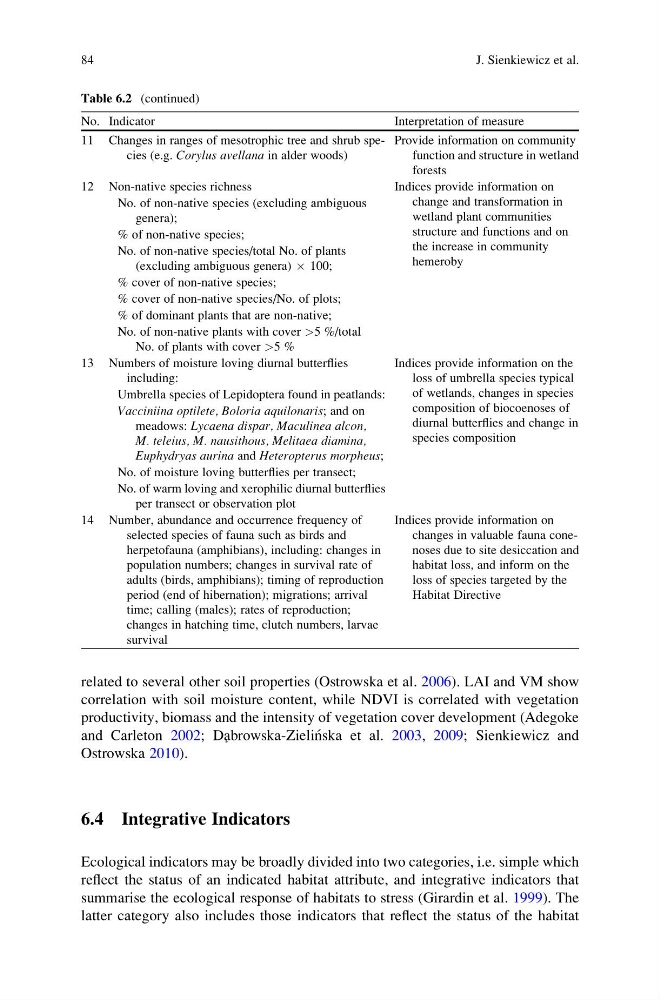
Table 6.2 (continued)
No. Indicator
Interpretation of measure
11 Changes in ranges of mesotrophic tree and shrub species (e.g. Corylus avellana in alder woods)
Provide information on community
function and structure in wetland
forests
12 Non-native species richness
Indices provide information on
change and transformation in
wetland plant communities
structure and functions and on
the increase in community
hemeroby
No. of non-native species (excluding ambiguous
genera);
% of non-native species;
No. of non-native species/total No. of plants
(excluding ambiguous genera) Â 100;
% cover of non-native species;
% cover of non-native species/No. of plots;
% of dominant plants that are non-native;
No. of non-native plants with cover >5 %/total
No. of plants with cover >5 %
13 Numbers of moisture loving diurnal butterflies
including:
Indices provide information on the
loss of umbrella species typical
of wetlands, changes in species
composition of biocoenoses of
diurnal butterflies and change in
species composition
Umbrella species of Lepidoptera found in peatlands:
Vacciniina optilete, Boloria aquilonaris; and on
meadows: Lycaena dispar, Maculinea alcon,
M. teleius, M. nausithous, Melitaea diamina,
Euphydryas aurina and Heteropterus morpheus;
No. of moisture loving butterflies per transect;
No. of warm loving and xerophilic diurnal butterflies
per transect or observation plot
14 Number, abundance and occurrence frequency of
selected species of fauna such as birds and
herpetofauna (amphibians), including: changes in
population numbers; changes in survival rate of
adults (birds, amphibians); timing of reproduction
period (end of hibernation); migrations; arrival
time; calling (males); rates of reproduction;
changes in hatching time, clutch numbers, larvae
survival
Indices provide information on
changes in valuable fauna conenoses due to site desiccation and
habitat loss, and inform on the
loss of species targeted by the
Habitat Directive
84
J. Sienkiewicz et al.
correlation with soil moisture content, while NDVI is correlated with vegetation
productivity, biomass and the intensity of vegetation cover development (Adegoke
and Carleton 2002; Da ˛browska-Zielin ´ska et al. 2003, 2009; Sienkiewicz and
Ostrowska 2010).
6.4 Integrative Indicators
Ecological indicators may be broadly divided into two categories, i.e. simple which
reflect the status of an indicated habitat attribute, and integrative indicators that
summarise the ecological response of habitats to stress (Girardin et al. 1999). The
latter category also includes those indicators that reflect the status of the habitat
Table 6.2 (continued)
No. Indicator
Interpretation of measure
11 Changes in ranges of mesotrophic tree and shrub species (e.g. Corylus avellana in alder woods)
Provide information on community
function and structure in wetland
forests
12 Non-native species richness
Indices provide information on
change and transformation in
wetland plant communities
structure and functions and on
the increase in community
hemeroby
No. of non-native species (excluding ambiguous
genera);
% of non-native species;
No. of non-native species/total No. of plants
(excluding ambiguous genera) Â 100;
% cover of non-native species;
% cover of non-native species/No. of plots;
% of dominant plants that are non-native;
No. of non-native plants with cover >5 %/total
No. of plants with cover >5 %
13 Numbers of moisture loving diurnal butterflies
including:
Indices provide information on the
loss of umbrella species typical
of wetlands, changes in species
composition of biocoenoses of
diurnal butterflies and change in
species composition
Umbrella species of Lepidoptera found in peatlands:
Vacciniina optilete, Boloria aquilonaris; and on
meadows: Lycaena dispar, Maculinea alcon,
M. teleius, M. nausithous, Melitaea diamina,
Euphydryas aurina and Heteropterus morpheus;
No. of moisture loving butterflies per transect;
No. of warm loving and xerophilic diurnal butterflies
per transect or observation plot
14 Number, abundance and occurrence frequency of
selected species of fauna such as birds and
herpetofauna (amphibians), including: changes in
population numbers; changes in survival rate of
adults (birds, amphibians); timing of reproduction
period (end of hibernation); migrations; arrival
time; calling (males); rates of reproduction;
changes in hatching time, clutch numbers, larvae
survival
Indices provide information on
changes in valuable fauna conenoses due to site desiccation and
habitat loss, and inform on the
loss of species targeted by the
Habitat Directive
84
J. Sienkiewicz et al.