

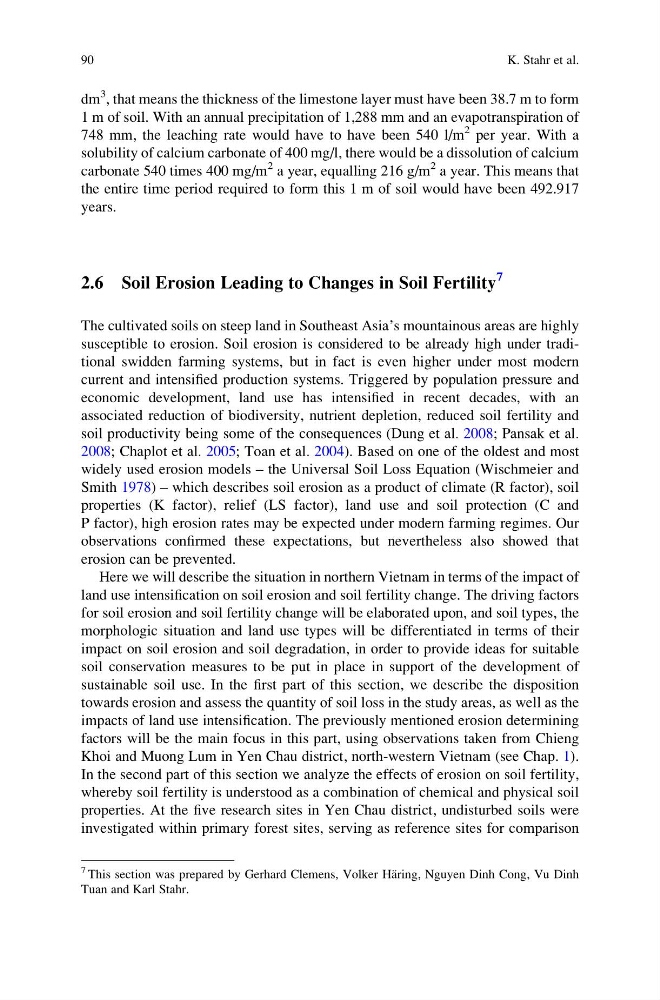
dm
3 , that means the thickness of the limestone layer must have been 38.7 m to form
1 m of soil. With an annual precipitation of 1,288 mm and an evapotranspiration of
748 mm, the leaching rate would have to have been 540 l/m
2 per year. With a
solubility of calcium carbonate of 400 mg/l, there would be a dissolution of calcium
carbonate 540 times 400 mg/m
2 a year, equalling 216 g/m
2 a year. This means that
the entire time period required to form this 1 m of soil would have been 492.917
years.
2.6 Soil Erosion Leading to Changes in Soil Fertility
7
The cultivated soils on steep land in Southeast Asia’s mountainous areas are highly
susceptible to erosion. Soil erosion is considered to be already high under traditional swidden farming systems, but in fact is even higher under most modern
current and intensified production systems. Triggered by population pressure and
economic development, land use has intensified in recent decades, with an
associated reduction of biodiversity, nutrient depletion, reduced soil fertility and
soil productivity being some of the consequences (Dung et al. 2008; Pansak et al.
2008; Chaplot et al. 2005; Toan et al. 2004). Based on one of the oldest and most
widely used erosion models – the Universal Soil Loss Equation (Wischmeier and
Smith 1978) – which describes soil erosion as a product of climate (R factor), soil
properties (K factor), relief (LS factor), land use and soil protection (C and
P factor), high erosion rates may be expected under modern farming regimes. Our
observations confirmed these expectations, but nevertheless also showed that
erosion can be prevented.
Here we will describe the situation in northern Vietnam in terms of the impact of
land use intensification on soil erosion and soil fertility change. The driving factors
for soil erosion and soil fertility change will be elaborated upon, and soil types, the
morphologic situation and land use types will be differentiated in terms of their
impact on soil erosion and soil degradation, in order to provide ideas for suitable
soil conservation measures to be put in place in support of the development of
sustainable soil use. In the first part of this section, we describe the disposition
towards erosion and assess the quantity of soil loss in the study areas, as well as the
impacts of land use intensification. The previously mentioned erosion determining
factors will be the main focus in this part, using observations taken from Chieng
Khoi and Muong Lum in Yen Chau district, north-western Vietnam (see Chap. 1).
In the second part of this section we analyze the effects of erosion on soil fertility,
whereby soil fertility is understood as a combination of chemical and physical soil
properties. At the five research sites in Yen Chau district, undisturbed soils were
investigated within primary forest sites, serving as reference sites for comparison
7 This section was prepared by Gerhard Clemens, Volker Ha ¨ring, Nguyen Dinh Cong, Vu Dinh
Tuan and Karl Stahr.
90
K. Stahr et al.
3 , that means the thickness of the limestone layer must have been 38.7 m to form
1 m of soil. With an annual precipitation of 1,288 mm and an evapotranspiration of
748 mm, the leaching rate would have to have been 540 l/m
2 per year. With a
solubility of calcium carbonate of 400 mg/l, there would be a dissolution of calcium
carbonate 540 times 400 mg/m
2 a year, equalling 216 g/m
2 a year. This means that
the entire time period required to form this 1 m of soil would have been 492.917
years.
2.6 Soil Erosion Leading to Changes in Soil Fertility
7
The cultivated soils on steep land in Southeast Asia’s mountainous areas are highly
susceptible to erosion. Soil erosion is considered to be already high under traditional swidden farming systems, but in fact is even higher under most modern
current and intensified production systems. Triggered by population pressure and
economic development, land use has intensified in recent decades, with an
associated reduction of biodiversity, nutrient depletion, reduced soil fertility and
soil productivity being some of the consequences (Dung et al. 2008; Pansak et al.
2008; Chaplot et al. 2005; Toan et al. 2004). Based on one of the oldest and most
widely used erosion models – the Universal Soil Loss Equation (Wischmeier and
Smith 1978) – which describes soil erosion as a product of climate (R factor), soil
properties (K factor), relief (LS factor), land use and soil protection (C and
P factor), high erosion rates may be expected under modern farming regimes. Our
observations confirmed these expectations, but nevertheless also showed that
erosion can be prevented.
Here we will describe the situation in northern Vietnam in terms of the impact of
land use intensification on soil erosion and soil fertility change. The driving factors
for soil erosion and soil fertility change will be elaborated upon, and soil types, the
morphologic situation and land use types will be differentiated in terms of their
impact on soil erosion and soil degradation, in order to provide ideas for suitable
soil conservation measures to be put in place in support of the development of
sustainable soil use. In the first part of this section, we describe the disposition
towards erosion and assess the quantity of soil loss in the study areas, as well as the
impacts of land use intensification. The previously mentioned erosion determining
factors will be the main focus in this part, using observations taken from Chieng
Khoi and Muong Lum in Yen Chau district, north-western Vietnam (see Chap. 1).
In the second part of this section we analyze the effects of erosion on soil fertility,
whereby soil fertility is understood as a combination of chemical and physical soil
properties. At the five research sites in Yen Chau district, undisturbed soils were
investigated within primary forest sites, serving as reference sites for comparison
7 This section was prepared by Gerhard Clemens, Volker Ha ¨ring, Nguyen Dinh Cong, Vu Dinh
Tuan and Karl Stahr.
90
K. Stahr et al.