

However, the organic matter store at 1 m depth was on average 200 t/ha, with a
spread from about 100–300 t. Only in the Chernozems and Umbrisols, which were
very rare, was the organic matter content found to be double or more. There are two
key reasons for this, one, due to the binding of organic matter to freshly precipitated
calcium carbonate, and two, due to the colluviation of eroded soil material together
with organic matter at an above average rate. Therefore, these soils seemed to be
those with the highest level of fertility.
2.5.5 Discussion
A typical chrono-sequence for soil development was established. The development
of morphological soil profiles is strongly correlated with the formation of minerals,
and when we compared this sequence with the observations made in Laos and
Vietnam, the last mineral, Ferralsol, was missing, though the other minerals seemed
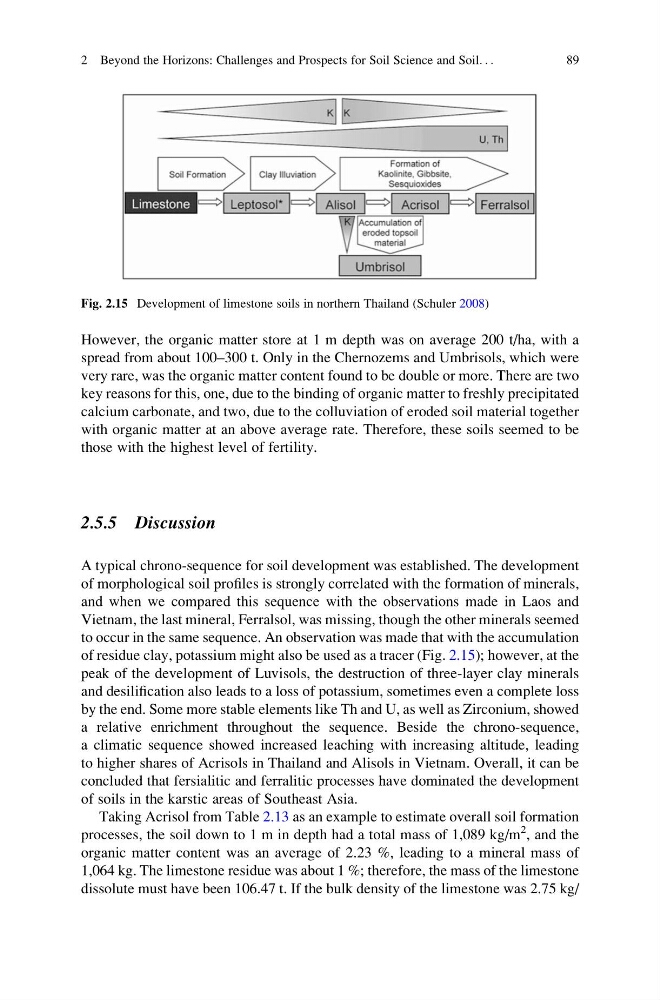
to occur in the same sequence. An observation was made that with the accumulation
of residue clay, potassium might also be used as a tracer (Fig. 2.15); however, at the
peak of the development of Luvisols, the destruction of three-layer clay minerals
and desilification also leads to a loss of potassium, sometimes even a complete loss
by the end. Some more stable elements like Th and U, as well as Zirconium, showed
a relative enrichment throughout the sequence. Beside the chrono-sequence,
a climatic sequence showed increased leaching with increasing altitude, leading
to higher shares of Acrisols in Thailand and Alisols in Vietnam. Overall, it can be
concluded that fersialitic and ferralitic processes have dominated the development
of soils in the karstic areas of Southeast Asia.
Taking Acrisol from Table 2.13 as an example to estimate overall soil formation
processes, the soil down to 1 m in depth had a total mass of 1,089 kg/m
2 , and the
organic matter content was an average of 2.23 %, leading to a mineral mass of
1,064 kg. The limestone residue was about 1 %; therefore, the mass of the limestone
dissolute must have been 106.47 t. If the bulk density of the limestone was 2.75 kg/
Fig. 2.15 Development of limestone soils in northern Thailand (Schuler 2008)
2 Beyond the Horizons: Challenges and Prospects for Soil Science and Soil. . .
89
spread from about 100–300 t. Only in the Chernozems and Umbrisols, which were
very rare, was the organic matter content found to be double or more. There are two
key reasons for this, one, due to the binding of organic matter to freshly precipitated
calcium carbonate, and two, due to the colluviation of eroded soil material together
with organic matter at an above average rate. Therefore, these soils seemed to be
those with the highest level of fertility.
2.5.5 Discussion
A typical chrono-sequence for soil development was established. The development
of morphological soil profiles is strongly correlated with the formation of minerals,
and when we compared this sequence with the observations made in Laos and
Vietnam, the last mineral, Ferralsol, was missing, though the other minerals seemed
to occur in the same sequence. An observation was made that with the accumulation
of residue clay, potassium might also be used as a tracer (Fig. 2.15); however, at the
peak of the development of Luvisols, the destruction of three-layer clay minerals
and desilification also leads to a loss of potassium, sometimes even a complete loss
by the end. Some more stable elements like Th and U, as well as Zirconium, showed
a relative enrichment throughout the sequence. Beside the chrono-sequence,
a climatic sequence showed increased leaching with increasing altitude, leading
to higher shares of Acrisols in Thailand and Alisols in Vietnam. Overall, it can be
concluded that fersialitic and ferralitic processes have dominated the development
of soils in the karstic areas of Southeast Asia.
Taking Acrisol from Table 2.13 as an example to estimate overall soil formation
processes, the soil down to 1 m in depth had a total mass of 1,089 kg/m
2 , and the
organic matter content was an average of 2.23 %, leading to a mineral mass of
1,064 kg. The limestone residue was about 1 %; therefore, the mass of the limestone
dissolute must have been 106.47 t. If the bulk density of the limestone was 2.75 kg/
Fig. 2.15 Development of limestone soils in northern Thailand (Schuler 2008)
2 Beyond the Horizons: Challenges and Prospects for Soil Science and Soil. . .
89