

In Huay Sang in Laos, the majority of the area was found to be covered by
claystone, with only prominent limestone outcrops covered mainly by Acrisols,
Luvisols and Cambisols. In contrast to Bor Krai, depressions here were covered
with Anthrosols, which may be equivalent to Umbrisols in the other study area.
Here we also found more acidified Acrisols along the slopes (Fig. 2.13).
As for the other areas, the landscape around Muong Lum in Vietnam was
dominated by soils which revealed clay illuviation (Fig. 2.14); however, here
Luvisols dominated, accompanied by Alisols – occurring in karst pockets several
meters deep between Rendzic and Lithic Leptosols. We did not detect
rubeficated soils in this area, a sign that the soils are younger and less developed.
The presence of less developed soils can signify the presence of pronounced
erosion activities, but in this area, in spite of erosion being present (as observed
in all three areas), this was found not to be the case. A special feature of the
soils found on limestone is that due to their dynamic, weathering contacts with
the lithic surface, the more weathered horizons/minerals occur directly above the
bottom layer of the soil, so a transitional BC or Cw horizon is not normally
observed. This means that under erosion activity, the most developed horizons
can still be detected until all of the soil has been eroded; up to that point a deep
soil horizon can be observed. In this area, Leptosols with Nudilithic, and
Rendzic qualifiers, were more widespread; furthermore, on higher slopes, even
those without freshwater lime present, Phaeozems were detected, and in
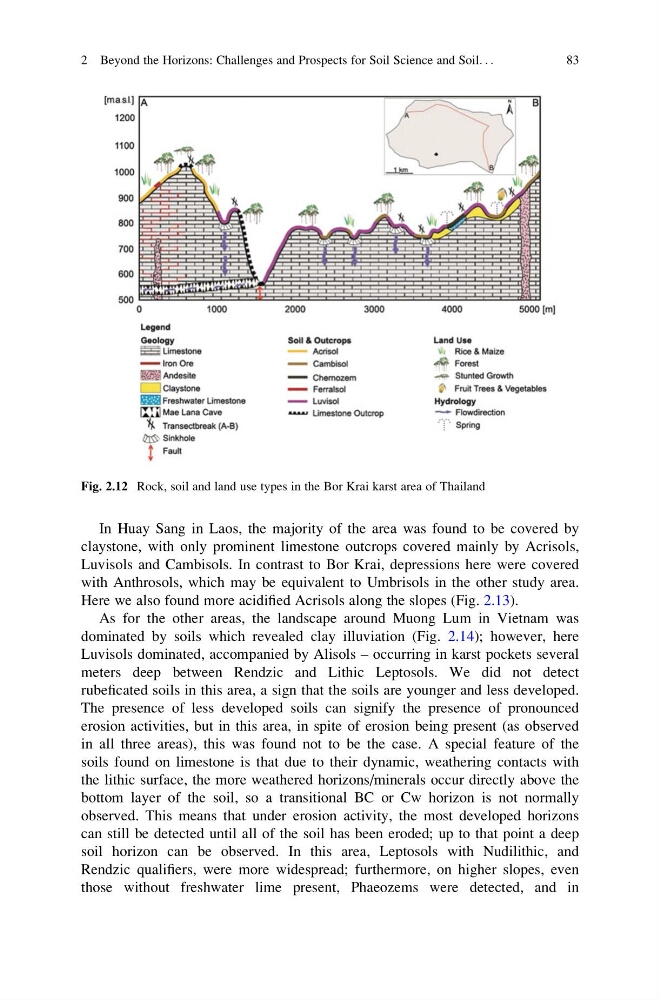
Fig. 2.12 Rock, soil and land use types in the Bor Krai karst area of Thailand
2 Beyond the Horizons: Challenges and Prospects for Soil Science and Soil. . .
83
claystone, with only prominent limestone outcrops covered mainly by Acrisols,
Luvisols and Cambisols. In contrast to Bor Krai, depressions here were covered
with Anthrosols, which may be equivalent to Umbrisols in the other study area.
Here we also found more acidified Acrisols along the slopes (Fig. 2.13).
As for the other areas, the landscape around Muong Lum in Vietnam was
dominated by soils which revealed clay illuviation (Fig. 2.14); however, here
Luvisols dominated, accompanied by Alisols – occurring in karst pockets several
meters deep between Rendzic and Lithic Leptosols. We did not detect
rubeficated soils in this area, a sign that the soils are younger and less developed.
The presence of less developed soils can signify the presence of pronounced
erosion activities, but in this area, in spite of erosion being present (as observed
in all three areas), this was found not to be the case. A special feature of the
soils found on limestone is that due to their dynamic, weathering contacts with
the lithic surface, the more weathered horizons/minerals occur directly above the
bottom layer of the soil, so a transitional BC or Cw horizon is not normally
observed. This means that under erosion activity, the most developed horizons
can still be detected until all of the soil has been eroded; up to that point a deep
soil horizon can be observed. In this area, Leptosols with Nudilithic, and
Rendzic qualifiers, were more widespread; furthermore, on higher slopes, even
those without freshwater lime present, Phaeozems were detected, and in
Fig. 2.12 Rock, soil and land use types in the Bor Krai karst area of Thailand
2 Beyond the Horizons: Challenges and Prospects for Soil Science and Soil. . .
83