

K bearing clay minerals like illite are transformed into potassium-free clay
minerals like kaolinite, leading to lower K-Th ratios. The separation line for the
ground-based measurements was eTh ¼ 16 K. Using this criterion for field
mapping, some Alisols were still classified as Acrisols. According to our analytics,
these were transitional soil profiles with CEC clay close to the separation criterion
of 24 cmol (c+) kg
À1 . Taking into account the analytical accuracy of the CEC
method (CV 11 %, Herrmann 2005), these results lie within the error range.
As a consequence, we can use, at least in the Bor Krai area, field gamma-ray data
for the separation of high and low activity clay RSGs (especially Alisols and
Acrisols). Combining the whole field description, including pH and bulk density,
with gamma-ray data, further RSGs can be separated (i.e. Luvisols and Ferralsols).
Also, early results from Germany (unpublished) indicate that the above mentioned
eTh/K separation criterion for ground-based measurements works there and thus
might have a global validity.
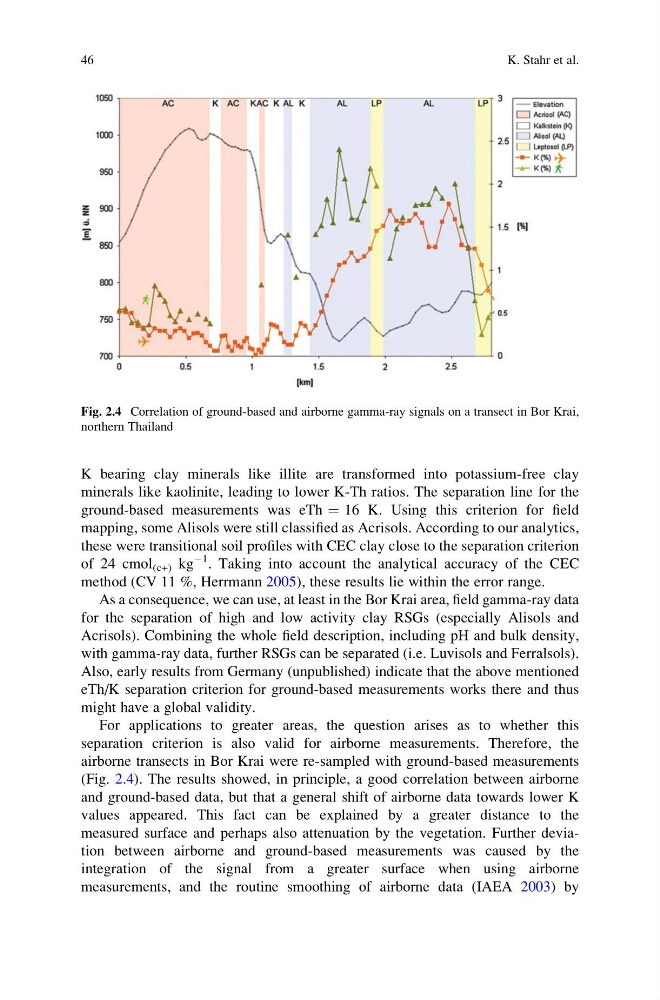
For applications to greater areas, the question arises as to whether this
separation criterion is also valid for airborne measurements. Therefore, the
airborne transects in Bor Krai were re-sampled with ground-based measurements
(Fig. 2.4). The results showed, in principle, a good correlation between airborne
and ground-based data, but that a general shift of airborne data towards lower K
values appeared. This fact can be explained by a greater distance to the
measured surface and perhaps also attenuation by the vegetation. Further deviation between airborne and ground-based measurements was caused by the
integration of the signal from a greater surface when using airborne
measurements, and the routine smoothing of airborne data (IAEA 2003) by
Fig. 2.4 Correlation of ground-based and airborne gamma-ray signals on a transect in Bor Krai,
northern Thailand
46
K. Stahr et al.
minerals like kaolinite, leading to lower K-Th ratios. The separation line for the
ground-based measurements was eTh ¼ 16 K. Using this criterion for field
mapping, some Alisols were still classified as Acrisols. According to our analytics,
these were transitional soil profiles with CEC clay close to the separation criterion
of 24 cmol (c+) kg
À1 . Taking into account the analytical accuracy of the CEC
method (CV 11 %, Herrmann 2005), these results lie within the error range.
As a consequence, we can use, at least in the Bor Krai area, field gamma-ray data
for the separation of high and low activity clay RSGs (especially Alisols and
Acrisols). Combining the whole field description, including pH and bulk density,
with gamma-ray data, further RSGs can be separated (i.e. Luvisols and Ferralsols).
Also, early results from Germany (unpublished) indicate that the above mentioned
eTh/K separation criterion for ground-based measurements works there and thus
might have a global validity.
For applications to greater areas, the question arises as to whether this
separation criterion is also valid for airborne measurements. Therefore, the
airborne transects in Bor Krai were re-sampled with ground-based measurements
(Fig. 2.4). The results showed, in principle, a good correlation between airborne
and ground-based data, but that a general shift of airborne data towards lower K
values appeared. This fact can be explained by a greater distance to the
measured surface and perhaps also attenuation by the vegetation. Further deviation between airborne and ground-based measurements was caused by the
integration of the signal from a greater surface when using airborne
measurements, and the routine smoothing of airborne data (IAEA 2003) by
Fig. 2.4 Correlation of ground-based and airborne gamma-ray signals on a transect in Bor Krai,
northern Thailand
46
K. Stahr et al.