

Landscape scale mapping of Reference Soil Groups and the correlation
between ground-based and airborne data: Soil mapping at present means first
of all soil type mapping, since the idea of a soil type is directly related to soil
forming processes and properties. For regional to global applications in the
future, i.e., for predicting climate change effects, single properties will receive
more emphasis. In the World Reference Base for Soil Resources (IUSS Working
Group WRB 2006), used for worldwide correlation purposes, soil types are
grouped into so-called Reference Soil Groups (RSGs). In the northern Thai
highlands, RSGs prevail, as predominantly characterised by clay illuviation
(Schuler 2008). In the WRB, these are differentiated by the base saturation
and cation exchange capacity of the clay fraction. While a relation exists
between pH and base saturation, so far no field approaches have existed to
determine or estimate the CEC, except for very crude approaches based on
clay and organic matter concentrations. The WRB sets a sharp threshold at
24 cmol (c+) kg
À1 when separating “high and low activity clays”. This value
has classificatory force, since it separates the high activity clay illuviation RSGs
(Luvisol and Alisol) from the low activity clay illuviation RSGs (Lixisol and
Acrisol). Where both types occur in one landscape, no field separation has been
possible so far, but expensive analytics are necessary in principle for each single
auger. Coming back to what has been shown with respect to gamma-ray signals
at the soil profile scale, gamma-spectrometry has the potential to separate these
RSGs, particularly due to the fact that high activity clays contain higher amounts
of K due to their higher concentrations of illite and vermiculite plus smectite
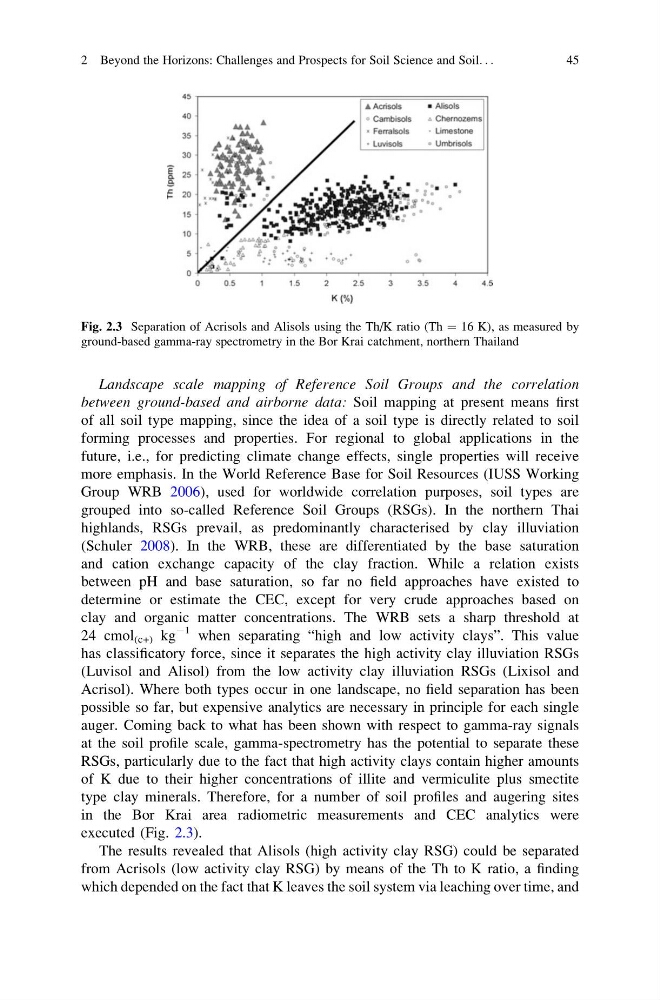
type clay minerals. Therefore, for a number of soil profiles and augering sites
in the Bor Krai area radiometric measurements and CEC analytics were
executed (Fig. 2.3).
The results revealed that Alisols (high activity clay RSG) could be separated
from Acrisols (low activity clay RSG) by means of the Th to K ratio, a finding
which depended on the fact that K leaves the soil system via leaching over time, and
Fig. 2.3 Separation of Acrisols and Alisols using the Th/K ratio (Th ¼ 16 K), as measured by
ground-based gamma-ray spectrometry in the Bor Krai catchment, northern Thailand
2 Beyond the Horizons: Challenges and Prospects for Soil Science and Soil. . .
45
between ground-based and airborne data: Soil mapping at present means first
of all soil type mapping, since the idea of a soil type is directly related to soil
forming processes and properties. For regional to global applications in the
future, i.e., for predicting climate change effects, single properties will receive
more emphasis. In the World Reference Base for Soil Resources (IUSS Working
Group WRB 2006), used for worldwide correlation purposes, soil types are
grouped into so-called Reference Soil Groups (RSGs). In the northern Thai
highlands, RSGs prevail, as predominantly characterised by clay illuviation
(Schuler 2008). In the WRB, these are differentiated by the base saturation
and cation exchange capacity of the clay fraction. While a relation exists
between pH and base saturation, so far no field approaches have existed to
determine or estimate the CEC, except for very crude approaches based on
clay and organic matter concentrations. The WRB sets a sharp threshold at
24 cmol (c+) kg
À1 when separating “high and low activity clays”. This value
has classificatory force, since it separates the high activity clay illuviation RSGs
(Luvisol and Alisol) from the low activity clay illuviation RSGs (Lixisol and
Acrisol). Where both types occur in one landscape, no field separation has been
possible so far, but expensive analytics are necessary in principle for each single
auger. Coming back to what has been shown with respect to gamma-ray signals
at the soil profile scale, gamma-spectrometry has the potential to separate these
RSGs, particularly due to the fact that high activity clays contain higher amounts
of K due to their higher concentrations of illite and vermiculite plus smectite
type clay minerals. Therefore, for a number of soil profiles and augering sites
in the Bor Krai area radiometric measurements and CEC analytics were
executed (Fig. 2.3).
The results revealed that Alisols (high activity clay RSG) could be separated
from Acrisols (low activity clay RSG) by means of the Th to K ratio, a finding
which depended on the fact that K leaves the soil system via leaching over time, and
Fig. 2.3 Separation of Acrisols and Alisols using the Th/K ratio (Th ¼ 16 K), as measured by
ground-based gamma-ray spectrometry in the Bor Krai catchment, northern Thailand
2 Beyond the Horizons: Challenges and Prospects for Soil Science and Soil. . .
45