

require social assistance from the government. In addition, it appears highly
questionable whether subsidized loans are an appropriate tool to use for poverty
assistance programs, as the intrinsic incentives in such systems always create biases
that benefit the non-poor.
12.6 Conclusions and Policy Implications
The empirical results presented in this chapter show that smallholder households in
the northern uplands of Vietnam and Thailand have reached a high degree of
commercialization and market integration. In the case of Thailand, where commercialization has entailed the diversification of land use to include such activities as
fruit and vegetable cultivation, the results clearly show that the process of market
integration has contributed to a higher level of efficiency for farm production and to
higher household incomes. Despite a general rise in food prices from 2006 to 2008
in Vietnam, our results show that agricultural commercialization has also led to
higher net farm incomes and declines in poverty in northern Vietnam.
For upland farming in Vietnam, commercialization has entailed maize monocropping, with almost the entire harvest sold. Such a high degree of specialization
has exposed farm households to high levels of risk due to volatile input and output
prices, and a resulting high variation in household incomes. Options for farmers to
adapt to the high variability of maize prices have remained limited, while it is
possible maize yields will decline in the long-term due to environmental degradation, an issue addressed in Chap. 7. To reduce farmers’ exposure to market risks
with respect to maize cultivation, policies should be introduced which help improve
the rural infrastructure and market environment, and give farmers more options in
terms of managing risk. In particular, our results show that improved storage
capacity could help farmers preserve maize quality and sell their produce when
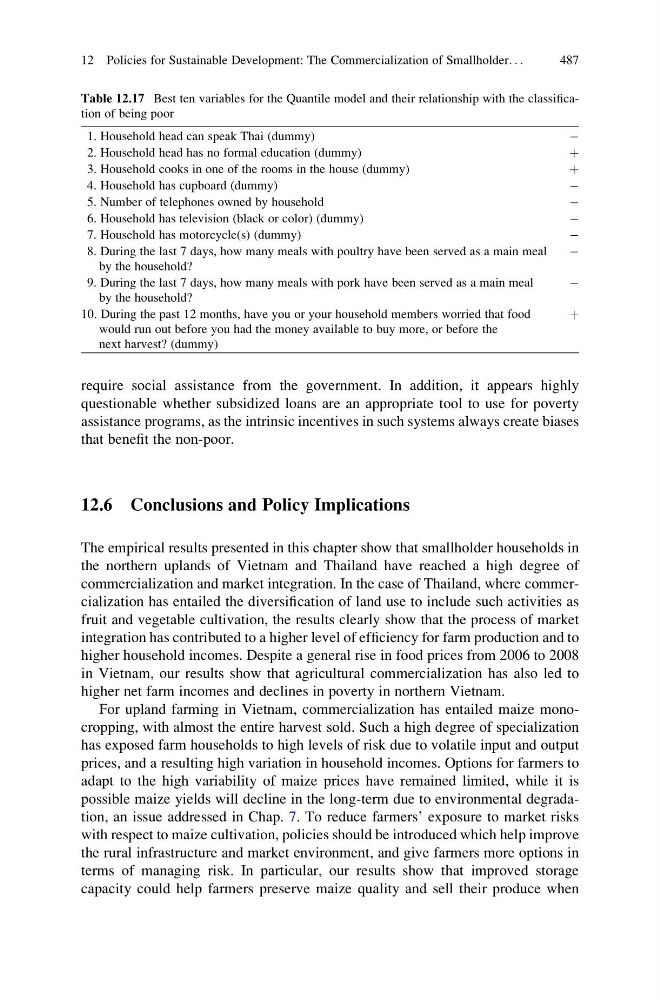
Table 12.17 Best ten variables for the Quantile model and their relationship with the classification of being poor
1. Household head can speak Thai (dummy)
À
2. Household head has no formal education (dummy)
þ
3. Household cooks in one of the rooms in the house (dummy)
þ
4. Household has cupboard (dummy)
À
5. Number of telephones owned by household
À
6. Household has television (black or color) (dummy)
À
7. Household has motorcycle(s) (dummy)
À
8. During the last 7 days, how many meals with poultry have been served as a main meal
by the household?
À
9. During the last 7 days, how many meals with pork have been served as a main meal
by the household?
À
10. During the past 12 months, have you or your household members worried that food
would run out before you had the money available to buy more, or before the
next harvest? (dummy)
þ
12 Policies for Sustainable Development: The Commercialization of Smallholder. . .
487
questionable whether subsidized loans are an appropriate tool to use for poverty
assistance programs, as the intrinsic incentives in such systems always create biases
that benefit the non-poor.
12.6 Conclusions and Policy Implications
The empirical results presented in this chapter show that smallholder households in
the northern uplands of Vietnam and Thailand have reached a high degree of
commercialization and market integration. In the case of Thailand, where commercialization has entailed the diversification of land use to include such activities as
fruit and vegetable cultivation, the results clearly show that the process of market
integration has contributed to a higher level of efficiency for farm production and to
higher household incomes. Despite a general rise in food prices from 2006 to 2008
in Vietnam, our results show that agricultural commercialization has also led to
higher net farm incomes and declines in poverty in northern Vietnam.
For upland farming in Vietnam, commercialization has entailed maize monocropping, with almost the entire harvest sold. Such a high degree of specialization
has exposed farm households to high levels of risk due to volatile input and output
prices, and a resulting high variation in household incomes. Options for farmers to
adapt to the high variability of maize prices have remained limited, while it is
possible maize yields will decline in the long-term due to environmental degradation, an issue addressed in Chap. 7. To reduce farmers’ exposure to market risks
with respect to maize cultivation, policies should be introduced which help improve
the rural infrastructure and market environment, and give farmers more options in
terms of managing risk. In particular, our results show that improved storage
capacity could help farmers preserve maize quality and sell their produce when
Table 12.17 Best ten variables for the Quantile model and their relationship with the classification of being poor
1. Household head can speak Thai (dummy)
À
2. Household head has no formal education (dummy)
þ
3. Household cooks in one of the rooms in the house (dummy)
þ
4. Household has cupboard (dummy)
À
5. Number of telephones owned by household
À
6. Household has television (black or color) (dummy)
À
7. Household has motorcycle(s) (dummy)
À
8. During the last 7 days, how many meals with poultry have been served as a main meal
by the household?
À
9. During the last 7 days, how many meals with pork have been served as a main meal
by the household?
À
10. During the past 12 months, have you or your household members worried that food
would run out before you had the money available to buy more, or before the
next harvest? (dummy)
þ
12 Policies for Sustainable Development: The Commercialization of Smallholder. . .
487