

or poorly timed support from their allocated CEW due to a number of factors,
including insufficient incentives to travel to remote villages, the poor planning of
extension activities, and an – at least on paper – extremely high workload among
the CEWs (for a more detailed analysis of the deficient incentive system for CEWs
and the common labor practices, see Castella et al. 2006; Linh et al. 2006;
Friederichsen 2009). Moreover, as Schad et al. (2011) note, extension seeks to
disperse innovation by targeting ‘model farmers’ that have the necessary resources
(finance, labor and influence), a good command of Vietnamese as the official
language and are easily reachable by main roads. Consequently, the opportunities
and advantages available are more likely to accrue to the more privileged farmers,
excluding a substantial proportion of the ethnic minority farmers living in more
remote areas and in less favorable conditions.
11.2.2 Para-Statal and Non-State Actors
A second major group of actors in the public extension arena are the so-called ‘mass
organizations’, such as the Women’s Union and Farmers’ Union, which were both
founded in the early 1940s as heralds of the socialist state in northern Vietnam. Prior
to Doi Moi, the unions – with branches rigorously down to the village level – were
mainly used to disseminate government directives. Regardless of their decreasing
presence and influence among lowland farming communities, the unions have
maintained their profile and role in the mountains, as forums for local development
planning and as transmitters of extension messages from the OE service to the local
level (Schad et al. 2011; Minh et al. 2010). Mass organizations, and – as supported
by policies aimed at establishing extension services more widely in local
communities (GSRV 2010) – an increasing number of voluntary so-called ‘extension
clubs’ initiated through official extension services, promote knowledge exchange
covering a wide range of content depending on farmers’ interests (Schad et al. 2011;
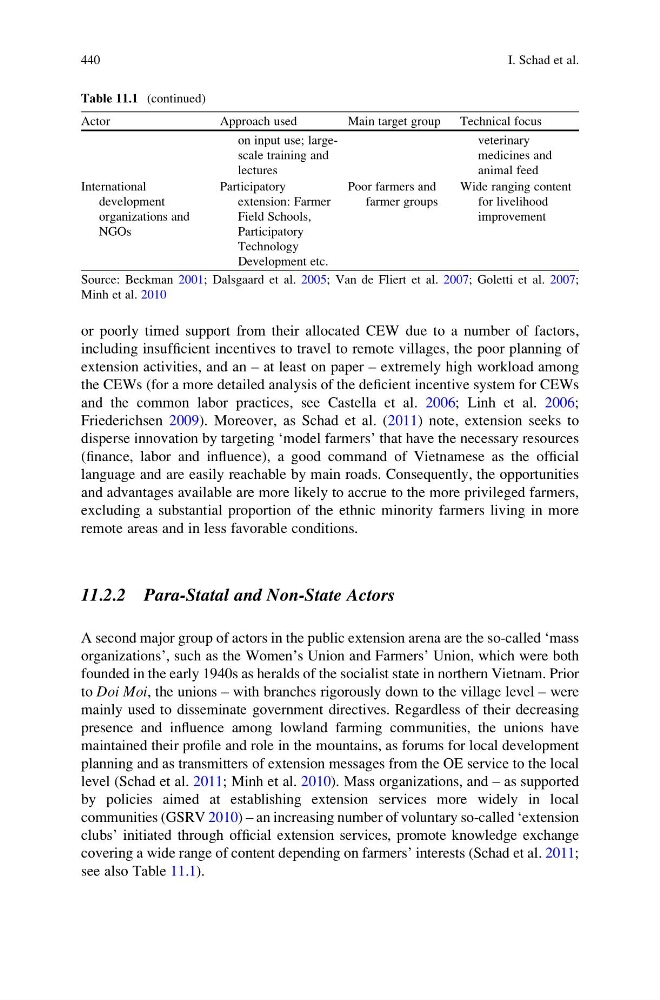
see also Table 11.1).
Table 11.1 (continued)
Actor
Approach used
Main target group
Technical focus
on input use; largescale training and
lectures
veterinary
medicines and
animal feed
International
development
organizations and
NGOs
Participatory
extension: Farmer
Field Schools,
Participatory
Technology
Development etc.
Poor farmers and
farmer groups
Wide ranging content
for livelihood
improvement
Source: Beckman 2001; Dalsgaard et al. 2005; Van de Fliert et al. 2007; Goletti et al. 2007;
Minh et al. 2010
440
I. Schad et al.
including insufficient incentives to travel to remote villages, the poor planning of
extension activities, and an – at least on paper – extremely high workload among
the CEWs (for a more detailed analysis of the deficient incentive system for CEWs
and the common labor practices, see Castella et al. 2006; Linh et al. 2006;
Friederichsen 2009). Moreover, as Schad et al. (2011) note, extension seeks to
disperse innovation by targeting ‘model farmers’ that have the necessary resources
(finance, labor and influence), a good command of Vietnamese as the official
language and are easily reachable by main roads. Consequently, the opportunities
and advantages available are more likely to accrue to the more privileged farmers,
excluding a substantial proportion of the ethnic minority farmers living in more
remote areas and in less favorable conditions.
11.2.2 Para-Statal and Non-State Actors
A second major group of actors in the public extension arena are the so-called ‘mass
organizations’, such as the Women’s Union and Farmers’ Union, which were both
founded in the early 1940s as heralds of the socialist state in northern Vietnam. Prior
to Doi Moi, the unions – with branches rigorously down to the village level – were
mainly used to disseminate government directives. Regardless of their decreasing
presence and influence among lowland farming communities, the unions have
maintained their profile and role in the mountains, as forums for local development
planning and as transmitters of extension messages from the OE service to the local
level (Schad et al. 2011; Minh et al. 2010). Mass organizations, and – as supported
by policies aimed at establishing extension services more widely in local
communities (GSRV 2010) – an increasing number of voluntary so-called ‘extension
clubs’ initiated through official extension services, promote knowledge exchange
covering a wide range of content depending on farmers’ interests (Schad et al. 2011;
see also Table 11.1).
Table 11.1 (continued)
Actor
Approach used
Main target group
Technical focus
on input use; largescale training and
lectures
veterinary
medicines and
animal feed
International
development
organizations and
NGOs
Participatory
extension: Farmer
Field Schools,
Participatory
Technology
Development etc.
Poor farmers and
farmer groups
Wide ranging content
for livelihood
improvement
Source: Beckman 2001; Dalsgaard et al. 2005; Van de Fliert et al. 2007; Goletti et al. 2007;
Minh et al. 2010
440
I. Schad et al.