

10.8.4 Discussion and Conclusions
The coupled modeling allowed parallel development and application of the models
and increased levels of details and precision for modeling, and was thus a valuable
improvement over the use of either individual model. While this came at the price
of higher data requirements and more effort needed for data interpretation, the
coupling of models allowed us to simulate more realistic scenarios to a higher
precision and thus potentially greater accuracy.
10.8.4.1 Adoption of Soil Conservation Measures
The results of this study agree with those in Sect. 10.6, in so far as soil conservation
measures were initially unattractive for farmers. After 5 years; however, adoption
in our simulations extended to a substantial fraction of the maize area. The primary
reason for non-adoption in Quang’s study was crop competition with hedgerows
and thus lower yields, but this did not apply to the same extent to our scenarios,
which assumed cover crops that did not compete for nutrients with other crops.
Another reason, mentioned by Saint-Macary et al. (2010), was the comparatively
higher costs of soil conservation methods simulated in Sect. 10.6. In our
simulations, we tested the adoption of low cost methods (which required labor,
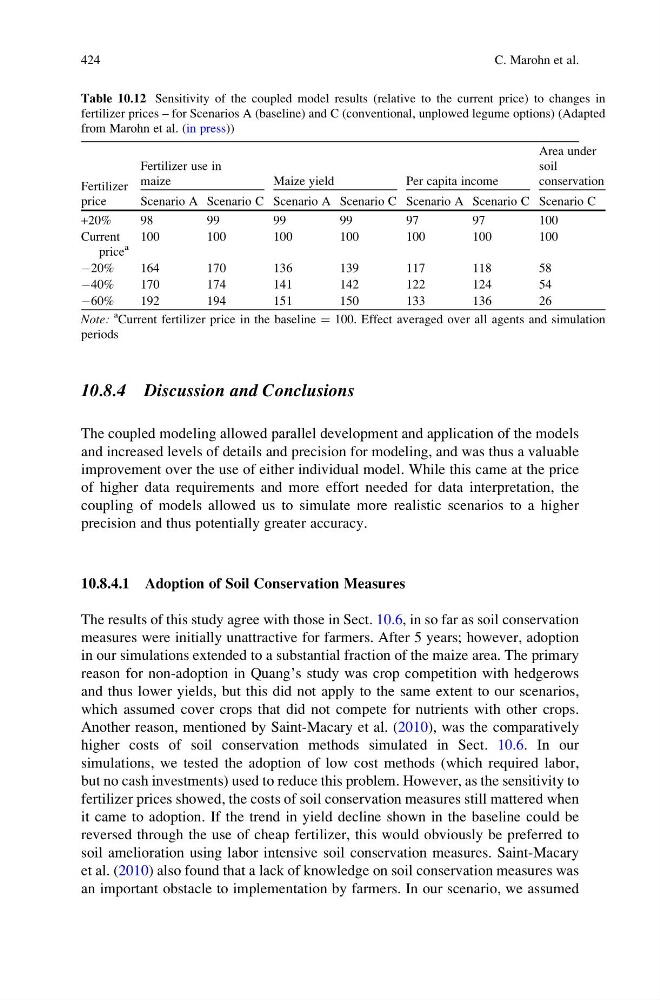
but no cash investments) used to reduce this problem. However, as the sensitivity to
fertilizer prices showed, the costs of soil conservation measures still mattered when
it came to adoption. If the trend in yield decline shown in the baseline could be
reversed through the use of cheap fertilizer, this would obviously be preferred to
soil amelioration using labor intensive soil conservation measures. Saint-Macary
et al. (2010) also found that a lack of knowledge on soil conservation measures was
an important obstacle to implementation by farmers. In our scenario, we assumed
Table 10.12 Sensitivity of the coupled model results (relative to the current price) to changes in
fertilizer prices – for Scenarios A (baseline) and C (conventional, unplowed legume options) (Adapted
from Marohn et al. (in press))
Fertilizer
price
Fertilizer use in
maize
Maize yield
Per capita income
Area under
soil
conservation
Scenario A Scenario C Scenario A Scenario C Scenario A Scenario C Scenario C
+20%
98
99
99
99
97
97
100
Current
price
a
100
100
100
100
100
100
100
À20%
164
170
136
139
117
118
58
À40%
170
174
141
142
122
124
54
À60%
192
194
151
150
133
136
26
Note:
a
Current fertilizer price in the baseline ¼ 100. Effect averaged over all agents and simulation
periods
424
C. Marohn et al.
The coupled modeling allowed parallel development and application of the models
and increased levels of details and precision for modeling, and was thus a valuable
improvement over the use of either individual model. While this came at the price
of higher data requirements and more effort needed for data interpretation, the
coupling of models allowed us to simulate more realistic scenarios to a higher
precision and thus potentially greater accuracy.
10.8.4.1 Adoption of Soil Conservation Measures
The results of this study agree with those in Sect. 10.6, in so far as soil conservation
measures were initially unattractive for farmers. After 5 years; however, adoption
in our simulations extended to a substantial fraction of the maize area. The primary
reason for non-adoption in Quang’s study was crop competition with hedgerows
and thus lower yields, but this did not apply to the same extent to our scenarios,
which assumed cover crops that did not compete for nutrients with other crops.
Another reason, mentioned by Saint-Macary et al. (2010), was the comparatively
higher costs of soil conservation methods simulated in Sect. 10.6. In our
simulations, we tested the adoption of low cost methods (which required labor,
but no cash investments) used to reduce this problem. However, as the sensitivity to
fertilizer prices showed, the costs of soil conservation measures still mattered when
it came to adoption. If the trend in yield decline shown in the baseline could be
reversed through the use of cheap fertilizer, this would obviously be preferred to
soil amelioration using labor intensive soil conservation measures. Saint-Macary
et al. (2010) also found that a lack of knowledge on soil conservation measures was
an important obstacle to implementation by farmers. In our scenario, we assumed
Table 10.12 Sensitivity of the coupled model results (relative to the current price) to changes in
fertilizer prices – for Scenarios A (baseline) and C (conventional, unplowed legume options) (Adapted
from Marohn et al. (in press))
Fertilizer
price
Fertilizer use in
maize
Maize yield
Per capita income
Area under
soil
conservation
Scenario A Scenario C Scenario A Scenario C Scenario A Scenario C Scenario C
+20%
98
99
99
99
97
97
100
Current
price
a
100
100
100
100
100
100
100
À20%
164
170
136
139
117
118
58
À40%
170
174
141
142
122
124
54
À60%
192
194
151
150
133
136
26
Note:
a
Current fertilizer price in the baseline ¼ 100. Effect averaged over all agents and simulation
periods
424
C. Marohn et al.