

10.5.6 Conclusion
The study presented here used an integrated model application called
CatchScapeFS, which was based on an MAS approach. The study showed that
the application was able to evaluate and project the sustainability of farming
systems in the study area. The model showed its ability to present the ex-ante
results, as emergence of the system generating through the systems’ complexity
property whereby the classic assumption, ceteris paribus, was neglected. Furthermore, qualitative and quantitative variables could be included together in the
model, which is difficult or impossible to achieve in conventional models. As a
consequence, a model relying on the MAS approach may be used to address
research questions over a wider or different perspective, in which the heterogeneity,
interaction and dynamics of the system elements need to be accounted for. However, the main purpose of the model was not to replace conventional approaches,
but rather to act as a complement; to enhance a study’s ability to answer research
questions over a wider range. Also, this study shows that modeling using a
behavioral, heuristic approach in general has advantages, not only in terms of
mimicking real-world situations, but also in terms of integrating other models,
those which use a different temporal resolution. Also, the activity processes in the
model can be presented in decision-tree diagrams, which make the model more
flexible when it comes to communicating with non-programmers and stakeholders,
those who participated in the model’s development.
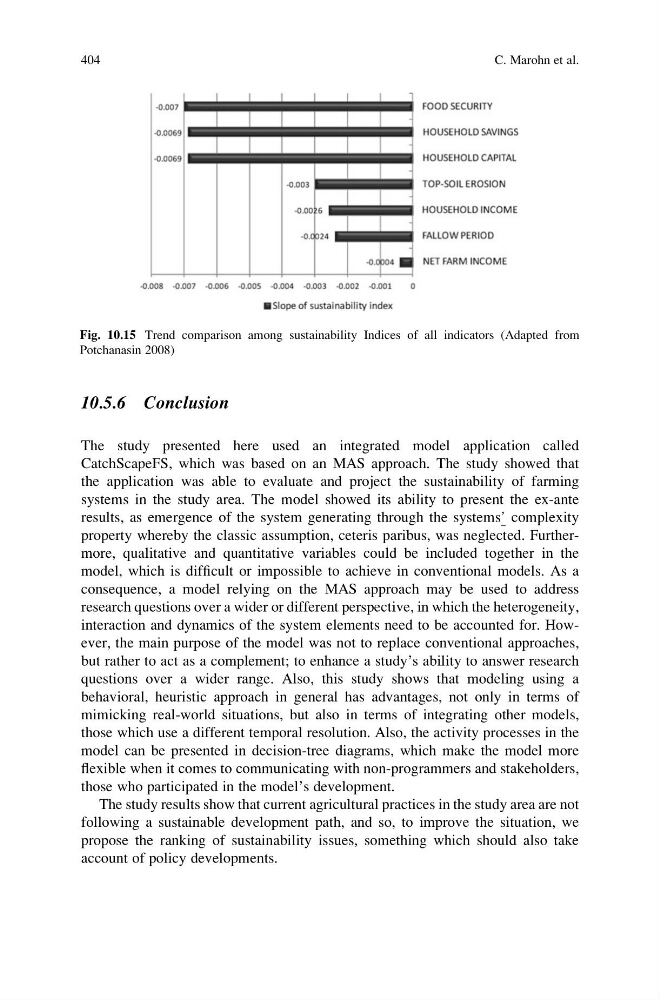
The study results show that current agricultural practices in the study area are not
following a sustainable development path, and so, to improve the situation, we
propose the ranking of sustainability issues, something which should also take
account of policy developments.
Fig. 10.15 Trend comparison among sustainability Indices of all indicators (Adapted from
Potchanasin 2008)
404
C. Marohn et al.
The study presented here used an integrated model application called
CatchScapeFS, which was based on an MAS approach. The study showed that
the application was able to evaluate and project the sustainability of farming
systems in the study area. The model showed its ability to present the ex-ante
results, as emergence of the system generating through the systems’ complexity
property whereby the classic assumption, ceteris paribus, was neglected. Furthermore, qualitative and quantitative variables could be included together in the
model, which is difficult or impossible to achieve in conventional models. As a
consequence, a model relying on the MAS approach may be used to address
research questions over a wider or different perspective, in which the heterogeneity,
interaction and dynamics of the system elements need to be accounted for. However, the main purpose of the model was not to replace conventional approaches,
but rather to act as a complement; to enhance a study’s ability to answer research
questions over a wider range. Also, this study shows that modeling using a
behavioral, heuristic approach in general has advantages, not only in terms of
mimicking real-world situations, but also in terms of integrating other models,
those which use a different temporal resolution. Also, the activity processes in the
model can be presented in decision-tree diagrams, which make the model more
flexible when it comes to communicating with non-programmers and stakeholders,
those who participated in the model’s development.
The study results show that current agricultural practices in the study area are not
following a sustainable development path, and so, to improve the situation, we
propose the ranking of sustainability issues, something which should also take
account of policy developments.
Fig. 10.15 Trend comparison among sustainability Indices of all indicators (Adapted from
Potchanasin 2008)
404
C. Marohn et al.