

The lack of sustainability could also be noticed through a worsening of the
household savings and capital indicator situation, meaning that the situation regarding household capital became less sustainable over time; the result of a decreased
production of farm products (farm capital goods). This situation subsequently
compromised the ability of households to recover once faced with stress events.
Regarding food security, sustainability slightly decreased; however, the results
show a strong variation at the beginning of the first 4 years, which was influenced
by an unfavorable distribution of rainfall and a poor availability of suitable land
during some of the production years. This situation induced a lag in the production
decisions, or led to wrong decisions being made by the farm agents, corresponding
to biophysical conditions that were uncertain and varied from year to year. In the
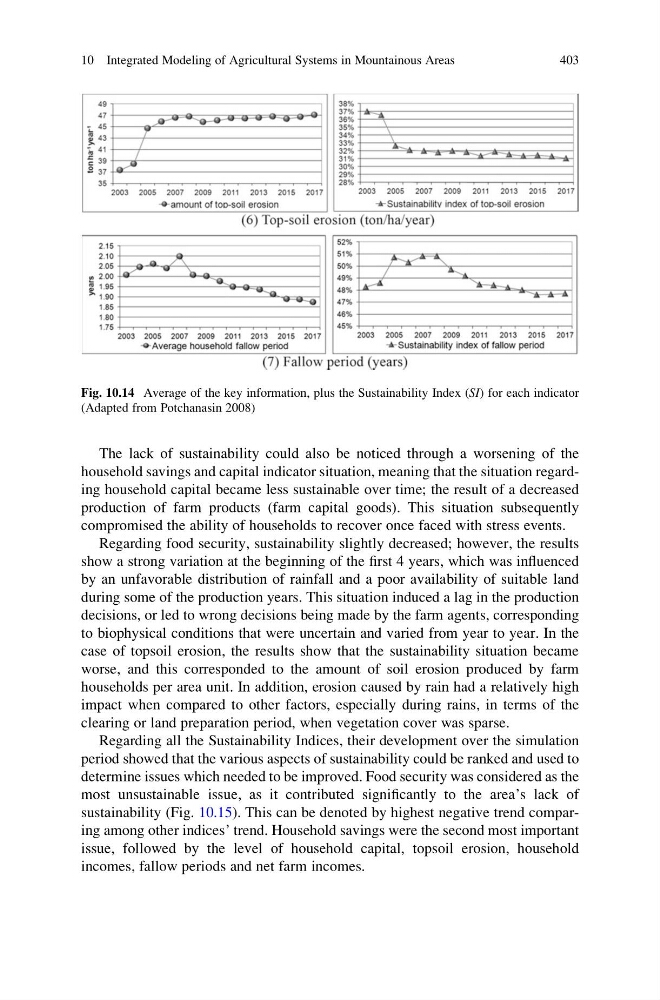
case of topsoil erosion, the results show that the sustainability situation became
worse, and this corresponded to the amount of soil erosion produced by farm
households per area unit. In addition, erosion caused by rain had a relatively high
impact when compared to other factors, especially during rains, in terms of the
clearing or land preparation period, when vegetation cover was sparse.
Regarding all the Sustainability Indices, their development over the simulation
period showed that the various aspects of sustainability could be ranked and used to
determine issues which needed to be improved. Food security was considered as the
most unsustainable issue, as it contributed significantly to the area’s lack of
sustainability (Fig. 10.15). This can be denoted by highest negative trend comparing among other indices’ trend. Household savings were the second most important
issue, followed by the level of household capital, topsoil erosion, household
incomes, fallow periods and net farm incomes.
Fig. 10.14 Average of the key information, plus the Sustainability Index (SI) for each indicator
(Adapted from Potchanasin 2008)
10 Integrated Modeling of Agricultural Systems in Mountainous Areas
403
household savings and capital indicator situation, meaning that the situation regarding household capital became less sustainable over time; the result of a decreased
production of farm products (farm capital goods). This situation subsequently
compromised the ability of households to recover once faced with stress events.
Regarding food security, sustainability slightly decreased; however, the results
show a strong variation at the beginning of the first 4 years, which was influenced
by an unfavorable distribution of rainfall and a poor availability of suitable land
during some of the production years. This situation induced a lag in the production
decisions, or led to wrong decisions being made by the farm agents, corresponding
to biophysical conditions that were uncertain and varied from year to year. In the
case of topsoil erosion, the results show that the sustainability situation became
worse, and this corresponded to the amount of soil erosion produced by farm
households per area unit. In addition, erosion caused by rain had a relatively high
impact when compared to other factors, especially during rains, in terms of the
clearing or land preparation period, when vegetation cover was sparse.
Regarding all the Sustainability Indices, their development over the simulation
period showed that the various aspects of sustainability could be ranked and used to
determine issues which needed to be improved. Food security was considered as the
most unsustainable issue, as it contributed significantly to the area’s lack of
sustainability (Fig. 10.15). This can be denoted by highest negative trend comparing among other indices’ trend. Household savings were the second most important
issue, followed by the level of household capital, topsoil erosion, household
incomes, fallow periods and net farm incomes.
Fig. 10.14 Average of the key information, plus the Sustainability Index (SI) for each indicator
(Adapted from Potchanasin 2008)
10 Integrated Modeling of Agricultural Systems in Mountainous Areas
403