

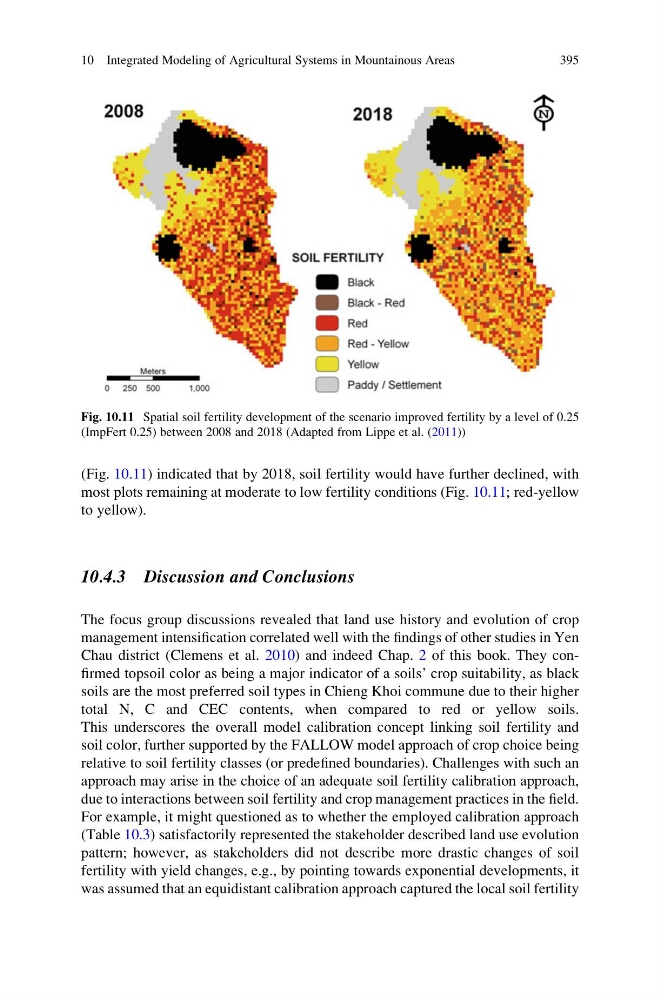
(Fig. 10.11) indicated that by 2018, soil fertility would have further declined, with
most plots remaining at moderate to low fertility conditions (Fig. 10.11; red-yellow
to yellow).
10.4.3 Discussion and Conclusions
The focus group discussions revealed that land use history and evolution of crop
management intensification correlated well with the findings of other studies in Yen
Chau district (Clemens et al. 2010) and indeed Chap. 2 of this book. They confirmed topsoil color as being a major indicator of a soils’ crop suitability, as black
soils are the most preferred soil types in Chieng Khoi commune due to their higher
total N, C and CEC contents, when compared to red or yellow soils.
This underscores the overall model calibration concept linking soil fertility and
soil color, further supported by the FALLOW model approach of crop choice being
relative to soil fertility classes (or predefined boundaries). Challenges with such an
approach may arise in the choice of an adequate soil fertility calibration approach,
due to interactions between soil fertility and crop management practices in the field.
For example, it might questioned as to whether the employed calibration approach
(Table 10.3) satisfactorily represented the stakeholder described land use evolution
pattern; however, as stakeholders did not describe more drastic changes of soil
fertility with yield changes, e.g., by pointing towards exponential developments, it
was assumed that an equidistant calibration approach captured the local soil fertility
Fig. 10.11 Spatial soil fertility development of the scenario improved fertility by a level of 0.25
(ImpFert 0.25) between 2008 and 2018 (Adapted from Lippe et al. (2011))
10 Integrated Modeling of Agricultural Systems in Mountainous Areas
395
most plots remaining at moderate to low fertility conditions (Fig. 10.11; red-yellow
to yellow).
10.4.3 Discussion and Conclusions
The focus group discussions revealed that land use history and evolution of crop
management intensification correlated well with the findings of other studies in Yen
Chau district (Clemens et al. 2010) and indeed Chap. 2 of this book. They confirmed topsoil color as being a major indicator of a soils’ crop suitability, as black
soils are the most preferred soil types in Chieng Khoi commune due to their higher
total N, C and CEC contents, when compared to red or yellow soils.
This underscores the overall model calibration concept linking soil fertility and
soil color, further supported by the FALLOW model approach of crop choice being
relative to soil fertility classes (or predefined boundaries). Challenges with such an
approach may arise in the choice of an adequate soil fertility calibration approach,
due to interactions between soil fertility and crop management practices in the field.
For example, it might questioned as to whether the employed calibration approach
(Table 10.3) satisfactorily represented the stakeholder described land use evolution
pattern; however, as stakeholders did not describe more drastic changes of soil
fertility with yield changes, e.g., by pointing towards exponential developments, it
was assumed that an equidistant calibration approach captured the local soil fertility
Fig. 10.11 Spatial soil fertility development of the scenario improved fertility by a level of 0.25
(ImpFert 0.25) between 2008 and 2018 (Adapted from Lippe et al. (2011))
10 Integrated Modeling of Agricultural Systems in Mountainous Areas
395