

highlighted the fact that fertilizer application and hybrid crop varieties were
masking the ongoing decline of soil fertility in the case study area; therefore, the
findings of the model simulation had a much broader message to convey at the
regional level, as many areas in the mountainous parts of northern Vietnam face
similar challenges. An apparent limitation of the study was failing to pass on the
modeling results to local stakeholders and regional policy makers (the soft systems
validation), as the primary aim of the study was to calibrate the employed land use
model with qualitative datasets in data-poor environments, considered a novelty by
the research team with regard to environmental modeling. However, the study
shows that building on an iterative participatory approach to obtain input variables
is suitable for semi-quantitative modeling and as a methodological pathway to
foster the implementation of sustainable upland cropping practices. The combined
approach used here has been shown to be a useful tool due to its open and adaptive
research approach in a data-poor environment.
9.3.2.2 Challenges for Stakeholder Involvement in Modeling
Whereas earlier studies involving participatory modeling tended to be over- enthusiastic towards the potential of such approaches (e.g., Barreteau 2003; Castella et al.
2005), several recent studies have drawn more attention to the ethical, social and
political challenges, pitfalls and constraints of stakeholder involvement in modeling,
particularly in potential conflict situations and in the context of severe power
differentials among stakeholders (e.g., Becu et al. 2008; Voinov and Bousquet 2010).
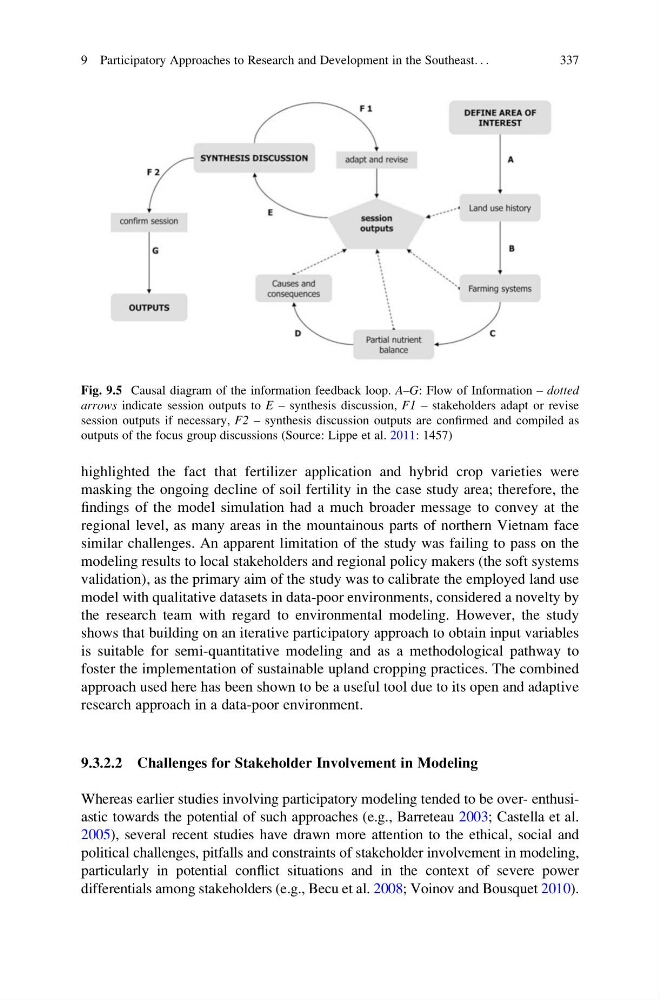
Fig. 9.5 Causal diagram of the information feedback loop. A–G: Flow of Information – dotted
arrows indicate session outputs to E – synthesis discussion, F1 – stakeholders adapt or revise
session outputs if necessary, F2 – synthesis discussion outputs are confirmed and compiled as
outputs of the focus group discussions (Source: Lippe et al. 2011: 1457)
9 Participatory Approaches to Research and Development in the Southeast. . .
337
masking the ongoing decline of soil fertility in the case study area; therefore, the
findings of the model simulation had a much broader message to convey at the
regional level, as many areas in the mountainous parts of northern Vietnam face
similar challenges. An apparent limitation of the study was failing to pass on the
modeling results to local stakeholders and regional policy makers (the soft systems
validation), as the primary aim of the study was to calibrate the employed land use
model with qualitative datasets in data-poor environments, considered a novelty by
the research team with regard to environmental modeling. However, the study
shows that building on an iterative participatory approach to obtain input variables
is suitable for semi-quantitative modeling and as a methodological pathway to
foster the implementation of sustainable upland cropping practices. The combined
approach used here has been shown to be a useful tool due to its open and adaptive
research approach in a data-poor environment.
9.3.2.2 Challenges for Stakeholder Involvement in Modeling
Whereas earlier studies involving participatory modeling tended to be over- enthusiastic towards the potential of such approaches (e.g., Barreteau 2003; Castella et al.
2005), several recent studies have drawn more attention to the ethical, social and
political challenges, pitfalls and constraints of stakeholder involvement in modeling,
particularly in potential conflict situations and in the context of severe power
differentials among stakeholders (e.g., Becu et al. 2008; Voinov and Bousquet 2010).
Fig. 9.5 Causal diagram of the information feedback loop. A–G: Flow of Information – dotted
arrows indicate session outputs to E – synthesis discussion, F1 – stakeholders adapt or revise
session outputs if necessary, F2 – synthesis discussion outputs are confirmed and compiled as
outputs of the focus group discussions (Source: Lippe et al. 2011: 1457)
9 Participatory Approaches to Research and Development in the Southeast. . .
337