

(fresh matter, FM) at the case study farms, as this species has to consume large
quantities of plant material in order to obtain the nutrients required (Tan 1970;
Cui et al. 1992, 1994). The gross relationship, in the case study ponds, between the
amount of green fodder applied (FM) and the net gain in grass carp biomass (FM)
showed that 1 kg of grass carp was produced when approximately 68 kg of grass
and leaf material were applied to the pond.
Table 8.3 shows the gross chemical composition of some typical feeds used in
the study area – data partly published by Dongmeza et al. (2009). Most of the feeds
applied here have high moisture and fiber content and relatively low protein
content. Dongmeza et al. (2009) found that the general quality of the applied
feeds was rather poor; however, certain feeds such as cassava and mulberry leaves
contained high crude protein contents (20–30 %) (Dongmeza et al. 2009), though
high protein content does not necessarily indicate a better quality diet, as
demonstrated by authors such as Shireman et al. (1978) and Tan (1970). Low
fiber content is also an important factor, and the digestibility coefficients for
crude protein and gross energy; for example, decline significantly with increased
fiber content of the plant feed (Hajra et al. 1987). As well as the gross energy and
chemical composition, the presence of anti-nutrients may also influence fish growth
(Francis et al. 2001a, b, 2002). Banana leaves; for example, contain tannins and
saponins, and cassava leaves contain cyanides, tannins and saponins, which show
haemolytic activity (Dongmeza et al. 2009).
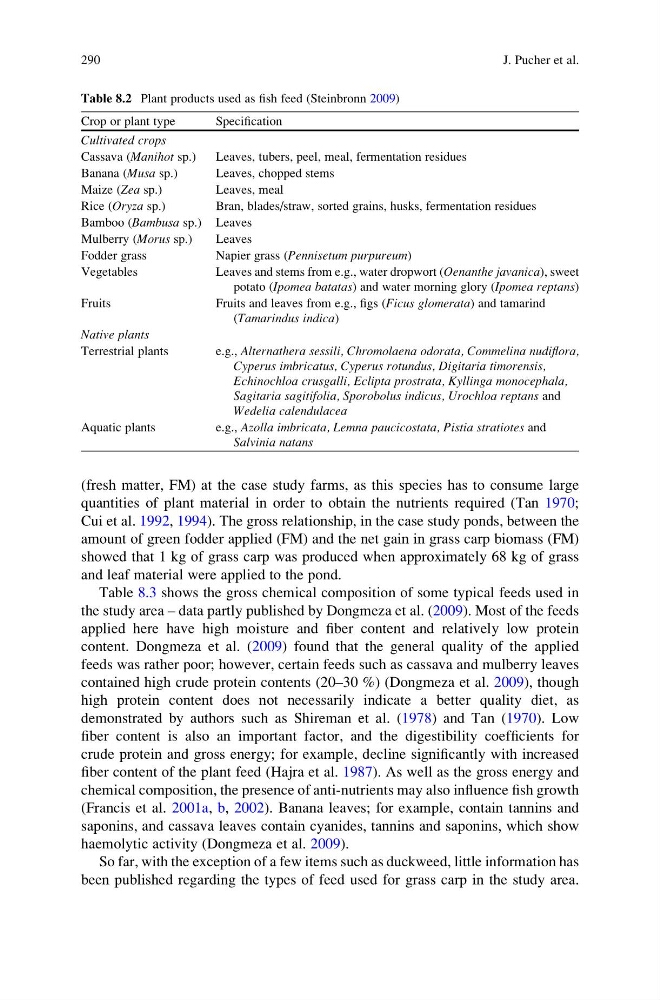
So far, with the exception of a few items such as duckweed, little information has
been published regarding the types of feed used for grass carp in the study area.
Table 8.2 Plant products used as fish feed (Steinbronn 2009)
Crop or plant type
Specification
Cultivated crops
Cassava (Manihot sp.)
Leaves, tubers, peel, meal, fermentation residues
Banana (Musa sp.)
Leaves, chopped stems
Maize (Zea sp.)
Leaves, meal
Rice (Oryza sp.)
Bran, blades/straw, sorted grains, husks, fermentation residues
Bamboo (Bambusa sp.) Leaves
Mulberry (Morus sp.)
Leaves
Fodder grass
Napier grass (Pennisetum purpureum)
Vegetables
Leaves and stems from e.g., water dropwort (Oenanthe javanica), sweet
potato (Ipomea batatas) and water morning glory (Ipomea reptans)
Fruits
Fruits and leaves from e.g., figs (Ficus glomerata) and tamarind
(Tamarindus indica)
Native plants
Terrestrial plants
e.g., Alternathera sessili, Chromolaena odorata, Commelina nudiflora,
Cyperus imbricatus, Cyperus rotundus, Digitaria timorensis,
Echinochloa crusgalli, Eclipta prostrata, Kyllinga monocephala,
Sagitaria sagitifolia, Sporobolus indicus, Urochloa reptans and
Wedelia calendulacea
Aquatic plants
e.g., Azolla imbricata, Lemna paucicostata, Pistia stratiotes and
Salvinia natans
290
J. Pucher et al.
quantities of plant material in order to obtain the nutrients required (Tan 1970;
Cui et al. 1992, 1994). The gross relationship, in the case study ponds, between the
amount of green fodder applied (FM) and the net gain in grass carp biomass (FM)
showed that 1 kg of grass carp was produced when approximately 68 kg of grass
and leaf material were applied to the pond.
Table 8.3 shows the gross chemical composition of some typical feeds used in
the study area – data partly published by Dongmeza et al. (2009). Most of the feeds
applied here have high moisture and fiber content and relatively low protein
content. Dongmeza et al. (2009) found that the general quality of the applied
feeds was rather poor; however, certain feeds such as cassava and mulberry leaves
contained high crude protein contents (20–30 %) (Dongmeza et al. 2009), though
high protein content does not necessarily indicate a better quality diet, as
demonstrated by authors such as Shireman et al. (1978) and Tan (1970). Low
fiber content is also an important factor, and the digestibility coefficients for
crude protein and gross energy; for example, decline significantly with increased
fiber content of the plant feed (Hajra et al. 1987). As well as the gross energy and
chemical composition, the presence of anti-nutrients may also influence fish growth
(Francis et al. 2001a, b, 2002). Banana leaves; for example, contain tannins and
saponins, and cassava leaves contain cyanides, tannins and saponins, which show
haemolytic activity (Dongmeza et al. 2009).
So far, with the exception of a few items such as duckweed, little information has
been published regarding the types of feed used for grass carp in the study area.
Table 8.2 Plant products used as fish feed (Steinbronn 2009)
Crop or plant type
Specification
Cultivated crops
Cassava (Manihot sp.)
Leaves, tubers, peel, meal, fermentation residues
Banana (Musa sp.)
Leaves, chopped stems
Maize (Zea sp.)
Leaves, meal
Rice (Oryza sp.)
Bran, blades/straw, sorted grains, husks, fermentation residues
Bamboo (Bambusa sp.) Leaves
Mulberry (Morus sp.)
Leaves
Fodder grass
Napier grass (Pennisetum purpureum)
Vegetables
Leaves and stems from e.g., water dropwort (Oenanthe javanica), sweet
potato (Ipomea batatas) and water morning glory (Ipomea reptans)
Fruits
Fruits and leaves from e.g., figs (Ficus glomerata) and tamarind
(Tamarindus indica)
Native plants
Terrestrial plants
e.g., Alternathera sessili, Chromolaena odorata, Commelina nudiflora,
Cyperus imbricatus, Cyperus rotundus, Digitaria timorensis,
Echinochloa crusgalli, Eclipta prostrata, Kyllinga monocephala,
Sagitaria sagitifolia, Sporobolus indicus, Urochloa reptans and
Wedelia calendulacea
Aquatic plants
e.g., Azolla imbricata, Lemna paucicostata, Pistia stratiotes and
Salvinia natans
290
J. Pucher et al.