

poor- and medium-quality soils rather than on fertile plots. Farmers’ propensity to
establish agroforestry on a plot of poor soil fertility was 19 percentage points higher
than on a fertile plot, implying that farmers tended not to use the technology as a
precautionary measure to avoid a loss in soil fertility. In conformance with the
qualitative results, the relative size of the plots also influenced adoption decisions at
the plot level. We found that 62 % of the adopters chose the first or second largest of
their plots to implement the technology. Regarding agroforestry, space was a
constraining factor, as both trees and hedgerows occupy parts of the plot; moreover,
they may have negatively affected the crop through shading and competition for
nutrients. As in the household-level model, support was found to be an important
determinant of the adoption decision (although the measured effect was of smaller
magnitude), while access to credit was insignificant. According to the plot-level
model, receiving outside support increased the probability of establishing agroforestry by 5–24 percentage points (95 % confidence interval).
Finally, variables capturing land policy had a significant effect, though in this
model we omitted those variables reflecting experiences of land reallocations, as
their coefficients were not statistically significant, but their inclusion reduced the
predictive quality of the model. We found that plots operated under a land title were
more likely to be covered by agroforestry than other plots. The marginal effect
differed significantly from zero at the 1 % level of error probability ranging from
0.7 to 4.6 percentage points (95 % confidence interval). Similar to the householdlevel model, we found that the households’ personal expectation did not influence
adoption at the plot level, but that the same variable measured at the village level
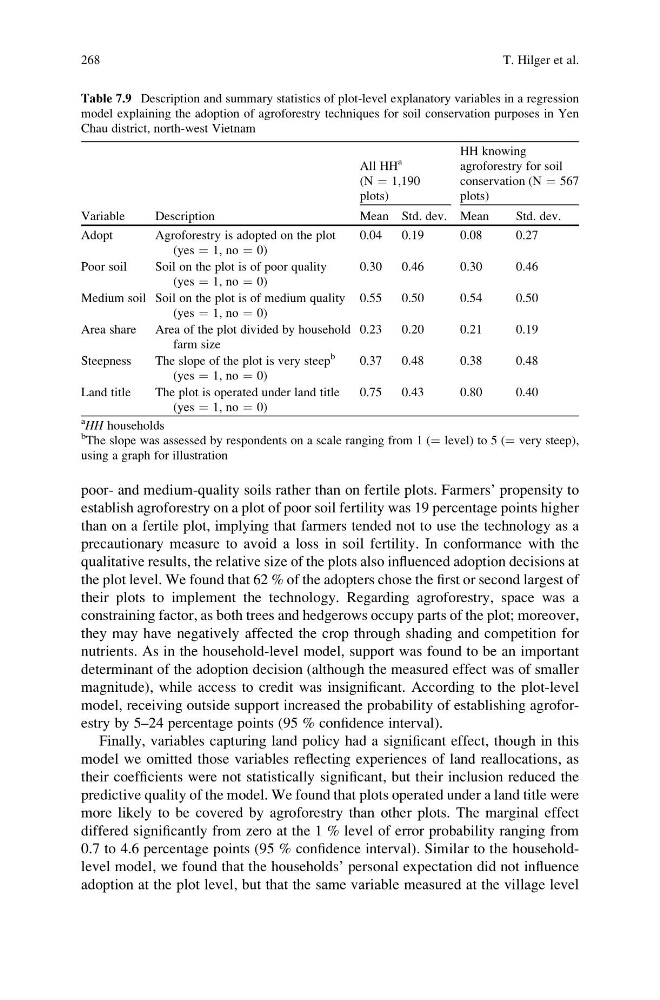
Table 7.9 Description and summary statistics of plot-level explanatory variables in a regression
model explaining the adoption of agroforestry techniques for soil conservation purposes in Yen
Chau district, north-west Vietnam
Variable
Description
All HH
a
(N ¼ 1,190
plots)
HH knowing
agroforestry for soil
conservation (N ¼ 567
plots)
Mean Std. dev. Mean
Std. dev.
Adopt
Agroforestry is adopted on the plot
(yes ¼ 1, no ¼ 0)
0.04
0.19
0.08
0.27
Poor soil
Soil on the plot is of poor quality
(yes ¼ 1, no ¼ 0)
0.30
0.46
0.30
0.46
Medium soil Soil on the plot is of medium quality
(yes ¼ 1, no ¼ 0)
0.55
0.50
0.54
0.50
Area share Area of the plot divided by household
farm size
0.23
0.20
0.21
0.19
Steepness
The slope of the plot is very steep
b
(yes ¼ 1, no ¼ 0)
0.37
0.48
0.38
0.48
Land title
The plot is operated under land title
(yes ¼ 1, no ¼ 0)
0.75
0.43
0.80
0.40
a
HH households
b
The slope was assessed by respondents on a scale ranging from 1 (¼ level) to 5 (¼ very steep),
using a graph for illustration
268
T. Hilger et al.
establish agroforestry on a plot of poor soil fertility was 19 percentage points higher
than on a fertile plot, implying that farmers tended not to use the technology as a
precautionary measure to avoid a loss in soil fertility. In conformance with the
qualitative results, the relative size of the plots also influenced adoption decisions at
the plot level. We found that 62 % of the adopters chose the first or second largest of
their plots to implement the technology. Regarding agroforestry, space was a
constraining factor, as both trees and hedgerows occupy parts of the plot; moreover,
they may have negatively affected the crop through shading and competition for
nutrients. As in the household-level model, support was found to be an important
determinant of the adoption decision (although the measured effect was of smaller
magnitude), while access to credit was insignificant. According to the plot-level
model, receiving outside support increased the probability of establishing agroforestry by 5–24 percentage points (95 % confidence interval).
Finally, variables capturing land policy had a significant effect, though in this
model we omitted those variables reflecting experiences of land reallocations, as
their coefficients were not statistically significant, but their inclusion reduced the
predictive quality of the model. We found that plots operated under a land title were
more likely to be covered by agroforestry than other plots. The marginal effect
differed significantly from zero at the 1 % level of error probability ranging from
0.7 to 4.6 percentage points (95 % confidence interval). Similar to the householdlevel model, we found that the households’ personal expectation did not influence
adoption at the plot level, but that the same variable measured at the village level
Table 7.9 Description and summary statistics of plot-level explanatory variables in a regression
model explaining the adoption of agroforestry techniques for soil conservation purposes in Yen
Chau district, north-west Vietnam
Variable
Description
All HH
a
(N ¼ 1,190
plots)
HH knowing
agroforestry for soil
conservation (N ¼ 567
plots)
Mean Std. dev. Mean
Std. dev.
Adopt
Agroforestry is adopted on the plot
(yes ¼ 1, no ¼ 0)
0.04
0.19
0.08
0.27
Poor soil
Soil on the plot is of poor quality
(yes ¼ 1, no ¼ 0)
0.30
0.46
0.30
0.46
Medium soil Soil on the plot is of medium quality
(yes ¼ 1, no ¼ 0)
0.55
0.50
0.54
0.50
Area share Area of the plot divided by household
farm size
0.23
0.20
0.21
0.19
Steepness
The slope of the plot is very steep
b
(yes ¼ 1, no ¼ 0)
0.37
0.48
0.38
0.48
Land title
The plot is operated under land title
(yes ¼ 1, no ¼ 0)
0.75
0.43
0.80
0.40
a
HH households
b
The slope was assessed by respondents on a scale ranging from 1 (¼ level) to 5 (¼ very steep),
using a graph for illustration
268
T. Hilger et al.