

red-yellow and yellow-black), and then combined these with inherent soil fertility
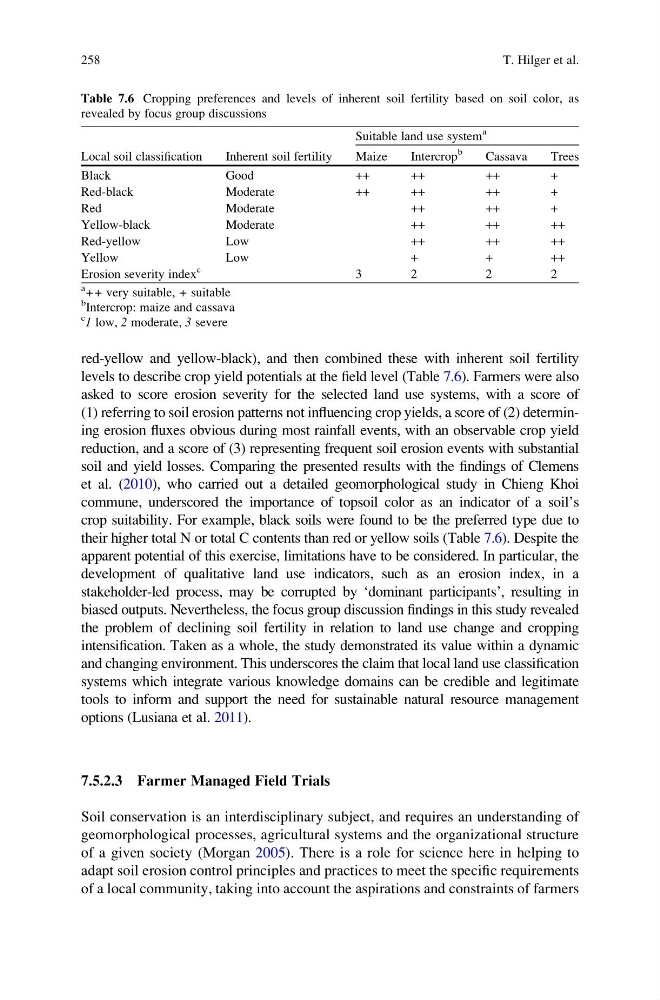
levels to describe crop yield potentials at the field level (Table 7.6). Farmers were also
asked to score erosion severity for the selected land use systems, with a score of
(1) referring to soil erosion patterns not influencing crop yields, a score of (2) determining erosion fluxes obvious during most rainfall events, with an observable crop yield
reduction, and a score of (3) representing frequent soil erosion events with substantial
soil and yield losses. Comparing the presented results with the findings of Clemens
et al. (2010), who carried out a detailed geomorphological study in Chieng Khoi
commune, underscored the importance of topsoil color as an indicator of a soil’s
crop suitability. For example, black soils were found to be the preferred type due to
their higher total N or total C contents than red or yellow soils (Table 7.6). Despite the
apparent potential of this exercise, limitations have to be considered. In particular, the
development of qualitative land use indicators, such as an erosion index, in a
stakeholder-led process, may be corrupted by ‘dominant participants’, resulting in
biased outputs. Nevertheless, the focus group discussion findings in this study revealed
the problem of declining soil fertility in relation to land use change and cropping
intensification. Taken as a whole, the study demonstrated its value within a dynamic
and changing environment. This underscores the claim that local land use classification
systems which integrate various knowledge domains can be credible and legitimate
tools to inform and support the need for sustainable natural resource management
options (Lusiana et al. 2011).
7.5.2.3 Farmer Managed Field Trials
Soil conservation is an interdisciplinary subject, and requires an understanding of
geomorphological processes, agricultural systems and the organizational structure
of a given society (Morgan 2005). There is a role for science here in helping to
adapt soil erosion control principles and practices to meet the specific requirements
of a local community, taking into account the aspirations and constraints of farmers
Table 7.6 Cropping preferences and levels of inherent soil fertility based on soil color, as
revealed by focus group discussions
Local soil classification
Inherent soil fertility
Suitable land use system
a
Maize
Intercrop
b
Cassava
Trees
Black
Good
++
++
++
+
Red-black
Moderate
++
++
++
+
Red
Moderate
++
++
+
Yellow-black
Moderate
++
++
++
Red-yellow
Low
++
++
++
Yellow
Low
+
+
++
Erosion severity index
c
3
2
2
2
a
++ very suitable, + suitable
b
Intercrop: maize and cassava
c
1 low, 2 moderate, 3 severe
258
T. Hilger et al.
levels to describe crop yield potentials at the field level (Table 7.6). Farmers were also
asked to score erosion severity for the selected land use systems, with a score of
(1) referring to soil erosion patterns not influencing crop yields, a score of (2) determining erosion fluxes obvious during most rainfall events, with an observable crop yield
reduction, and a score of (3) representing frequent soil erosion events with substantial
soil and yield losses. Comparing the presented results with the findings of Clemens
et al. (2010), who carried out a detailed geomorphological study in Chieng Khoi
commune, underscored the importance of topsoil color as an indicator of a soil’s
crop suitability. For example, black soils were found to be the preferred type due to
their higher total N or total C contents than red or yellow soils (Table 7.6). Despite the
apparent potential of this exercise, limitations have to be considered. In particular, the
development of qualitative land use indicators, such as an erosion index, in a
stakeholder-led process, may be corrupted by ‘dominant participants’, resulting in
biased outputs. Nevertheless, the focus group discussion findings in this study revealed
the problem of declining soil fertility in relation to land use change and cropping
intensification. Taken as a whole, the study demonstrated its value within a dynamic
and changing environment. This underscores the claim that local land use classification
systems which integrate various knowledge domains can be credible and legitimate
tools to inform and support the need for sustainable natural resource management
options (Lusiana et al. 2011).
7.5.2.3 Farmer Managed Field Trials
Soil conservation is an interdisciplinary subject, and requires an understanding of
geomorphological processes, agricultural systems and the organizational structure
of a given society (Morgan 2005). There is a role for science here in helping to
adapt soil erosion control principles and practices to meet the specific requirements
of a local community, taking into account the aspirations and constraints of farmers
Table 7.6 Cropping preferences and levels of inherent soil fertility based on soil color, as
revealed by focus group discussions
Local soil classification
Inherent soil fertility
Suitable land use system
a
Maize
Intercrop
b
Cassava
Trees
Black
Good
++
++
++
+
Red-black
Moderate
++
++
++
+
Red
Moderate
++
++
+
Yellow-black
Moderate
++
++
++
Red-yellow
Low
++
++
++
Yellow
Low
+
+
++
Erosion severity index
c
3
2
2
2
a
++ very suitable, + suitable
b
Intercrop: maize and cassava
c
1 low, 2 moderate, 3 severe
258
T. Hilger et al.