

Moderate levels of sediment flow from upper to lower slope positions in the
landscape may benefit the lower slopes by providing additional nutrients (Schmitter
et al. 2011), but severe soil erosion leads to the accumulation of eroded infertile
subsoil material in the lower slope positions, that which may no longer support
intensive agricultural production (Clemens et al. 2010).
As natural systems are complex in their behavior, the effects of land use change
depend on a multitude of processes and site specific characteristics with various
spatial and temporal dimensions (Phillips 2003). Hence, similar conditions and
processes may develop in different ways and adjust to multiple states at varying
times and on different scales (Bruijnzeel 2004). As a consequence, it is difficult to
generalize regarding resource stock changes that occur due to land use change and
intensification; it also complicates the definition of what is environmentally sustainable. Simplified narratives of causes and effects can be influential, but not
necessarily conducive to addressing the problem of conserving natural resources
(Forsyth and Walker 2008).
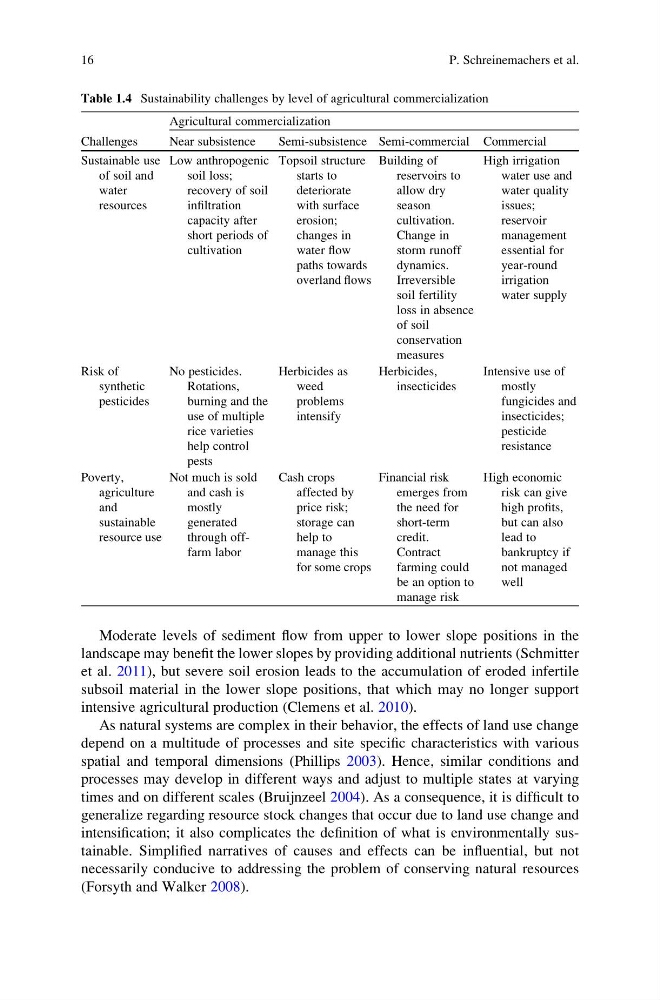
Table 1.4 Sustainability challenges by level of agricultural commercialization
Challenges
Agricultural commercialization
Near subsistence
Semi-subsistence Semi-commercial Commercial
Sustainable use
of soil and
water
resources
Low anthropogenic
soil loss;
recovery of soil
infiltration
capacity after
short periods of
cultivation
Topsoil structure
starts to
deteriorate
with surface
erosion;
changes in
water flow
paths towards
overland flows
Building of
reservoirs to
allow dry
season
cultivation.
Change in
storm runoff
dynamics.
Irreversible
soil fertility
loss in absence
of soil
conservation
measures
High irrigation
water use and
water quality
issues;
reservoir
management
essential for
year-round
irrigation
water supply
Risk of
synthetic
pesticides
No pesticides.
Rotations,
burning and the
use of multiple
rice varieties
help control
pests
Herbicides as
weed
problems
intensify
Herbicides,
insecticides
Intensive use of
mostly
fungicides and
insecticides;
pesticide
resistance
Poverty,
agriculture
and
sustainable
resource use
Not much is sold
and cash is
mostly
generated
through offfarm labor
Cash crops
affected by
price risk;
storage can
help to
manage this
for some crops
Financial risk
emerges from
the need for
short-term
credit.
Contract
farming could
be an option to
manage risk
High economic
risk can give
high profits,
but can also
lead to
bankruptcy if
not managed
well
16
P. Schreinemachers et al.
landscape may benefit the lower slopes by providing additional nutrients (Schmitter
et al. 2011), but severe soil erosion leads to the accumulation of eroded infertile
subsoil material in the lower slope positions, that which may no longer support
intensive agricultural production (Clemens et al. 2010).
As natural systems are complex in their behavior, the effects of land use change
depend on a multitude of processes and site specific characteristics with various
spatial and temporal dimensions (Phillips 2003). Hence, similar conditions and
processes may develop in different ways and adjust to multiple states at varying
times and on different scales (Bruijnzeel 2004). As a consequence, it is difficult to
generalize regarding resource stock changes that occur due to land use change and
intensification; it also complicates the definition of what is environmentally sustainable. Simplified narratives of causes and effects can be influential, but not
necessarily conducive to addressing the problem of conserving natural resources
(Forsyth and Walker 2008).
Table 1.4 Sustainability challenges by level of agricultural commercialization
Challenges
Agricultural commercialization
Near subsistence
Semi-subsistence Semi-commercial Commercial
Sustainable use
of soil and
water
resources
Low anthropogenic
soil loss;
recovery of soil
infiltration
capacity after
short periods of
cultivation
Topsoil structure
starts to
deteriorate
with surface
erosion;
changes in
water flow
paths towards
overland flows
Building of
reservoirs to
allow dry
season
cultivation.
Change in
storm runoff
dynamics.
Irreversible
soil fertility
loss in absence
of soil
conservation
measures
High irrigation
water use and
water quality
issues;
reservoir
management
essential for
year-round
irrigation
water supply
Risk of
synthetic
pesticides
No pesticides.
Rotations,
burning and the
use of multiple
rice varieties
help control
pests
Herbicides as
weed
problems
intensify
Herbicides,
insecticides
Intensive use of
mostly
fungicides and
insecticides;
pesticide
resistance
Poverty,
agriculture
and
sustainable
resource use
Not much is sold
and cash is
mostly
generated
through offfarm labor
Cash crops
affected by
price risk;
storage can
help to
manage this
for some crops
Financial risk
emerges from
the need for
short-term
credit.
Contract
farming could
be an option to
manage risk
High economic
risk can give
high profits,
but can also
lead to
bankruptcy if
not managed
well
16
P. Schreinemachers et al.