

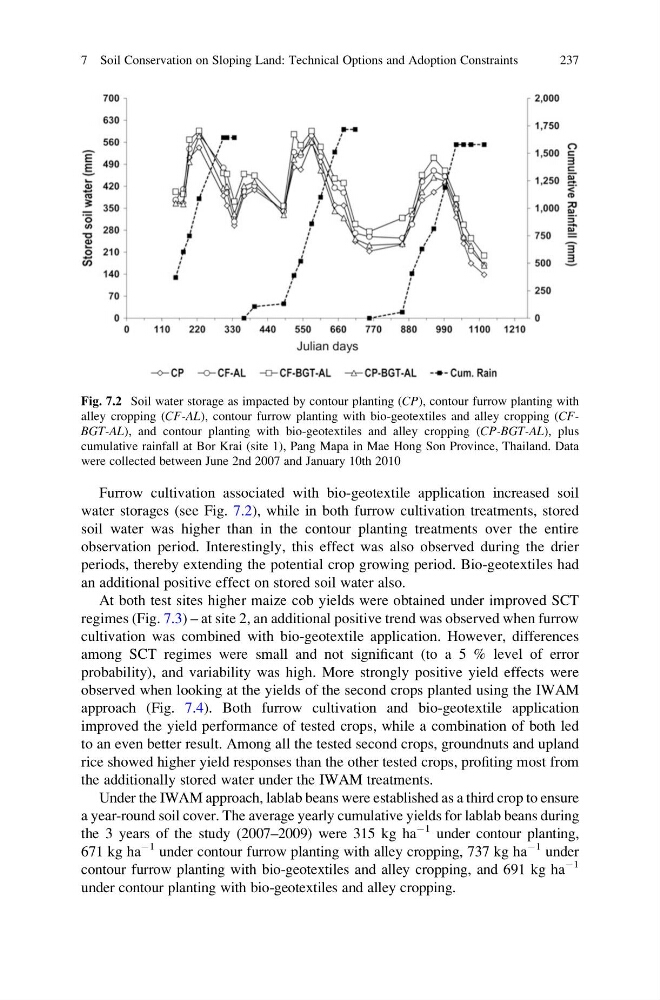
Furrow cultivation associated with bio-geotextile application increased soil
water storages (see Fig. 7.2), while in both furrow cultivation treatments, stored
soil water was higher than in the contour planting treatments over the entire
observation period. Interestingly, this effect was also observed during the drier
periods, thereby extending the potential crop growing period. Bio-geotextiles had
an additional positive effect on stored soil water also.
At both test sites higher maize cob yields were obtained under improved SCT
regimes (Fig. 7.3) – at site 2, an additional positive trend was observed when furrow
cultivation was combined with bio-geotextile application. However, differences
among SCT regimes were small and not significant (to a 5 % level of error
probability), and variability was high. More strongly positive yield effects were
observed when looking at the yields of the second crops planted using the IWAM
approach (Fig. 7.4). Both furrow cultivation and bio-geotextile application
improved the yield performance of tested crops, while a combination of both led
to an even better result. Among all the tested second crops, groundnuts and upland
rice showed higher yield responses than the other tested crops, profiting most from
the additionally stored water under the IWAM treatments.
Under the IWAM approach, lablab beans were established as a third crop to ensure
a year-round soil cover. The average yearly cumulative yields for lablab beans during
the 3 years of the study (2007–2009) were 315 kg ha
À1 under contour planting,
671 kg ha
À1 under contour furrow planting with alley cropping, 737 kg ha
À1 under
contour furrow planting with bio-geotextiles and alley cropping, and 691 kg ha
À1
under contour planting with bio-geotextiles and alley cropping.
Fig. 7.2 Soil water storage as impacted by contour planting (CP), contour furrow planting with
alley cropping (CF-AL), contour furrow planting with bio-geotextiles and alley cropping (CFBGT-AL), and contour planting with bio-geotextiles and alley cropping (CP-BGT-AL), plus
cumulative rainfall at Bor Krai (site 1), Pang Mapa in Mae Hong Son Province, Thailand. Data
were collected between June 2nd 2007 and January 10th 2010
7 Soil Conservation on Sloping Land: Technical Options and Adoption Constraints
237
water storages (see Fig. 7.2), while in both furrow cultivation treatments, stored
soil water was higher than in the contour planting treatments over the entire
observation period. Interestingly, this effect was also observed during the drier
periods, thereby extending the potential crop growing period. Bio-geotextiles had
an additional positive effect on stored soil water also.
At both test sites higher maize cob yields were obtained under improved SCT
regimes (Fig. 7.3) – at site 2, an additional positive trend was observed when furrow
cultivation was combined with bio-geotextile application. However, differences
among SCT regimes were small and not significant (to a 5 % level of error
probability), and variability was high. More strongly positive yield effects were
observed when looking at the yields of the second crops planted using the IWAM
approach (Fig. 7.4). Both furrow cultivation and bio-geotextile application
improved the yield performance of tested crops, while a combination of both led
to an even better result. Among all the tested second crops, groundnuts and upland
rice showed higher yield responses than the other tested crops, profiting most from
the additionally stored water under the IWAM treatments.
Under the IWAM approach, lablab beans were established as a third crop to ensure
a year-round soil cover. The average yearly cumulative yields for lablab beans during
the 3 years of the study (2007–2009) were 315 kg ha
À1 under contour planting,
671 kg ha
À1 under contour furrow planting with alley cropping, 737 kg ha
À1 under
contour furrow planting with bio-geotextiles and alley cropping, and 691 kg ha
À1
under contour planting with bio-geotextiles and alley cropping.
Fig. 7.2 Soil water storage as impacted by contour planting (CP), contour furrow planting with
alley cropping (CF-AL), contour furrow planting with bio-geotextiles and alley cropping (CFBGT-AL), and contour planting with bio-geotextiles and alley cropping (CP-BGT-AL), plus
cumulative rainfall at Bor Krai (site 1), Pang Mapa in Mae Hong Son Province, Thailand. Data
were collected between June 2nd 2007 and January 10th 2010
7 Soil Conservation on Sloping Land: Technical Options and Adoption Constraints
237