

Construction of cultivated furrows has to be carried out with great care. Furrows
were constructed using a hand hoe and digging the soil up to 30–40 cm in depth.
Starting from the lowest part of the plot with the first furrow, subsoil was taken to
construct the ridge, with topsoil moved from the second upper furrow into the first
furrow. The same procedure was repeated in the next ridge, and so on. The widths
of the ridges and furrows were 25 and 50 cm respectively. Soil losses and run-off
values were recorded between June 2007 and January 2010 using Wischmeier plots,
with plot sizes of 5 m by 30 m at site 1 and 6 m by 40 m at site 2.
7.2.3.2 Soil Loss and Run-Off
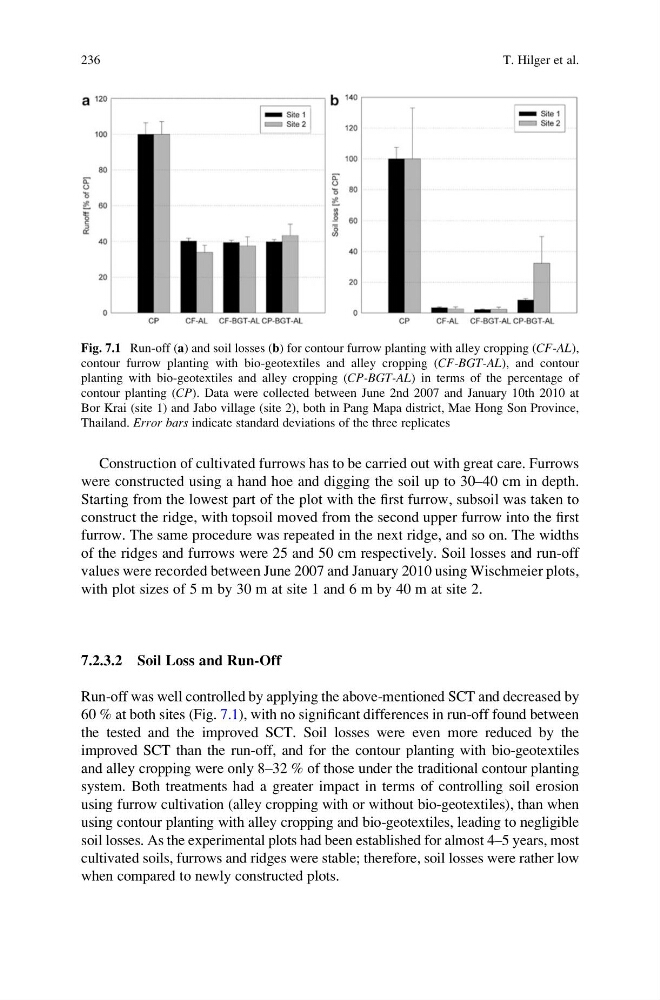
Run-off was well controlled by applying the above-mentioned SCT and decreased by
60 % at both sites (Fig. 7.1), with no significant differences in run-off found between
the tested and the improved SCT. Soil losses were even more reduced by the
improved SCT than the run-off, and for the contour planting with bio-geotextiles
and alley cropping were only 8–32 % of those under the traditional contour planting
system. Both treatments had a greater impact in terms of controlling soil erosion
using furrow cultivation (alley cropping with or without bio-geotextiles), than when
using contour planting with alley cropping and bio-geotextiles, leading to negligible
soil losses. As the experimental plots had been established for almost 4–5 years, most
cultivated soils, furrows and ridges were stable; therefore, soil losses were rather low
when compared to newly constructed plots.
Fig. 7.1 Run-off (a) and soil losses (b) for contour furrow planting with alley cropping (CF-AL),
contour furrow planting with bio-geotextiles and alley cropping (CF-BGT-AL), and contour
planting with bio-geotextiles and alley cropping (CP-BGT-AL) in terms of the percentage of
contour planting (CP). Data were collected between June 2nd 2007 and January 10th 2010 at
Bor Krai (site 1) and Jabo village (site 2), both in Pang Mapa district, Mae Hong Son Province,
Thailand. Error bars indicate standard deviations of the three replicates
236
T. Hilger et al.
were constructed using a hand hoe and digging the soil up to 30–40 cm in depth.
Starting from the lowest part of the plot with the first furrow, subsoil was taken to
construct the ridge, with topsoil moved from the second upper furrow into the first
furrow. The same procedure was repeated in the next ridge, and so on. The widths
of the ridges and furrows were 25 and 50 cm respectively. Soil losses and run-off
values were recorded between June 2007 and January 2010 using Wischmeier plots,
with plot sizes of 5 m by 30 m at site 1 and 6 m by 40 m at site 2.
7.2.3.2 Soil Loss and Run-Off
Run-off was well controlled by applying the above-mentioned SCT and decreased by
60 % at both sites (Fig. 7.1), with no significant differences in run-off found between
the tested and the improved SCT. Soil losses were even more reduced by the
improved SCT than the run-off, and for the contour planting with bio-geotextiles
and alley cropping were only 8–32 % of those under the traditional contour planting
system. Both treatments had a greater impact in terms of controlling soil erosion
using furrow cultivation (alley cropping with or without bio-geotextiles), than when
using contour planting with alley cropping and bio-geotextiles, leading to negligible
soil losses. As the experimental plots had been established for almost 4–5 years, most
cultivated soils, furrows and ridges were stable; therefore, soil losses were rather low
when compared to newly constructed plots.
Fig. 7.1 Run-off (a) and soil losses (b) for contour furrow planting with alley cropping (CF-AL),
contour furrow planting with bio-geotextiles and alley cropping (CF-BGT-AL), and contour
planting with bio-geotextiles and alley cropping (CP-BGT-AL) in terms of the percentage of
contour planting (CP). Data were collected between June 2nd 2007 and January 10th 2010 at
Bor Krai (site 1) and Jabo village (site 2), both in Pang Mapa district, Mae Hong Son Province,
Thailand. Error bars indicate standard deviations of the three replicates
236
T. Hilger et al.