

Acknowledgments This work was financed by Deutsche Forschungsgemeinschaft (DFG),
within the collaborative research program ‘Sustainable rural development in the mountainous
regions of Southeast Asia’ (SFB 564), as well as the National Research Council of Thailand
(NRCT) and the Fiat Panis Foundation, Ulm. Special thanks go to Asst. Prof. Dr. Noporn
Boonplod, Dept. of Horticulture, Mae Jo University, as well as Umavadee Srikasetsarakul,
Dr. Korawan Sringkarm and Assoc. Prof. Dr. Pittaya Sruamsiri, Faculty of Agriculture, Chiang
Mai University, for their kind cooperation. The authors also extend their gratitude to Preecha
Saepueng, Wanwisa Jantika and Eakapan Loongbooy for their assistance in the field and with
greenhouse experiments, to Wanwarang Pattanapo and Wipawadee Saepueng for their technical
support, and to SuwimonWicharuk for soil analyses. The kind cooperation of Charoen Kumsupa,
Thongdee Tasai and Nan Thongrat from the Phrao Mango Farmers’ Cooperative, and Rewat
Promjom from Netafim Thailand, is gratefully acknowledged. Finally, thanks go to Gary
Morrison for English language editing and to Peter Elstner for improving the layout and for
fruitful discussions.
References
Abrisqueta JM, Mounzer O, Alvarez S, Conejero W, Garcia-Orellana Y, Tapia LM, Vera J,
Abrisqueta I, Ruiz-Sanchez MC (2008) Root dynamics of peach trees submitted to partial
rootzone drying and continuous deficit irrigation. Agr Water Manage 95:959–967
Chomchalow N, Songkhla P (2008) Thai mango export: a slow-but-sustainable development AU.
J Technol 12(1):1–8
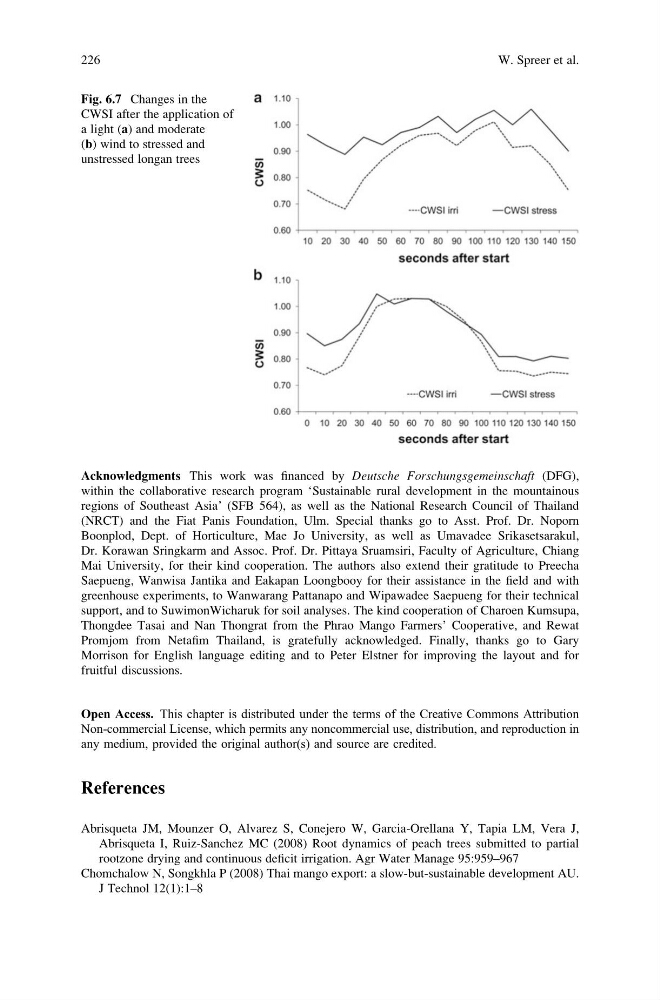
Fig. 6.7 Changes in the
CWSI after the application of
a light (a) and moderate
(b) wind to stressed and
unstressed longan trees
Open Access. This chapter is distributed under the terms of the Creative Commons Attribution
Non-commercial License, which permits any noncommercial use, distribution, and reproduction in
any medium, provided the original author(s) and source are credited.
226
W. Spreer et al.
within the collaborative research program ‘Sustainable rural development in the mountainous
regions of Southeast Asia’ (SFB 564), as well as the National Research Council of Thailand
(NRCT) and the Fiat Panis Foundation, Ulm. Special thanks go to Asst. Prof. Dr. Noporn
Boonplod, Dept. of Horticulture, Mae Jo University, as well as Umavadee Srikasetsarakul,
Dr. Korawan Sringkarm and Assoc. Prof. Dr. Pittaya Sruamsiri, Faculty of Agriculture, Chiang
Mai University, for their kind cooperation. The authors also extend their gratitude to Preecha
Saepueng, Wanwisa Jantika and Eakapan Loongbooy for their assistance in the field and with
greenhouse experiments, to Wanwarang Pattanapo and Wipawadee Saepueng for their technical
support, and to SuwimonWicharuk for soil analyses. The kind cooperation of Charoen Kumsupa,
Thongdee Tasai and Nan Thongrat from the Phrao Mango Farmers’ Cooperative, and Rewat
Promjom from Netafim Thailand, is gratefully acknowledged. Finally, thanks go to Gary
Morrison for English language editing and to Peter Elstner for improving the layout and for
fruitful discussions.
References
Abrisqueta JM, Mounzer O, Alvarez S, Conejero W, Garcia-Orellana Y, Tapia LM, Vera J,
Abrisqueta I, Ruiz-Sanchez MC (2008) Root dynamics of peach trees submitted to partial
rootzone drying and continuous deficit irrigation. Agr Water Manage 95:959–967
Chomchalow N, Songkhla P (2008) Thai mango export: a slow-but-sustainable development AU.
J Technol 12(1):1–8
Fig. 6.7 Changes in the
CWSI after the application of
a light (a) and moderate
(b) wind to stressed and
unstressed longan trees
Open Access. This chapter is distributed under the terms of the Creative Commons Attribution
Non-commercial License, which permits any noncommercial use, distribution, and reproduction in
any medium, provided the original author(s) and source are credited.
226
W. Spreer et al.