

imbalance. Rapid and non-invasive methods able to detect water stress in longan at
the early growth stages are thus required.
One method which in recent years has become increasingly important in the field
of water stress monitoring is thermal imaging. This method is based on the fact that
leaves under water stress close their stomata, which results in a lower transpiration
cooling rate and, as a consequence, a higher canopy temperature (T c ). Since first
being documented (Jones 1999), this method has been researched for different
crops and different applications (e.g., Zia et al. 2009; Romano et al. 2011), and
has turned out to be a promising method for use with the irrigation of longan trees.
Under controlled conditions, it has been shown that, using thermal imaging, water
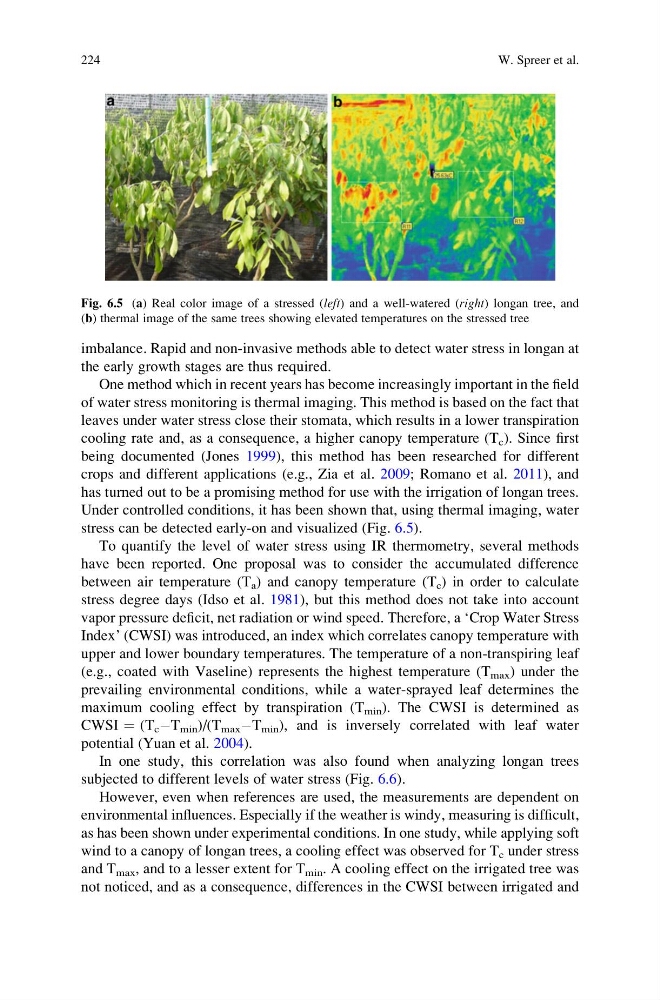
stress can be detected early-on and visualized (Fig. 6.5).
To quantify the level of water stress using IR thermometry, several methods
have been reported. One proposal was to consider the accumulated difference
between air temperature (T a ) and canopy temperature (T c ) in order to calculate
stress degree days (Idso et al. 1981), but this method does not take into account
vapor pressure deficit, net radiation or wind speed. Therefore, a ‘Crop Water Stress
Index’ (CWSI) was introduced, an index which correlates canopy temperature with
upper and lower boundary temperatures. The temperature of a non-transpiring leaf
(e.g., coated with Vaseline) represents the highest temperature (T max ) under the
prevailing environmental conditions, while a water-sprayed leaf determines the
maximum cooling effect by transpiration (T min ). The CWSI is determined as
CWSI ¼ (T c ÀT min )/(T max ÀT min ), and is inversely correlated with leaf water
potential (Yuan et al. 2004).
In one study, this correlation was also found when analyzing longan trees
subjected to different levels of water stress (Fig. 6.6).
However, even when references are used, the measurements are dependent on
environmental influences. Especially if the weather is windy, measuring is difficult,
as has been shown under experimental conditions. In one study, while applying soft
wind to a canopy of longan trees, a cooling effect was observed for T c under stress
and T max , and to a lesser extent for T min . A cooling effect on the irrigated tree was
not noticed, and as a consequence, differences in the CWSI between irrigated and
Fig. 6.5 (a) Real color image of a stressed (left) and a well-watered (right) longan tree, and
(b) thermal image of the same trees showing elevated temperatures on the stressed tree
224
W. Spreer et al.
the early growth stages are thus required.
One method which in recent years has become increasingly important in the field
of water stress monitoring is thermal imaging. This method is based on the fact that
leaves under water stress close their stomata, which results in a lower transpiration
cooling rate and, as a consequence, a higher canopy temperature (T c ). Since first
being documented (Jones 1999), this method has been researched for different
crops and different applications (e.g., Zia et al. 2009; Romano et al. 2011), and
has turned out to be a promising method for use with the irrigation of longan trees.
Under controlled conditions, it has been shown that, using thermal imaging, water
stress can be detected early-on and visualized (Fig. 6.5).
To quantify the level of water stress using IR thermometry, several methods
have been reported. One proposal was to consider the accumulated difference
between air temperature (T a ) and canopy temperature (T c ) in order to calculate
stress degree days (Idso et al. 1981), but this method does not take into account
vapor pressure deficit, net radiation or wind speed. Therefore, a ‘Crop Water Stress
Index’ (CWSI) was introduced, an index which correlates canopy temperature with
upper and lower boundary temperatures. The temperature of a non-transpiring leaf
(e.g., coated with Vaseline) represents the highest temperature (T max ) under the
prevailing environmental conditions, while a water-sprayed leaf determines the
maximum cooling effect by transpiration (T min ). The CWSI is determined as
CWSI ¼ (T c ÀT min )/(T max ÀT min ), and is inversely correlated with leaf water
potential (Yuan et al. 2004).
In one study, this correlation was also found when analyzing longan trees
subjected to different levels of water stress (Fig. 6.6).
However, even when references are used, the measurements are dependent on
environmental influences. Especially if the weather is windy, measuring is difficult,
as has been shown under experimental conditions. In one study, while applying soft
wind to a canopy of longan trees, a cooling effect was observed for T c under stress
and T max , and to a lesser extent for T min . A cooling effect on the irrigated tree was
not noticed, and as a consequence, differences in the CWSI between irrigated and
Fig. 6.5 (a) Real color image of a stressed (left) and a well-watered (right) longan tree, and
(b) thermal image of the same trees showing elevated temperatures on the stressed tree
224
W. Spreer et al.